Thursday, July 28, 2011

Borisovna Abbasova–applicability of Gender Guidelines and failure to consider psychological issues in credibility

Borisovna Abbasova v. Canada (Citizenship and Immigration), 2011 FC 43 (CanLII)

Judge: Justice Shore

Date heard: January 10, 2011

Date decided: January 14, 2011

Counsel for Borisovna Abbasova: Denise Feret

Counsel for Minister: Christine Bernard

Place of Hearing: Montréal, Quebec

This was judicial review of a pre-removal risk assessment decision turning on the Gender Guidelines.

Justice Shore opened the reasons with the following emphatic but convoluted statement: “For decision-makers at all levels, procedural fairness sounds a rarely heard alarm, and that alarm must be heard if injustice is not to be done.” (para. 1)

The Applicant was a Russian national who alleged persecution at the hands of her common-law partner, in the form of domestic abuse complicated by the fact that the abuser was a police officer. She further alleged having been mislead by a fraudulent non-lawyer (para. 10).

Her refugee claim was denied in February 2009 (para. 12).

The Applicant filed a PRRA in August 2009, and it was denied in April 2010 (para. 13). A stay of removal was granted in June 2010 (para. 14).

The PRRA officer assigned no weight to the Applicant’s new evidence (para. 15).

The issues were whether the officer erred in not considering the relevant evidence and/or erred in failing to apply the Refugee Protection Division’s Guideline 7 of women fearing gender-related persecution (para. 16).

Justice Shore approved of the PRRA officer’s giving no weight to documentation which, while it post-dated the hearing, “simply echoed the information previously submitted” (paras. 28-30).

However, the PRRA officer also gave no weight to a post-hearing psychological assessment of the Applicant (para. 30). Justice Shore noted that the RPD had found the Applicant not credible, but the psychological report clarified this issue; the PRRA officer ought to have taken into consideration “Possible evidence of the applicant’s inability to testify” (paras. 30-31).

Justice Shore noted that:

It is not for the Court to reassess the evidence submitted to the PRRA officer and that is not what it intends to do; nonetheless, the developments in Ms. Abbasova’s evidence, particularly regarding her psychological condition, could have been considered to be relevant if they had been analyzed. More specifically, in her particular case, as shown, a psychological problem apparently impaired Ms. Abbasova’s ability to testify. That evidence could have been central to the determination of credibility, considering that the RPD and, subsequently, the PRRA officer found Ms. Abbasova not to be credible based on the answers she gave in her testimony. … (para. 37, emphasis in original)

Justice Shore also took into account the new evidence filed by the Applicant in the stay application, notwithstanding the fact that this new medical evidence was not before the PRRA officer (paras. 39-43). Furthermore, the Judge found that even if only the preliminary psychological evidence had been considered by the PRRA officer, the officer night have concluded in the Applicant’s favor or at least that there was an issue of credibility/psychological issues which warranted a hearing (para. 44).

Regarding the Gender Guideline, Justice Shore affirmed their applicability as an “aid” in PRRA decisions (paras. 53-54).

JUDICIAL REVIEW ALLOWED

Thursday, June 23, 2011

Muhari—considering the totality of evidence and discrimination in refugee case

Muhari v. Canada (Citizenship and Immigration), 2011 FC 27 (CanLII)

Judge: Justice Scott

Date heard: December 15, 2010

Date decided: January 12, 2011

Counsel for Muhari: Michel Le Brun

Counsel for Minister: Emilie Tremblay

Place of Hearing: Montréal, Quebec

The principal Applicant and his family were of Hungarian ethnicity but Serbian citizenship. They arrived in Canada on visitors visas in January 2008. In February 2008, Kosovo declared independence from Serbia, heightening the Applicants fears of persecution based on their ethnicity (paras. 2-5).

The Refugee Protection Division (RPD) found the Applicants credible but rejected their claim on the basis that they had suffered discrimination, not persecution (para. 7).

Justice Scott reiterated the settled law that the RPD must consider all the evidence on an issue and if rejecting evidence must provide an explanation (paras. 13-15).

In the Applicant’s case, the panel referred to a piece of documentary evidence which, on the whole, supported their case; however, the panel referred only to a part of the document which supported the panel’s conclusions (para. 16). Justice Scott stated that while it was true that the panel did not have to explicitly refer or respond to each piece of documentary evidence, but added “However, where the evidence deals with an element that is crucial to the dispute, the panel’s obligation is quite different. It must refer to that evidence and explain why it did not accept it (Singh v Canada (Minister of Citizenship and Immigration), 2009 FC 485 (CanLII), 2009 FC 485, [2009] FCJ No. 616 (QL) at paragraph 15).”

Justice Scott also found that the panel had failed to consider the cumulative effect of severe discrimination, which may amount to persecution (paras. 23-25).

JUDICIAL REVIEW GRANTED

Premaratne—unusual remedy

Premaratne v. Canada (Citizenship and Immigration), 2011 FC 30

Judge: Justice Snider

Date heard: January 11, 2011

Date decided: January 12, 2011

Counsel for Premaratne: T. Viresh Fernando

Counsel for Minister: Kareena R. Wilding

Place of Hearing: Toronto, Ontario

The Applicant was a 28-year-old citizen of Sri Lanka who applied for a study permit to allow her to come attend an eight-month course at George Brown College (para. 1). The Officer denied the request, in part due to a misapprehension of the evidence on the Applicant’s uncle in Canada (para. 2).

This case is unusual in that the Respondent conceded the error and submitted that the appropriate remedy would be to send the application back to be re-determined by a different Officer (para. 3). This is, in fact, the default remedy in immigration judicial reviews (para 5).

The Applicant, however, requested a range of additional remedies:

1. An order directing the Respondent to reconsider the Applicant’s application for a student visa within 30 days of order;

2. An order that, if the Respondent has any concerns with respect to the Applicant’s application, the Applicant be apprised of those specific concerns in writing, within three days, and the Respondent provide the Applicant 15 days in which to respond in writing;

3. An order that the Applicant not be charged additional fees;

4. An order that the Respondent shall adopt non-arbitrary and unbiased criteria for evaluation of student visa;

5. An order that the Respondent adopt procedures to ensure that the decision making process is free of ethnic and religious bias and those procedures be made available forthwith to the Applicant and publicized in Sri Lanka;

6. An order that the Respondent shall not permit the opinions or advice of locally engaged staff, with respect to the authenticity of a visa application, be relied upon by any designated decision maker;

7. An order that all visa applications be made only by properly trained and qualified Canadian visa officers;

8. An order prohibiting the Respondent from defacing passports of persons refused a visa; and

9. An order for costs. (para 4)

Justice Snider noted that re-determination is the default remedy, and stated that she was not prepared to order any of the additional remedies, except an order that the Applicant not be required to pay additional fees (para. 6). Justice Snider also gave her opinion of the other remedies requested:

Regarding #1, she would not so order because the applicant bears the burden of supporting the application, and the case law was already clear as to when an officer must provide the applicant with a chance to respond (para. 8.1).

Regarding #2, Justice Snider found that it was not proper for the court to make an order about the timing of the decision, particularly as the original decision had been made in a timely fashion (para. 8.2).

Regarding #4, Justice Snider declined to make an order that amounted to ordering the Respondent to make a legally valid decision: “It is presumed that the visa officer who decides this matter will make a determination in an impartial, unbiased manner having regard to all of the evidence, the Respondent’s Guidelines and the existing jurisprudence. That is simply a matter of law and common sense; no order is required or appropriate.” (para. 8.4)

Regarding #5, Justice Snider declined to make an order as there was no information before her that visa officers were unqualified or untrained.

Regarding #6, Justice Snider stated that she was not persuaded that the Officer “relied on, or was unduly influenced by, ‘the opinions or advice of locally engaged staff’” (para. 8.6).

Regarding #7, the request for costs, she found there were no “special reasons” as required by the Federal Courts Immigration and Refugee Protection Rules (para. 8.7).

While finding in the Applicant’s favour, Justice Snider also expressed concern with the allegations made by the Applicant towards the Officer, e.g. of criminality and perjury (paras. 10-13).

JUDICIAL REVIEW GRANTED

Tuesday, May 24, 2011

Republicans have souls, Minnesota edition

From BoingBoing: Minnesota GOP legislator makes passionate speech in support of marriage equality

Few things in life will make me tear up faster than people whose politics I disagree with generally, passionately and courageously supporting a universal human right. Gives a little boost to my waning hope for the human race.

Thursday, May 19, 2011

Persaud–wrong application of Mobil Oil

Persaud v. Canada (Citizenship and Immigration), 2011 FC 31 (CanLII)

Judge: Justice Hughes

Date heard: January 11, 2011

Date decided: January 12, 2011

Counsel for Persaud: Robert Blanshay

Counsel for Minister: Brad Gotkin

Place of Hearing: Toronto, Ontario

The Applicant was a citizen of Guyana who had married a Canadian citizen and been sponsored and came to Canada as a permanent resident in October 2003 (para. 2). In September 2006, the Applicant was interviewed by a Minister’s Delegate (MD); she was not advised of the purpose of the interview, did not have counsel and was not advised that she could have counsel (para. 3). From that interview the MD produced a “Narrative Memoranda” which referred to the interview and a statutory declaration from the husband which was said to be, but was not, attached (para. 3). The MD recommended deportation.

Before the Immigration Division, the Applicant’s counsel argued that the interview was improper and that the absence of the husband’s statutory declaration was another error (para. 4).

The ID gave a written decision in June 2008 that the Applicant was inadmissible as her marriage was not genuine, or in the alternative if it had been entered into in good faith the Applicant had later failed to disclose its breakdown. The ID recognized that the interview had been conducted in breach of procedural fairness and therefore gave no weight to alleged contradictions between the evidence given at the interview and elsewhere (para. 5). Nevertheless, the ID found that either the marriage was entered into for immigration purposes, or if it had been genuine at the beginning the Applicant had failed to disclose its subsequent breakdown (para. 5).

On March 29, 2010, the IAD heard the Applicant’s appeal and decided that since the ID found the interview tainted, it ought to have sent the matter back to be re-determined (para. 6). This was especially true since, despite stating later that it was not taking contradictions from the interview into account, the ID decision explicitly referred to one such contradiction. It was this decision of the IAD, which despite its conclusion that the ID had erred dismissed the appeal, which Justice Hughes overturned.

Before rendering a decision the IAD asked for submissions on the Mobil Oil case (para. 8). The IAD held that Mobile Oil was authority for the proposition that “a breach of procedural fairness does not require a new hearing in “special circumstances” where the claim in question is otherwise “hopeless” or the outcome reached was “inevitable”” (para. 17). On that basis, the IAD found that had the ID heard the evidence properly, it still could not have done other than to dismiss the case (para. 10).

However, at the Federal Court both parties agreed that this summary was not correct:

Mobil Oil dealt with a unique set of circumstances where there was a finding of breach of procedural fairness which the Supreme Court found would have required the matter to be sent back for redetermination. However, since the matter that would have been the subject of redetermination was not the subject of the remedies sought, it was determined to be impractical to send it back. (para. 18)

Given that the dismissal was based on a fundamental misunderstanding of the law, Justice Hughes granted the judicial review and sent the matter back to be re-determined by the IAD, with a further non-binding recommendation that the IAD refer it back to the ID (para. 21).

JUDICIAL REVIEW ALLOWED

Thursday, May 12, 2011

Raina–equivalency of offenses

Raina v. Canada (Citizenship and Immigration), 2011 FC 19 (CanLII)

Judge: Justice Heneghan

Date heard: July 13, 2010

Date decided: January 11, 2011

Counsel for Raina: Krassina Kostadinov

Counsel for Minister: Amy Lambiris, Manuel Mendelzon

Place of Hearing: Toronto, Ontario

The Applicant was a citizen of India who claimed refugee protection after coming to Canada in 2006 (para. 2).

Before coming to Canada, the Applicant had been convicted of “indecent assault” in New Zealand in December 2001, and served 2.5 years. At the same time, he was acquitted of the “more serious offence of sexual violence for the same incident” (para. 2).

Before the RPD, the Minister argued that indecent assault was the equivalent of the Canadian crime of “Sexual interference”, referring to s. 151 of the Criminal Code, which states that it could be dealt with summarily (term of 14 days to 18 months) or by indictment (term of 45 days to 10 years) (para. 4).

The RPD found the Applicant’s conviction to be equivalent to “child molestation” and stated without explanation that the punishment could be up to ten years, which the RPD found to create a presumption that the Applicant had committed a serious non-political crime. The RPD rejected the Applicant’s argument that the elements of the offense in New Zealand did not match those in s. 151 of the Criminal Code (paras. 5-6).

Justice Heneghan relied on the FCA decision of Hill v. Canada (Minister of Employment & Immigration) (1987), 73 N.R. 315 for its statement on determining equivalency:

“It seems to me that because of the presence of the words ‘would constitute an offence ... in Canada’, the equivalency can be determined in three ways: - first, by a comparison of the precise wording in each statute both through documents and, if available, through the evidence of an expert or experts in the foreign law and determining therefrom the essential ingredients of the respective offences. Two, by examining the evidence adduced before the adjudicator, both oral and documentary, to ascertain whether or not that evidence was sufficient to establish that the essential ingredients of the offence in Canada had been proven in the foreign proceedings, whether precisely described in the initiating documents or in the statutory provisions in the same words or not. Third, by a combination of one and two.”

On the basis of Hill, Justice Heneghan found that the RPD had failed to apply the proper tests for equivalency (paras. 7-9).

Furthermore, Heneghan J. found that the RPD had erred in using the Applicant’s acquittal on the charge of “sexual violence” to determine whether the conviction was for a serious non-political crime (para. 10). Relying on Bertold v. Canada (Minister of Citizenship and Immigration) (1999), 175 F.T.R. 195, Justice Heneghan reiterated that such “references to outstanding criminal charges are inadmissible and violate the Canadian Charter of Rights and Freedoms…” (para. 11).

JUDICIAL REVIEW ALLOWED

Friday, May 06, 2011

Sharpe–fair consideration of the evidence in medical inadmissibility, unusual remedy

Sharpe v. Canada (Citizenship and Immigration), 2011 FC 21  (CanLII)

Judge: Justice Phelan

Date heard: December 15, 2010

Date decided: January 11, 2011

Counsel for Becerra Vazquez: Mr. Michael Greene

Counsel for Minister: Mr. Rick Garvin

Place of Hearing: Calgary, Alberta

This was the second judicial review of the decision that the Applicant’s dependant son was medically inadmissible. The Applicant was the principle applicant in a Federal Skilled Worker application to immigrate from the UK (paras. 1, 3).

The Applicant’s application was commenced in January 2004. The Applicant was requested to, and did, provide medical reports on his son’s condition. In July, 2006, the medical officer (MO) provided the London visa post with an opinion that the son’s condition “might reasonably be expected to cause an ‘excessive demand on Canadian social services’” (paras. 3-5).

In about August 2006, the Applicant received a fairness letter warning them of the excessive demand opinion and inviting them to make further submissions. Therefore in October 2006, the Applicants submitted updated reports from various professionals; “All of the letters and reports were to the same effect; that Conor’s needs were such that he no longer required the health and social services earlier reports suggested he did” (paras. 6-7).

The application was refused on May 9, 2007 on the grounds of excessive demand (para. 8). The Applicant wrote to the London visa office expressing concern that the newer information had not been properly reviewed and undertaking to pay for any special schooling or social services. On May 25, 2007, the London visa office responded that the new information had been taken into consideration in the refusal (paras. 9-10).

Justice Phelan characterized the response of May 25, 2007 thusly: “This response was a barefaced falsehood” (para. 11).

The MO’s opinion, on which the refusal was based, was made in July 2006, before the receipts of various relevant documents (para. 11). The Applicant’s filed an application for judicial review which was discontinued when the Minister offered to reconsider the matter (paras. 12-13).

In October 2008, a second MO forwarded an opinion which was nearly identical to the first (para. 14). In March 2009, a second visa officer (VO) sent a second fairness letter maintaining the contention that the son was medically inadmissible (para. 15). In response, the Applicant submitted further new information on his son’s current educational placement, conditional acceptance to a private school in Alberta, and assessments of how the Alberta education system characterized his disability, e.g. as “mild” (para. 16). The 2nd MO reconsidered in view of the new evidence and forwarded an opinion that the son was not likely to be an excessive demand (para. 17).

However, the 2nd VO challenged the 2nd MO’s decision, the result of which was the 2nd MO changing opinions again, this time finding that the son was severely disabled. (paras. 18-19). The application was again refused (para. 20).

Justice Phelan stated: “There are several problems with the Respondent’s conclusion as to the nature and severity of Conor’s disability quite independent of the shabby treatment the Applicant has experienced at the London Visa Office” (para. 26).

In reviewing the decision, Justice Phelan found that the main consideration was whether the son’s disability was assessed as “severe” or “mild” under Alberta policy (para. 27). The only evidence on that particular point was a report stating explicitly that his disabilities would be considered mild; the 2nd MO could not reject this conclusion without reason (paras. 28-31). The 2nd MO had relied on another report describing the son’s disability as “significant”, but no evidence that “significant” meant “severe” in the context (para. 32). The 2nd MO’s other comments on the expense of educating the son were not relevant (paras. 33-34).

This decision is particularly interesting in that Justice Phelan notes that he is considering retaining jurisdiction to ensure that the reconsideration of the Applicant’s file “is completed as expeditiously and as fairly as possible” (para. 39). Justice Phelan further suggested “may be possible to have one person, acceptable to the parties, conduct the necessary assessment and whose report would bind both parties. The Court’s mediation role could be utilized to assist if the parties so request” (para. 40).

JUDICIAL REVIEW ALLOWED

Becerra Vazquez–cumulative errors in assessing credibility

Becerra Vazquez v. Canada (Citizenship and Immigration), 2011 FC 9 (CanLII)

Judge: Justice Pinard

Date heard: December 2, 2010

Date decided: January 6, 2011

Counsel for Becerra Vazquez: Me Stephen Fogarty

Counsel for Minister: Ms. Sara Gauthier (student-at-law), Me Evan Liosis

The Applicant was a citizen of Mexico who worked for a newspaper. Although not a reporter, he was sent to cover a secret meeting between the Secretary-General of Guanajuato and land developers. He was discovered and threatened. A complaint was made to the Mexican Human Rights Commission. After the paper published the story, he was the victim of attempted murder, and tried to report it to the police but they did not come. Doubting the efficacy of the police, he fled to Canada (paras. 2-4).

The Applicant spoke little English when he arrived in Canada, but at the Port of Entry (POE) he was questioned without an interpreter (para. 4). The POE interview notes state that he was a reporter (para. 4).

The RPD’s decision to refuse the Applicant’s claim was based on a finding of lack of credibility, based on five points:

  1. The Applicant testified that his job was “surveiller le contenu des éditoriaux” but he lacked understanding of that position as the RPD understood it (para. 7).
  2. The POE notes state that the Applicant said he was a reporter, but in testimony before the RPD the Applicant stated that he was not a reporter per se but rather involved in the production of this problematic article (para. 8).
  3. The RPD rejected a letter from the paper stating that the Applicant had worked for them for five years on the basis that it was submitted just prior to the hearing and that fraudulent documents were easy to obtain in Mexico (para. 9).
  4. The RPD rejected the Applicant’s testimony that he worked 40 hours a week at the newspaper while pursuing a university degree (para. 10).
  5. The RPD took issue with the Applicant’s version of events after the murder attempt, namely, why he had not informed his employer and why he had bothered to inform the police at all if he did not trust them; it did not believe his testimony that he was in shock at the time (para. 11).

Justice Pinard found that the RPD had interpreted the Applicant’s job description too narrowly, and therefore had erred in doubting the Applicant’s credibility on the basis of his alleged lack of knowledge of his stated profession (paras. 17-18).

Similarly, Justice Pinard found that the RPD had placed too much weight on the specific job title cited by the Applicant in his POE notes, and therefore on doubting his credibility due to an alleged discrepancy (paras. 19-21).

Regarding the letter from the newspaper, Justice Pinard found that that RPD’s rejection of it was marred by circular logic (paras. 22-25):

The evidence relied upon to discredit the letter was the applicant’s lack of credibility and therefore the likelihood that he had obtained the letter fraudulently, and the applicant was also found not to be credible because he had no corroborative evidence once the letter was discredited. I find this to be unreasonable logic on the Board’s part, especially where the information in the letter was easily verifiable (para. 25).

Regarding the RPD’s finding that the Applicant was not credible regarding his working while pursuing a university degree, Justice Pinard did not find that the finding was unreasonable in and of itself, but in combination with the other flawed findings on credibility, the RPD’s conclusions on this point were “troubling” (paras. 26-27).

Similarly, regarding the RPD’s finding that the Applicant’s testimony regarding his actions following the murder attempt further impugned his credibility, Justice Pinard found that this was not a freestanding error, but that “the other three errors that I have identified in the Board’s credibility findings persuade me that the Board’s overall conclusion regarding the applicant’s credibility was tainted.” (paras. 28-30).

JUDICIAL REVIEW ALLOWED

Kirichenko–failure to deal with relevant evidence on conscientious objection

Kirichenko v. Canada (Citizenship and Immigration), 2011 FC 12 (CanLII)

Judge: Justice Russell

Date heard: October 28, 2010

Date decided: January 6, 2011

Counsel for Kirichenko: Geraldine MacDonald

Counsel for Minister: Gordon Lee

The Applicant is a citizen of Russia by birth and Israel by marriage. He claimed refugee protection in Canada due to fear of returning to either country (para. 2).

The Applicant testified that he had been kidnapped by Chechen rebel in 1995 and received injuries then. In 1997 he testified against one of the kidnappers and consequently received death threats. In 1997, he had planned to testify that Russian authorities had been complicit in the kidnapping, and he believed that the authorities wanted to stop him from giving testimony. He and his wife fled to Israel, where they had a child (para. 3).

The Applicant and his wife returned to Russia in 2000 and divorced in 2001. In 2003, the Applicant was again called to testify against his kidnappers and received death threats. He testified that he appeared in court in 2005 and on the following day was attacked by three men. Later in 2005 he was the victim of an attempted hit-and-run. In 2006, he was called to testify again and again received threats, so he decided to leave Russia (para. 4).

In 2006, the Applicant travelled to Israel, where he discovered that because he had been absent for over three years, his bank accounts had been closed and his documents expired. Because he was no longer the father of a young child, he would have to serve in the Israeli military. He left Israel, spent two months in Germany without claiming asylum, and then came to Canada (para. 5).

The RPD found that the Applicant lacked credibility (para. 7), and that he had not established that he was a conscientious objector to serving in the Israeli military (paras. 6-16), in part because it found he had served in the Russian military (para. 10).

At the Federal Court, the Minister conceded that the RPD had erred in finding that the Applicant had served in the Russian military, but maintained that the rest of the analysis on Israel was sufficient to allow the decision to stand (para. 45). Justice Russell, however, found two errors (para. 46).

First, the RPD cited and relied upon a Response to Information Request (an internal research document) that had never been disclosed to the Applicant; this was not “a situation where it can be said that the RPD used a country condition document from public sources that was available to the Applicant” (paras. 47-48). 

Second, the RPD did not mention or deal with the documentary evidence that conscientious objector status was not available to males in Israel (para. 49).

These two errors rendered the decision reviewable since “the whole notion of there being a way out for the Applicant through some available option that he failed to apply for was, on this evidence, entirely illusory” (para. 51).

JUDICIAL REVIEW ALLOWED

Thursday, May 05, 2011

Perez Mendoza–state protection analysis must be contextual

Perez Mendoza v. Canada (Citizenship and Immigration), 2010 FC 119 (CanLII)

Judge: Justice Lemieux

Date heard: November 19, 2009

Date decided: February 4, 2010

Counsel for Perez Mendoza: Alyssa Manning

Counsel for Minister: Khatidja Moloo

The Applicant was a citizen of Mexico who had applied for refugee protection in Canada and had been denied. The issue was whether he had rebutted the presumption of state protection (para. 1)

The Applicant identified his persecutors as high-ranking employees of two companies, TINEP and PEMEX. The Applicant worked for TINEP. TINEP did work for PEMEX. There was an internal investigation into whether TINEP had been paid for work it did not do, and the applicant initially cooperated with the investigation but was later told his supervisor would be dealing with the issue (paras. 2-5). 

In June 2007, the Applicant was assaulted by two men who told him to “go easy” on the investigation (para. 5). When he returned to work he was told he had been fired for tarnishing TINEP’s reputation and the political career of another PEMEX engineer involved in the scandal (para. 6). The Applicant made a complaint for wrongful dismissal, which appears to have lead to him being assaulted and threatened in a second incident (para. 7).

The Applicant now believed that the two companies were involved in a corruption scheme to funnel money towards the Institutional Revolutionary Party (IRP) and other political causes. He told a television station who covered the story. Soon he began receiving threatening phone calls, so he moved to another state. In August 2007 he was kidnapped and assaulted, and was told that it was because he had tarnished the reputation of TINEP’s owner and his son (paras. 8-10).

The Applicant made a denunciation to the police, and then again relocated. People continued to look for him. In October 2007 his car was shot at and he filed a second denunciation. He relocated again. He was advised by a lawyer to leave Mexico and he did so (paras. 11-13).

While the RPD did not doubt the Applicant’s story (para. 2), it found that he was targeted by criminals which did not provide a nexus, and furthermore that be relocating after making complaints he did not allow enough time to see if state protection would be forthcoming. Furthermore, the RPD appeared to have misapprehended the number of times the Applicant complained to authorities (paras. 14-20). As a result the RPD found that the Applicant did not “take all steps or even reasonable steps to seek protection in Mexico” (para. 23).

Justice Lemieux relied on Canada (Attorney General) v. Ward, [1993] 2 S.C.R. 689; Carillo v. Canada (Minister of Citizenship and Immigration), 2008 FCA 94; Avila v. Canada (Minister of Citizenship and Immigration), 2006 FC 359; and Hurtado-Martinez v. Canada (Minister of Citizenship and Immigration), 2008 FC 630 to creat a summary of the steps of analysis for this issue:

1) The state is presumed to be willing and capable of protecting its citizens (Ward).

2) Evidence of the state’s willingness to protect cannot be imputed as evidence of adequate state protection (Ward).

3) Each case is sui generis so while state protection may have been found to be available in Mexico, maybe even in a particular state, this does not preclude a court from finding the same state to offer inadequate protection on the basis of different facts (Avila).

4) The claimant is expected to have taken all reasonable steps in the circumstances to seek state protection from his persecutors (Ward, Avila). A claimant who does not do so and alleges that the state offers ineffective or inadequate protection bears an evidentiary and legal onus to convince the tribunal (Carillo).

5) This exception to the general expectation that claimants approach the state supports the principle that the claimant is not required to put himself in danger in order to demonstrate ineffectiveness (Ward, Avila).

6) Where a tribunal determines the applicant has failed to take steps to seek protection this finding is only fatal to the claim if the tribunal also finds that protection would have been reasonably forthcoming. A determination ofreasonably forthcoming requires that the tribunal examine the unique characteristics of power and influence of the alleged persecutor on the capability and willingness of the state to protect (Ward, Avila, Heurtado-Martinez).

7) Similarly, where a non-state actor is alleged to have persecuted the claimant, the tribunal must examine the motivation of the persecuting agent and his ability to go after the applicant locally or throughout the country, which may raise the question of the existence of internal refuge and its reasonableness (Avila).

8) The kind of evidence that may be adduced to show that the state protection would not have been reasonably forthcoming includes: testimony of similarly situated persons, individual experience with state protection and documentary evidence (Ward).

9) The standard of proof is balance of probabilities (Carillo).

10) The quality of such evidence will be raised in proportion with the degree of democracy of a state (Avila).

11) The degree of democracy may be lowered if the state tolerates corruption in its institutions (Avila).

12) Evidence of remedies for corruption is not evidence of their practical effect (Avila). In order to neutralize impact of corruption on the evidentiary analysis, the Board must determine that these remedies have a positive practical effect.

13) The evidence must be relevant, reliable, and convincing to satisfy the trier of fact on a balance of probabilities that the state protection was inadequate (Carillo). (para. 33)

Justice Lemieux applied the principles above and found that the RPD had made two errors. It had ignored the Applicant’s explanation of why he had to leave the jurisdictions following his filing of complaints, and it did not make an analysis of whether state protection would have been reasonable forthcoming in the Applicant’s circumstances (paras. 39-43).

JUDICIAL REVIEW ALLOWED

Kaleja–failure to properly consider country conditions and discrimination versus persecution

Kaleja v. Canada (Citizenship and Immigration), 2010 FC 252 (CanLII)

Judge: Justice O'Keefe

Date heard: October 14, 2009

Date decided: March 4, 2010

Counsel for Kaleja: Max Berger

Counsel for Minister: Kevin Doyle

The Applicants were a father and daughter from the Czech republic of Roma ethnicity who had claimed refugee protection in Canada, and their claims had been denied by the RPD (para. 1).

Both Applicants had a history of being discriminated against in the Czech Republic because of their ethnicity, and the father had been attacked by skinheads (paras. 3-8).

The crux of the Applicants’ case was that the Board had erred in its understanding of the fact that they were not represented by counsel, in its analysis of the cumulative discrimination amounting to persecution, and in its analysis of country conditions (paras. 9-11).

The RPD decision contains a single paragraph on the general conditions for Roma in the Czech Republic, and then finds that the past experiences of the Applicants did not meet that threshold. Justice O’Keefe found that “This does not respect the requirement of an ‘existence of justification, transparency and intelligibility within the decision-making process’…” (paras. 21-22). For the Member to have properly found that the Applicants experienced only discrimination and not persecution, he or she would have had to “sufficiently distinguish persecution from what the applicants experienced” (para. 23) and properly address the country conditions documents (para. 24), since the Member did come to the conclusion that they were members of a persecuted group (para. 25).

JUDICIAL REVIEW ALLOWED

All Immigration Law Posts To Date

Afanasyev v. Canada (Citizenship and Immigration), 2010 FC 737

Champagne v. Canada (Citizenship and Immigration), 2009 FC 1204 (quote only)

Diaz v. Canada (Citizenship and Immigration), 2010 FC 797

Gurshomov v. Canada (MPSEP), 2010 FC 1212

Hinzman v. Canada (Citizenship and Immigration), 2010 FCA 177 (quote only)

Huang v. Canada (MCI), 2010 FC 1217

Kadah v. Canada (MCI), 2010 FC 1223

Kaur v. Canada (Citizenship and Immigration), 2010 FC 805

Pusat v. Canada (Citizenship and Immigration), 2011 FC 428

Sandhu v. Canada (Citizenship and Immigration), 2010 FC 759

Sapru v. Canada (Citizenship and Immigration), 2011 FCA 35

Singh v. Canada (Citizenship and Immigration), 2010 FC 757

Zemo v. Canada (Citizenship and Immigration), 2010 FC 80

Saturday, April 23, 2011

Pusat–procedural fairness and disclosure in inadmissibility

Pusat v. Canada (Citizenship and Immigration), 2011 FC 428

Judge: Justice Mosley

Date heard: January 24, 2011

Date decided: April 7, 2011

Counsel for Pusat: Lorne Waldman

Counsel for the Minister: John Loncar

The applicant was an Alevi Kurd who applied oversees as a member of the family class. His wife was a Canadian permanent resident who had been granted refugee status some years before and was attempting to sponsor her husband (paras. 1-4).

The applicant was interviewed at the Canadian embassy in Ankara in September 2007:

The interview focused on whether he qualified as a member of the family class, but did briefly discuss his admissibility. The applicant explained that though he supports some of the PKK’s goals, he does not support the PKK because he did not believe in violence. (para. 4)

The application was dismissed on the basis that the applicant was inadmissible as a member of the PKK. The applicant brought a judicial review (IMM-5482-09), which was settled when the Minister agreed to re-determine the application (para. 5).

Another interview was scheduled at the Ankara embassy for April 2010. The applicant’s counsel in Canada repeatedly requested disclosure from the Minister, to no avail; however, the CAIPS notes contained a notation that the applicant was advised a day before the interview and told that the interview was related to inadmissibility (para. 6).

At the second interview, the applicant admitted to being involved with PKK advocacy activities in Switzerland (and that he had lived there), but stated that any involvement with the PKK was due to social pressure. He reiterated his abhorrence of violence and his non-membership, and that he had not been involved with the PKK in Turkey. The applicant’s counsel was not allowed to make submissions following the interview, and the decision was made the next day (paras. 7-8).

The Certified Tribunal Record (CTR) contained redacted information, and the Respondent filed a motion under s. 87 to maintain the confidentiality of that information. On the basis that neither the Court nor the Respondent would seek to rely on the redacted information, the redactions were not challenged (para. 9).

The FC decision was made on the basis of the breach of procedural fairness, and none of the other grounds alleged (para. 12).

The breaches of procedural fairness cited by the applicant were the failure to disclose the basis of the allegation of membership prior to the interview, and the failure to give an opportunity to respond with submissions after the interview (paras. 15-16). The judge rejected the Minister’s submission that the phone call prior to the interview, in combination with the knowledge arising from the previous case, comprised sufficient disclosure:

The record is clear that the respondent did not reply to the communications from counsel and did not provide any meaningful disclosure before the interview, notwithstanding that the application was sent back on consent to be reconsidered for that reason. The respondent' s attempt to rely on the CAIPS notes as evidence that he was informed of the purpose of the interview by a telephone call from someone, presumably an administrative assistant at the Embassy, two days prior to the event, is misplaced. There is no affidavit evidence from the assistant to verify the facts stated in the CAIPS notes. (para. 19)

While acknowledging that the content of procedural fairness must be assessed on a case-by-case basis, Justice Mosley found that there were documents that had clearly influenced the decision, contained in the CTR, which ought to have been disclosed to the applicant prior to the interview.

Citing Mekonen v. Canada (Minister of Citizenship and Immigration), 2007 FC 1133 (which cites Haghighi v. Canada (Minister of Citizenship and Immigration), [2000] 4 F.C. 407 (C.A.), and Canada (Minister of Citizenship and Immigration) v. Bhagwandass, 2001 FCA 49), Justice Mosley found that this was a case where procedural fairness required the evidence to be disclosed and the applicant given a meaningful opportunity to respond to it (paras. 21-32).

Justice Mosley also rejected the Minister’s submission that, having found a breach of procedural fairness, the court ought not to grant a remedy on the doctrine of “no useful purpose” as expressed in Mobil Oil Canada Ltd. v. Canada Newfoundland Offshore Petroleum Board, [1994] 1 SCR 202 (para. 33). He found that the question was still live and that the inadmissibility decision was not inevitable (para. 34).

Sapru–adequate reasons in medical inadmissibility

Sapru v. Canada (Citizenship and Immigration), 2011 FCA 35

Panel: Dawson J.A., Layden-Stevenson J.A., Stratas J.A.

Date heard: December 14, 2010

Date decided: February 1, 2011

For the Appellants: Cecil Rotenberg, Q.C.; Mario Bellissimo

For the Minister: Lorne McClenaghan

The reasons were written by Dawson J.A.. The case was an appeal from 2010 FC 240, wherein the following questions were certified by Justice Mosley:

a.         When considering whether a person is inadmissible on health grounds pursuant to paragraph 38(1)(c) of the Act, is a Medical Officer obligated to actively seek information about the applicants' ability and intent to mitigate excessive demand on social services from the outset of the inquiry, or is it sufficient for the Medical Officer to provide a Fairness Letter and rely on the applicants' response to that letter?

b.         Is a Medical Officer under a duty to provide adequate reasons for finding that a person is inadmissible on health grounds pursuant to paragraph 38(1)(c) of the Act, which is independent from the Visa Officer's duty to provide reasons and which is therefore not satisfied by the Visa Officer providing reasons that are clearly adequate?

The background was the immigration application of a family from India consisting of a principal applicant engineer, his wife, a pediatrician, and their two children, including Rishi (8 years old). As usual, the family had to undergo medical examinations prior to approval, with the following result:

The Medical Officer determined that Rishi suffers from developmental delay, including psychomotor delay and delay in speech development. At age 8, he had a mental age of 4 years and an I.Q. between 60 and 65. The Medical Officer determined that Rishi is likely to require a variety of social services in Canada. She provided detailed reasons for reaching these conclusions. (FC decision, para. 4)

A “fairness letter” was sent to the applicants advising of the above conclusion and offering the applicants an opportunity “to provide additional information on Rishi’s medical condition, social services required, and/or ‘your individualized plan to ensure that no excessive demand will be imposed on Canadian social services for the entire period indicated above and your signed Declaration of Ability and Intent.’”* (FC decision, para. 5)

Dr. Sapru, Rishi’s mother, responded by challenging the findings on the severity of his condition (para. 9) and the social services he would require (para. 10). She also submitted an education plan (private school at the family’s expense with additional support from his mother who would not be able to practice in Canada and would therefore be free to concentrate on Rishi), and an agreement to indemnify the province of Ontario against any services used for five years (para. 10) as well as other supporting documentation. These submissions were assessed by the medical officer (MO) and the immigration officer (IO) as follows:

The Fairness Response was sent to the medical officer for review and consideration.  A Procedural Fairness assessment was then completed by the medical officer and sent to the immigration officer.  In the Procedural Fairness assessment the medical officer listed the additional documents she had reviewed in the Fairness Response.  She then wrote:

[“]I have reviewed our medical file for the above-named Foreign National along with the additional material listed above and it is my opinion that no information has been provided which would indicate that the original immigration medical assessment was incorrect.  Therefore there is insufficient evidence to support a change or re-evaluation of this Foreign National’s medical assessment at this time.  Hence remains M5.[”]

The tribunal record contains no letter, note, e-mail or other writing that explains how the medical officer analysed the information provided in the Fairness Response or her basis for concluding that the Fairness Response contained no information that would lead the medical officer to the view that her original assessment was incorrect. (paras. 12-13)

The FC found that the MO had no obligation “to make any inquiries into the applicants' ability and intent to offset any excessive demand.” (FC decision, para. 35) Furthermore, the MO’s reasons in response to the fairness submissions were inadequate but “the inadequacy of the medical officer's reasons was saved by the detailed reasons of the immigration officer.” (FC decision, paras. 37-42)

The FCA agreed with Justice Mosley on the issue of inquiring into the applicant’s ability to offset excessive demand:

The Judge dealt with this submission at paragraph 35 of his reasons where he wrote:

[“][…] The applicants are in the best position to provide evidence of their ability and intent, and they are given a fair opportunity to do so in the Fairness Letter. There is no reason that a Medical Officer should have to make an inquiry at an earlier stage, as long as she considers any Fairness Response carefully and with an open mind.[”]

In my view the Judge was correct, for the reasons that he gave.  I would add one cautionary note.  The Judge’s conclusion was premised on the basis that the Fairness Letter gives an applicant “a fair opportunity” to respond to any concerns.  This requires the Fairness Letter to set out clearly all of the relevant concerns so that an applicant knows the case to be met and has a true opportunity to meaningfully respond to all of the concerns of the medical officer. (paras. 30-31)

The FCA then turned to the question of the adequacy of the reasons from the MO.

Having reviewed the legislation and the case law, the FCA held that “it follows from the obligation placed on an immigration officer to review the reasonableness of a medical officer's opinion that a medical officer must provide the immigration officer with sufficient information to enable the immigration officer to be satisfied that the medical officer's opinion is reasonable.” (para. 41)

The FCA also noted that different fact scenarios might give rise to an adequate opinion from the MO, including where the applicant’s responses did not call for further comment from the MO; where the MO issues a report to the IO; where advice is given orally (as long as that communication is adequately recorded, e.g. in CAIPS notes); or where the IO asks questions of and receives a response from the MO which is likewise documented (para. 42).

However, the main point was that the IO’s assessment, however complete it appears, must be based on the MO’s assessment; therefore the IO’s reasons cannot “repair” the inadequacy of the MO’s reasons (para. 54).

The FCA also held that the FC erred in its reliance on the MO’s affidavit, in particular the MO’s statement in the affidavit “that she had considered the applicants’ ability and intent to manage Rishi’s needs.” (para. 50) This information was not before the IO, and was bolstering as found to be of no weight in Sellathurai v. Canada (Minister of Public Safety and Emergency Preparedness),2008 FCA 255 (para. 52).


* See Operational Bulletin 063 for information on the declaration, which is a formal undertaking detailing the applicant’s willingness and ability to mitigate the excessive cost on social services.

Sunday, March 20, 2011

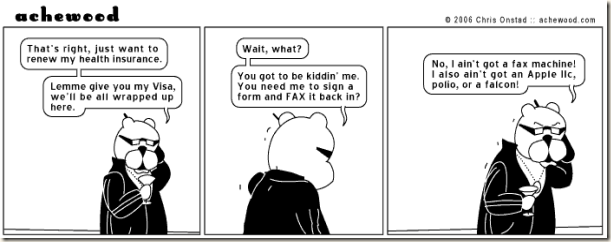
Against Unnecessary Faxes

Ray Against Unnecessary Faxes

I have long adored the above comic from Achewood.*

Now I can follow it up with this article from Slate: Kill Your Fax Machine.


*The cartoonist, Chris Onstad, has a thing allowing embedded comics, but it doesn’t play well with my blog app. So I cheated.

Sunday, March 06, 2011

Resistance is futile?

So France has finally crossed that line and on April 11 their reprehensible “burqa ban” comes into force. See JURIST roundup here.

CNN posted a story featuring this picture:

t1larg.burqa.2009.gi.afp

With a caption reading “A survey in 2010 found that more than four out of five French people backed a ban on wearing the burqa in public places.”


Uhm…

They do know that’s a woman’s BACK, right? I mean, note the carriage in front of her. She could easily be a hijabi…or, frankly, a nun.

The worst part is that “Violators wearing a face covering may be fined up to 150 euros and/or required to attend citizenship classes.”

Next step, re-education camps?

Friday, December 17, 2010

Kadah—failure to consider relevant evidence

Kadah v. Canada (MCI), 2010 FC 1223

Issued: December 3, 2010

Presiding: Justice O’Keefe

For the Applicant: Michael F. Battista

For the Minister: Amy King

This case was a judicial review of a finding that the Applicant, a homosexual Arab Israeli, was not a refugee on the basis that there was sufficient state protection in Israel.

There was no question of the Applicant’s credibility, or that he had faced violent persecution. However, the Board found that Israeli law enforcement would have been willing and able to protect him, and the fact that he was rebuffed the only time he sought help was not a good enough reason for him to have not continued to seek help.

Justice O’Keefe recognized the presumption of state protection, particularly in democratic countries, but also notes that “…democracy alone does not ensure adequate state protection and the Board must consider the quality of the institutions providing that protection (see Katwaru v. Canada (Minister of Citizenship and Immigration) 2007 FC 612 at paragraph 21)” (para. 39).

While the Applicant’s single negative experience with he police was not sufficient to rebut the presumption of state protection, the Board had before it documentary evidence of similarly situated individuals who also were unable to access state protection. While the Board is presumed to have considered all evidence put before it, “where there is important material evidence that contradicts a factual finding of the Board, it must provide reasons why the contradictory evidence was not considered relevant or trustworthy” (para. 43). The Board stated that “‘there is no evidence to suggest that police are not responsive to or fail to investigate complaints by members of the Arab community’” (para. 45), when in fact there was “extensive documentary evidence before the Board regarding Israeli police violence and intolerance towards Arab Israelis and Palestinians” (para. 46). The Board also found that “‘there is no evidence of persecution in Israel based on sexual orientation and, in fact, there are specific laws prohibiting discrimination on such a basis’” (para. 47), which contradicted with the Board;s finding that the Applicant’s testimony of his experiences was credible, as well as documentary evidence of persecution (paras. 48-49).

JUDICIAL REVIEW GRANTED

Thursday, December 16, 2010

Gurshomov–failure to consider relevant circumstances on deferral

Gurshomov v. Canada (MPSEP), 2010 FC 1212

Issued: December 1, 2010

Presiding: Justice Phelan

For the Applicant: Aviva Basman and Jennifer Egsgard, Refugee Law Office

For the Minister: Laden Shahrooz

The Applicant entered Canada with her husband and children in 2003. Their refugee claim was denied, and an H&C application was filed in May 2004 by the husband (para. 2). In 2008, the Applicant separated from her husband and filed and H&C in her own case. This H&C was denied in February 2009, concurrently with a PRRA denial. The Applicant understood that she had received a negative PRRA, but did not understand that the H&C was also denied (paras. 3-4).

Counsel and the Applicant checked the CIC case status website in April 2009 and it stated that there was an H&C pending. Since the husband’s H&C had been denied earlier that year, they took the status to mean that the Applicant’s H&C was still pending. Furthermore, they contacted CIC, and were told that the H&C was still pending and that progress required the payment of fees. As instructed, the fees were paid and further submissions were made on May 8, 2009, followed by additional submissions on May 28 and July 22, 2009 (paras. 5-6).

On July 24, 2009, the Applicant requested a deferral of removal on the basis of the “pending” H&C, which deferral was requested August 14, 2009 (para. 7).

Only on March 25, 2010 was the Applicant made aware of that the H&C had, in fact, been denied in February 2009—she was informed in the context of a removal itinerary (para. 8). She filed a third H&C and shortly thereafter requested another deferral, which was denied. The request was made in part on the risk to the Applicant and her children if returned to Israel where her abusive husband now lived. The Officer focussed on the ability of the children to adjust to the move, and did not address a custody order in favour of the Applicant nor the evidence that it would not be respected in Israel (paras. 9-12).

The Court noted the timeliness of filing and status of an H&C were relevant factors (para. 15). The Court stated that the Officer should have considered the circumstances of the late filing of the third H&C, as well as the fact that because of the miscommunication from CIC, the evidence on the personal risk to the Applicant, addressed only in the submissions which in fact post-dated the refusal, had not been considered (paras. 13-17). The Court held that this was an instance where the Officer failed to address relevant considerations (referring to Simoes) and where “special considerations” were also present (referring to Baron).

JUDICIAL REVIEW GRANTED

Huang–lack of procedural fairness in renewing a temporary residence/study permit

Huang v. Canada (MCI), 2010 FC 1217

Issued: December 2, 2010

Presiding: Justice Phelan

For the Applicant: Mario Bellissimo

For the Minister: Nicole Paduraru

The Applicant was a student from Taiwan who had been in Canada on temporary status since 1997 when he was 12 years old. The judicial review was of the denial of his most recent request for an extension of his temporary resident permit and study permit.

The Applicant had been under permit from 1997 until July 2005, when a request for extension was denied for the first time. Attempts to renew were made, one pursuant to a different quashing order, finally resulting in a renewal in May 2008 until October 2008. The Respondent asserted, but the evidence was not clear, that in May 2008 the Applicant was told that when that permit expired he would have to leave Canada and re-apply outside the country (paras. 2-4).

The Applicant was in fact granted another extension until August 2009, which was accompanied by a written warning that it was “expected” that he would leave Canada upon expiry, but making reference to re-application procedures both from inside and outside Canada. An extension request made before the expiry of that permit was denied, ostensibly because the Applicant had been told he must leave Canada twice and had not complied (paras. 5-6).

The Court found that the “reasons in this case are inadequate because of a) factual error, and b) non disclosure of a key rationale for the decision” (para. 13).

The Officer relied on the Applicant twice failing to comply with instructions to leave Canada, but the evidence did not establish the first caution, and the second “is of dubious nature” (paras. 14-16).

The Respondent Minister also sought to bolster the Officer’s reasons with an additional, and unsupportable rationale:

[18] Further, the “reasons” advanced by the Respondent were said to be contained in the FOSS notes. However, in reply to the Applicant’s affidavit in this matter, the Respondent filed an affidavit of the Officer which in part further explains the reasons for decision. This alone is improper but the Applicant was prepared to live with this procedural faux pas.

[19] The reason for the Applicant’s position is that the affidavit contains further reasons for the decision not previously disclosed. The most critical of which is the Officer’s assumption that the Applicant could leave Canada and reapply from another country – the U.S.

[20] Not only was this assumption or rationale not part of the “reasons”, it ignored the restriction on entry into the U.S. imposed on citizens of Taiwan, particularly those with no status in the outgoing country. This is not a simple case of swinging by Buffalo and dropping off one’s application. The Officer failed to consider that the Applicant would have to return to Taiwan and the consequences thereof.

The Court found that the precise nature of the breaches of procedural fairness did not need to be determined, since it was clear that there were such breaches (paras. 17 and 21).

The Applicant requested but was denied costs.

JUDICIAL REVIEW GRANTED

Friday, October 01, 2010

Kaur – failure to consider all evidence on H&C

Kaur v. Canada (Citizenship and Immigration), 2010 FC 805

The applicant was a widow in her seventies who had moved to Canada to be with her children after the death of her husband. The decision under review was to not grant her permanent residence from within Canada on H&C grounds.

In his reasons, the Officer had stated: “I do not believe that this person would suffer an unusual, undue or unwarranted inconvenience if she had to file her application for permanent residence from abroad as is provided for by the Canadian Immigration Act. The difficulties she will face will flow directly from her wish to remain illegally without the proper documentation in Canada; it is as simple as that.” (para. 17, emphasis added)

Justice Bedard relied on Hinzman v. Canada (Minister of Citizenship and Immigration), 2010 FCA 177 and found:

[18] The officer reached his conclusion on hardship on the basis of one consideration only: the hardship that she might suffer is the result of her own action. He did not address the question of whether the hardship would “have a disproportionate impact on the Applicant due to her personal circumstances”. I am of the view that the officer failed to address the Applicant’s personal circumstances which were central to her H&C application. The immigration officer has discretion as to the weight to be given to the personal circumstances raised by an applicant, but he cannot fail to have regard to the applicant’s personal circumstances.  

Furthermore, the Officer failed to provide adequate reasons.

Judge: Bedard

Date decided: August 5, 2010

Counsel: Andrea Snizynsky (for the applicant), Thi My Dung Tran (for the Minister)

Zemo – PRRA refusal errors on new evidence and no hearing

The applicant, a female former refugee claimant from Eritrea, made a pre-removal-risk-assessment application on the basis that she was a member of the Eritrean Liberation Front and a member of an unregistered church, and as such would be at risk if returned to Eritrea. Both grounds had previously been advanced and rejected. She also made a third, new argument, that she would be at risk as a returned refugee claimant.

The Officer rejected the evidence that the applicant was a member of an unregistered church, despite evidence submitted by the applicant:

[17] In the present circumstances and reading the decision as a whole, the Officer’s decision could only stand if the Applicant’s evidence of membership was not believed. There was more than sufficient evidence as to the risk to members of unregistered churches and there was sufficient evidence, if believed, to establish the Applicant’s membership in that type of church.

[18] Therefore, the Officer, having decided the issue on credibility, failed to consider whether a hearing should be held. The Applicant is not entitled per se to a hearing but the Minister is required to consider whether to have a hearing. In that respect there was an error of law because the Officer never turned her mind to that issue. …

The Officer also failed to properly consider the ground of being a returned refugee claimant, which was not raised before the RPD.

Judge: Phelan

Date decided: August 4, 2010

Counsel: Micheal Crane (applicant), Daniel Engel (Minister)

Diaz – refugee board fails in credibility analysis

Diaz v. Canada (Citizenship and Immigration), 2010 FC 797

In a case of a family from Colombia, Justice Zinn found that the RPD’s decision on negative credibility could not stand. The principal applicant testified that she could not be sure if the agents of persecution were FARC or a drug cartel, but this was not relevant to an assessment of risk under s. 97 (para. 19). The Board could have found her testimony regarding the murder of her husband’s co-worker to be not relevant, since she was not sure of the perpetrator, but the Board was wrong to call this “embellishment” (para. 20). The Board also made several straightforward factual errors, which while not reviewable in and of themselves, “cast some doubt on the thoroughness and accuracy of the Board’s assessment in its totality” (para 21). The Board focussed on whether or not FARC was targeting the applicants, to the exclusion of a complete analysis of the case and the risks. The Board also erred in finding there was an IFA to Colombia. Finally, the Board relied on cases and on the argument that the applicants were exposed to generalized risk, but failed to make an explicit finding of generalized risk.

Judge: Justice Zinn

Date decided: August 4, 2010

Counsel: Jack Davis for Applicants, Ladan Shahrooz for Minister.

Wednesday, August 11, 2010

Gingrich abuses history on Cordoba House issue

As carefully explained at Got Medieval:

Professor Newt's Distorted History Lesson

Newt Gingrich’s claims about how the proposed Cordoba House (or “Ground Zero Mosque” as it is often erroneously called) is named after a massive symbol of Muslim imperialism is so very, very wrong.

(Not mentioned in the post, although raised in the comments, is that the Cordoba mosque is currently a symbol of Christian imperialism, having been catherdralized after the Reconquista.)

Monday, August 09, 2010

Ladies and Gentlemen, Stephen Fry

A brilliant, brilliant commentary on gender identity and the Will/Jack debate by the always engaging Mr. Fry:

There was a time when polari and Julian and Sandy and limp-wristed mincing and winking innuendo were all that came between a certain kind of gay man and his pride, his self-respect and his ability to hold his head high in a hostile world. Read Quentin Crisp’s The Naked Civil Servant or watch John Hurt’s glorious portrayal. It is not the only way for a gay man to be, no one is saying it should be, but it is a wholly proper and acceptable manner (not to mention an often loveable and witty one) and to see it traduced with superiority by the very people who should be supporting and endorsing it sickens me.

Read the whole thing here.

Monday, August 02, 2010

Good news, if true: Israel to cooperate with UN probe

From the Beeb: Israel to co-operate with UN probe into Gaza flotilla

Three cheers for a strong judiciary

I was all prepared to get huffy when this came up on my RSS feeder:

Judging the judges

Is the Supreme Court becoming a threat to parliament?

The article is not anti-judge, as I’d feared, but rather about a strong (activist?) judiciary being a necessary bulwark against a strong executive and a weak legislature. I, of course, always prefer a strong judiciary (assuming they are also competent and just) because I have a deep-seated antipathy for tyranny of the majority and in the face of the decline of the upper houses, the judiciary remains our only chamber of sober second thought. Granted the nobility of the House of Lords has always struck me as quaintly outdated, but I am a firm supporter of the Double-E senate: equal and effective, yes, but certainly not elected. Because an elected Senate, like an elected judiciary, would simply be another tool of the majority and could not be depended upon to protect the minority, responsible as they would be to their constituents.

As for our senate, I’ve always felt it unfairly maligned. Sure it gets stacked be every sitting government, and granted it doesn’t do much in the way of making, as opposed to breaking laws, but it does important work in vetting legislation and studying it, so I don’t think it’s outlived its usefulness yet. On top of which, their decor is awesome:

Senate_of_Canada

Tuesday, July 27, 2010

Federal Court Key Quotes: Failure to Consider Evidence

Courtesy of Justice Russell in Champagne v. Canada (Citizenship and Immigration), 2009 FC 1204

[26] Not having regard for the totality of the evidence is an error of law. See Toro v. Canada (Minister of Employment and Immigration), [1981] 1 F.C. 652, [1980] F.C.J. No. 192. A claim in which the basic facts have been misconstrued should be set aside. Indeed, the Court has held that misconstruing evidence that forms the basis of the claim is a fundamental error. See Adamjee v. Canada (Minister of Citizenship Immigration), [1997] F.C.J. No. 1815. Moreover, a failure to mention facts that are a basis for the claim also constitutes a reviewable error. Fainshtein v. Canada(Minister of Citizenship and Immigration), [1995] F.C.J. No. 941. The Applicants cite and rely on many cases in which a decision has been set aside based on a misapprehension of the facts. See, for example, Mbiya v. Canada (Minister of Citizenship and Immigration), [1998] F.C.J. No. 1001 and Thambirasa v. Canada (Minister of Citizenship and Immigration), [1999] F.C.J. No. 205.

Afanasyev - inadmissibility for espionage, no need for formal relief submissions

Afanasyev v. Canada (Citizenship and Immigration), 2010 FC 737

Decision by de Montigny granting judicial review of inadmissibility under s. 34 (and refusal to grant Ministerial relief under s. 34(2)).

The Applicant served in the Soviet military from 1985 to 1987, and reported on radio transmissions; he was declared inadmissible under 34(a) and (f), namely:

engaging in an act of espionage or an act of subversion against a democratic government, institution or process as they are understood in Canada;

…or being a member of an organisation that did so.

Justice de Montigny found that the officer’s findings on what, exactly, the Applicant did were problematic on multiple fronts. First, the officer cited both the CSIS explanation of what the Applicant allegedly did and the Applicant’s description, without dealing with discrepancies between the two accounts. Furthermore, the decision was predicated on the officer’s understanding of “espionage”, but nowhere is that understanding explained. (paras. 32-34)

Justice de Montigny also found that the officer failed to consider Ministerial relief under s. 34(2) on the sole ground that there were not formal, separate submission on relief; there had clearly been a request for relief to be considered, and there was relevant evidence on the record (paras. 38-42)

Monday, July 26, 2010

Singh (Yadwinder) - requirement for a passport to be landed

Singh v. Canada (Citizenship and Immigration), 2010 FC 757

Decision of Justice de Montigny. The Applicant sought declatory relief and mandamus, where Citizenship and Immigration Canada had refused to confirm his status as a permanent resident because he did not personally have his passport available. He did not have his passport because it had been seized (the Applicant had a receipt) and appeared to have been lost. The Applicant faced the following catch-22: without a passport he could not regularize his status, and without regularized status he could not obtain a new Indian passport (paras. 5-6). When he did obtain a passport, his clearances had expired. When he received new clearances, a new inadmissibility issue arose. The Applicant successfully argued that he should have been landed in 1998, and that subsequent issues could not therefore bar his landing.

Sandhu - skilled worker - officer must seek clarification

Sandhu v. Canada (Citizenship and Immigration), 2010 FC 759

A decision of Justice Mandamin allowing judicial review on a refusal of a skilled worker application by Canadian High Commission, New Delhi.

On the on hand, "a Visa Officer is not obliged to notify applicants of inadequacies in their applications" (para. 25)

However:
[33] When a Visa Officer has a doubt which has no foundation in the facts and the Applicant puts her best foot forward by submitting a complete application; the Officer should seek clarification to either substantiate or eliminate the doubt. Without seeking clarification, the Officer was in no position to do either.

Hinzman -- FCA Decision on H&C for war resisters

CanLII - 2010 FCA 177 (CanLII):

Key Quotation:
[39] My conclusion should not be seen as altering the discretion of
officers making decisions on section 25 applications, nor as giving the
appellants a “right to a particular outcome or to the application of a
particular legal test” (Suresh v. Canada (Minister of Citizenship and
Immigration), 2002 SCC 1 (CanLII), 2002 SCC 1; [2002] 1 S.C.R. 3).

[40] However, the H&C Officer had the duty to look at all of the
appellants’ personal circumstances, including Mr. Hinzman’s beliefs and
motivations, before determining if there were sufficient reasons to make a
positive H&C decision (ibidem, Chapter 5, section 11.3). She did not. Had
the Applications Judge addressed the appellants’ ground of complaint, as stated
at paragraph 57 of his Reasons, I am convinced that he would have concluded as I
do and found that the H&C decision was significantly flawed and therefore
unreasonable.

[41] Consequently, I propose to allow the appeal and,
rendering the judgment that the Federal Court ought to have rendered, I would
set aside the decision of the Officer denying the appellants’ H&C
application and I would refer the application back for redetermination by a
different officer in accordance with these reasons.

David Mitchell on burqas

If Britain decides to ban the burqa I might just start wearing one | Comment is free | The Observer

I love this man.

Thursday, July 08, 2010

The CNN/Twitter/Hezbollah Debacle

CNN, Twitter and Why Hiding Journalists’ Opinions Is (Still) a Bad Idea - Tuned In - TIME.com

James Poniewozik has a good piece on this on his blog at TIME. My favourite part, though he doesn't pick up on it, is that when he queried CNN about their reasoning they said (and actually Nasr herself said):
It was an error of judgment for Octavia Nasr to write such a simplistic tweet about the death of Sayyed Mohammad Hussein Fadlallah.
Such a simplistic tweet? It was a tweet, for God's sake. 140 characters.

Anyway, that's leaving aside the whole problem of firing a journalist for expressing respect for a single newly-deceased leader of Hezbollah. The sooner the world accepts that both Hamas and Hezbollah are political entities that provide social services and back elected members of governments, the sooner they will have the momentum needed to end their violent activities. They, or perhaps more specifically the moderates within those parties, need an incentive to demilitarize. Having vapours every time they are mentioned in a non-terrorist capacity does not facilitate their rehabilitation.

Federal Court - Zaatreh v. Canada (Citizenship and Immigration)

Federal Court - Zaatreh v. Canada (Citizenship and Immigration)

Federal Court - Golbom v. Canada (Citizenship and Immigration)

Federal Court - Golbom v. Canada (Citizenship and Immigration)

Federal Court - Osegueda Garcia v. Canada (Citizenship and Immigration)

Federal Court - Osegueda Garcia v. Canada (Citizenship and Immigration)

Federal Court - Aguinaldo v. Canada (Citizenship and Immigration)

Federal Court - Aguinaldo v. Canada (Citizenship and Immigration)

July 2, 2010 - Parmar - positive JR on excessive demand, social services

Federal Court - Parmar v. Canada (Citizenship and Immigration)

Tuesday, June 29, 2010

Afghan women imprisoned for "moral crimes"

"Enter the cells of the Badam Bagh prison in Kabul, Afghanistan, and what culprits will you find locked up inside? A 16-year old recipient of an unplanned marriage proposal, a pregnant wife irrationally accused of adultery, and a veiled old woman who just displayed a "bad attitude.""

"Bad attitudes" land Afghan women in jail | FP Passport

Amazing Church Sign Win

Church Sign Win - FAIL Blog: Epic Fail Funny Pictures and Funny Videos of Owned, Pwned and Fail Moments
epic fail photos Church Sign Win

Monday, June 07, 2010

Sunday, May 09, 2010

Babies are not Mogwais


If there is one thing more annoying than the enormous strollers that seem to have become the norm, especially on the TTC, it is the huge clear vinyl tarps bunched up around them, adding to their already Hummer-analagous footprint. All of these infant-land-yachts have awnings anyway, so the oxygen tent\Hazmat containment system is NOT necessary. Babies don't melt if they get a little rain on them, people, and they are not mogwais.

Saturday, March 27, 2010

Dear Iceland: My feminism includes pasties

I was directed to this article by a friend on facebook: Iceland: the world's most feminist country |Life and style |The Guardian

And my first thought was: wait, what?*

Did the whole sex-positive movement skip Iceland? What about the personal liberties, the government has no place in our bedroom movement? Granted, sex-workers do seem to be the world's primary target for exploitation, but I was under the (apparently mistaken) impression that we had figured out a while ago that criminalizing sex work is not the way to go, because (a) some people like it and it's really none of our business, and (b) it makes a kabillion times more sense to regulate the industry so no one is getting exploited any more (or at least as few as possible as little as possible, since no government system is perfect).

Maybe I'm biased by my respect for Canadian sex columnist Sasha, a long-time advocate of sex-positivism and sex-workers rights, but this seems like a giant mistake to me, both in terms of principle and practical effect. And yet, the media appears to think this is entirely a plus in the empowerment of women column. While I obviously support the attempt to get the government behind efforts to end the exploitation of women, I vehemently oppose the state putting limits on sexual behaviours that do not hurt anyone else. Harm principle, anyone?

I smell disaster...


More news coverage indexed here: Iceland Bans Strip Clubs; What If The U.S. Did The Same?

* As an aside, I have long toyed with the idea of creating a Twitter feed or mini blog called "Wait, What?" that just includes links to randomness which elicit that reaction from me.

Friday, March 12, 2010

Elevation

People who take elevators to OR ESPECIALLY FROM the 2nd floor during the busiest time of the day need to learn to use the stairs.

Sunday, March 07, 2010

Blergh

Why is it that cough syrup tastes so incredibly heinous? Is it because they assume something that tastes like hell is less likely to become a street drug?

Or maybe it's the alcohol, menthol, D&C Red 33, FD&C Red 40, monoammonium glycyrrhizinate (which is some sort of licorice extract?), polyethylene glycol, sodium benzoate, sodium carboxymethyl-cellulose, sodium citrate, sodium cyclamate (gross!), sorbitol, or sucralose. Or the horrifying fake cherry flavor (although the Straight Dope claims there's a reason for that).

Oh, and BTW, the alcohol? I was not aware it was in there. I am allergic to alcohol (or at least as allergic as people get). And when I say alcohol allergy, I go straight from "Oh look, 0.05% fake wine" to alcohol poisoning.


Thursday, March 04, 2010

Hard-hit Iraq city sees rise in birth defects

As reported by the Beeb here: BBC News - Disturbing story of Fallujah's birth defects

And more stories here: Google News

Now, it's possible--and this is certainly what's being hinted about--that there was some sort of bio-weapon used that is causing this. But I wouldn't be surprised if the regular weapons used by all sides don't have teratogenic properties.

Saturday, February 20, 2010

The Definition

If war is diplomacy by other means, than an entirely puposive definition of terrorism can't work. If terrorism is just the use of violence to acheive a political end or send a message, then isn't all warfare terrorism? Would we prefer killing for the sole atavistic joy of bloodlust satisfied?

Similarly, tactics common to assymmetric warfare cannot make it terrorism. Guerilla warfare, even suicide bombings, are not per se terrorist, unless you're content to paint every national resistance movement ever with the same brush.

Therefore, it can only be the intentional targetting of non-combatants that makes a terrorist act.

Wednesday, February 10, 2010

My life in SCRABBLE

After a rather successful game of SCRABBLE on my iPod Nano on the bus home, I decided to check my stats.

Best word: 48 points…

JIHAD

*le huge sigh*

Tuesday, February 09, 2010

The problem of “privilege”

NB: I’ll say it throughout this post, but let me be perfectly clear: I am totally down with the concept of “privilege”, I just think the phrase is inexact, and that bothers me.

I was having a discussion last night with some friends/colleagues (frilleagues?) about—well, all sorts of sociological and philosophical things, and at one point, the conversation turned to “privilege”. We were the three of us similarly privileged, being well-educated females of similar economic standing (although one was a woman of colour and the other two, very much including myself, were the kind of hilariously culture-less blinding pale that may be unique to Canada).

I bring this up only to contextualize my standard negative reaction to the term “privilege”. Note that it is the term and not the concept that I find viscerally aggravating. I absolutely agree with the idea that we tend to internalize the dominance of the dominant group, especially as a member of that group, which brings with it assumptions of innocence, value, and correctness, etc etc.

My problem with the term is that it implies a number of things that I don’t think are necessarily true. It also fails to take into account elements of the underlying concept like its essential fluidity, and that there are types that are earned as well as types that are inherent or congenital.

Using myself as an example, I understand that I have been spared obstacles because I am white, because I speak the dominant language, and because I am in other ways a match with the “average” Canadian. I do not suffer any physical abnormalities or outwardly apparent physical or sensory difficulties which would mark me out as the “other” to members of the majority or the elite in my society, keeping in mind the context in which I live and work.

I have never experienced my sex or gender as in any way detracting from my experiences of life, although that may be a function of my age and lack of current interest in children. I know many other women have a different experience altogether.

At the same time, I have a number of objective social and physical characteristics which mean I have faced obstacles and barriers not experienced by my peers. I consider elements of my life, namely my education and my financial position, to have been things which I worked extremely, even desperately hard for.

Which causes a problem. On the one hand, I know that I would have faced more barriers if I came from a difference background (health, race, socio-economic, etc etc). On the other hand, I got where I am by the sweat of my brow; there was no silver spoon, and nothing was ever handed to me.

I think this is the root of my discomfort with the term “privilege”. It implies an advantage which implicitly detracts from my own efforts and struggles. So while I recognize that I fit into the concept of privilege, I find the term very troublesome indeed. Perhaps it is too late to develop another term, and in any event I have no idea what it would be. Socio-normative? Pretty sure that’s already taken. Plerumque-normative? From the Latin meaning for the most part, generally, commonly, mostly? Not-un-privileged? Homo-normative is too redundant, and xenophobic is too strong…so I will have to leave the nomenclature to the linguists.