Showing posts with label religion. Show all posts

Monday, November 19, 2012

Huang—good faith in sur place claims

Huang v. Canada (Citizenship and Immigration), 2012 FC 205 (CanLII)

Judge: Justice Zinn; Date heard: December 1, 2011; Date decided: February 10, 2012;Counsel for Huang: Lindsey K. Weppler; Counsel for Minister: Judy Michaely; Place of Hearing: Toronto, Ontario.

The Applicants were a family consisting of a Chinese woman and her minor children. In February 2007, having become ill, the Applicant became involved in Christianity and began attending a house church. In August 2008, the Applicant went into hiding when she learned that the Public Security Bureau was coming for the congregation. Friends were arrested and the PSB came to her house. She engaged an agent to bring her and her children to Canada. She also claimed on the basis of fear of forcible sterilization, since she had two children.

Justice Zinn found that the RPD had erred in relying on a 2005 document that suggested sterilization was no longer used as punishment for violating family planning laws, when a more recent document (2010) discussed a sterilization campaign in the Applicant’s home region. As always, the RPD may rely on whatever evidence it chooses, but cannot disregard evidence which directly supports the claim without giving a valid reason for doing so (paras. 22-24).

The RPD also erred in finding that the Applicant did not have a sur place claim in Canada, as the RPD found she was practising Christianity in Canada to strengthen her refugee claim. Justice Zinn noted that there was no evidence that her current practise of Christianity was not genuine (paras. 25-32).

Saturday, July 14, 2012

Lin—improper rejection of personal documents based on availability of false documents

Lin v. Canada (Citizenship and Immigration), 2012 FC 157 (CanLII)

Judge: Justice Russell; Date heard: January 10, 2012; Date decided: February 6, 2012; Counsel for Lin: Lindsey Weppler, Agent for Jacqueline Lewis; Counsel for Minister: Lucan Gregory; Place of Hearing: Toronto, Ontario.

The applicant was a citizen of China and professed Christian whose claim for protection was denied by the Refugee Protection Division (RPD).

The applicant claimed that in October 2007, he missed a service at the underground church which his family attended. A fellow member’s mother phoned him and told him that his parents had been arrested by the Public Security Bureau during a raid on the church (para. 3). The applicant was confident that his parents would not disclose that he was a member of the church, so he felt safe going to the police station to try to bail his parents out, whereupon he was detained for three days.

He and his parents were originally released upon payment of 100,000 Yuan [about $12,960.00 CDN], and they were under a reporting regime, weekly and sometimes more often. The family continued practicing in their home, and not attending their former underground church. The family decided that the applicant ought to leave China, and he stopped reporting to the PSB. With the assistance of a smuggler, the applicant left China in January 2008 and came to Canada via Dubai and Israel (paras. 4-6).

After the applicant made his claim, he alleged that he had learned that his parents had gone into hiding, and that they were subsequently arrested and were being held in prison (para. 7).

Justice Russell found that the RPD’s reasoning in rejecting the applicant’s documents was faulty. The RPD rejected the documents on the basis that there was evidence that false documents were widely available in China. Justice Russell stated:

The RPD’s reasoning would mean that even genuine documents would not be acceptable. The fact that inauthentic documents are available does not relieve the RPD of the duty to determine whether particular documents presented by a claimant are genuine or not. The Respondent argues that the “fraudulent documents” ground merely supports the RPD’s earlier finding that the Applicant’s evidence is not acceptable because it is not supported by the objective evidence referred to by the RPD. In my view, this would mean that the RPD excluded evidence on the sole basis that it contradicts its own information package, and not because it has any inherent defects. (para. 54)

Justice Russell found that the RPD was obliged to actually look at the documents to determine whether they were fraudulent (para. 55), particularly since it accepted his passport (paras. 56-58).

He—reasonable treatment of evidence on house churches versus state sanctioned churches

He v. Canada (Public Safety and Emergency Preparedness), 2012 FC 148 (CanLII)

Judge: Justice Rennie; Date heard: January 17, 2012; Date decided: February 3, 2012; Counsel for He: Catherine Bruce; Counsel for Minister: Lldiko Erdei; Place of Hearing: Toronto, Ontario.

The applicant was a Chinese citizen and Christian, who attended an (illegal) house church. On a business trip to Canada, he was advised by his family back in China that the Public Security Bureau was looking for him. He made a claim for refugee status in February 2007, and it was denied in March 2009 because the Refugee Protection Division did not believe he was a Chinese citizen, and therefore rejected his claim without considering the merits (paras. 1-2)

The applicant filed a PRRA, and the PRRA officer accepted his identity as a citizen of China (para. 3). The PRRA officer also accepted that the applicant was a practicing Christian, however, the PRRA officer:

…concluded that the applicant had not put forth “objective documentary evidence to support that his profile in China is similar to those that currently face a danger of torture, or a risk to life, or of cruel and unusual treatment or punishment in that country.”  The PRRA Officer further concluded that “the evidence before [him] does not support that the Chinese authorities are aware [that the applicant is a practicing Christian]”. (para. 5)

Justice Rennie relies on a decision of Justice Zinn on similar facts (Zhu v Canada (Citizenship and Immigration), 2008 FC 1066). In that case, Justice Zinn had noted that it was an error “not to take into account the doctrinal differences between the state sanctioned churches and unregistered churches” (para. 12).

The PRRA officer relied on evidence of increasing tolerance towards members of stat-sanctioned churches, but failed to differentiate the fact that the applicant was a member of an illegal house church (paras. 13-14).

Justice Rennie also cited another case on similar facts, a decision of Justice Russell in Yin v Canada (Citizenship and Immigration), 2010 FC 544.

Friday, February 08, 2008

Oh for Pete's Sake, Chill Out on the Archbishop of Canterbury

A few days ago, Rowan Williams, the completely sane Archbishop of Canterbury (i.e. the head of the Anglican Church), gave a speech on civil and religious law in which he backed the inclusion of some sharia law provisions into British law, similar to statements he had recently made in a BBC interview.

Cue international freak-out.

His actual statements include:

For example, Muslims could choose to have marital disputes or financial matters dealt with in a Sharia court.

He says Muslims should not have to choose between "the stark alternatives of cultural loyalty or state loyalty".

I defy you to find fault with that.

He also said, quite rightly:

He stresses that "nobody in their right mind would want to see in this country the kind of inhumanity that's sometimes been associated with the practice of the law in some Islamic states; the extreme punishments, the attitudes to women as well". ...

"There's a place for finding what would be a constructive accommodation with some aspects of Muslim law, as we already do with some other aspects of religious law."

So of course, the UK government and numerous commentators have decided to go completely snakey, shrilly insisting that there is no law but law, and the UK government is its creator, for all Brits.

Which is just not true, of course. Jewish and Muslim arbitrators exist and are regulated to deal with some family/civil law issues.

One of the main problems is that Muslim religious marriages are not recognized, requiring Muslim couples to register a civil marriage as well. This is not the case for most other groups' marriages. Because of the confusion and double standard, people who believe themselves to be protected by civil family law are not.

It was probably naive of the Archbishop to drop such comments into the already murky Euro-American debate about the merits and contours of multiculturalism without having a more concrete stance from which to argue. However, I find it incredibly irritating that the man is being attacked for suggesting that the UK (a) acknowledge that sharia is going on "behind closed doors", and (b) promoting pluralism and inclusion. All the pompous "experts" sputtering that no one should be excepted from the law because of their religion -- and alluding to polygamy and corporal punishment when they do so -- are indulging in a shamefully self-serving straw-man argument. Not only didn't Williams say that, but he explicitly said not that. If you aren't willing to debate the actual issue, please be quiet.

And even if Williams was making an absurd suggestion, he has no power to implement it. He's the head of a Christian sect, for heaven's sake. Everybody needs to simmer down now.

Saturday, November 10, 2007

I can has religious affiliation?

600px-Religious_symbols

Every few years I take this quiz called the Belief-O-Matic on the wonderful pan-denominational religion site Beliefnet. Just to see if I should be attending church again, or something.

Anyway, my results never change much. Neo-Pagan is always at the top, and I think my top 5 are always the same. I think it's interesting, given my religious upbringing, or rather, the ways in which my upbringing was and was not religious. I was christened Anglican and went to Sunday School until I was about 10, but I also went to an alternative school where there was a Goddess Club until about the same age. Then the only parent (of four) who had a continued interest in religion was Catholic, so I went to Catholic masses at Christmas and the occasional Easter.

I have one major stumbling-block when it comes to Christianity and religion in general, and I think that it is also the reason I come up as "Neo-Pagan" on so many of these types of tests. I cannot accept any religion taking primacy over another. I cannot imagine the universe any other way but as a plurality, a dharma-wheel of multiple paths all leading to the same end, be it enlightenment or salvation. At 13 I refused to be confirmed because the ritual involved swearing to monotheism, which I could not in good conscience do. And yet, I like both Catholicism and Anglicanism, warts and all. I just wish I could accept them for myself, without a concomitant obligation to deny the faiths of others.

1. Neo-Pagan (100%)

2. Liberal Quakers (93%)

3. Unitarian Universalism (92%)

4. Reform Judaism (90%)

5. Mainline to Liberal Christian Protestants (89%)

6. Mahayana Buddhism (86%)

7. New Age (82%)

8. Orthodox Quaker (76%)

9. Bahá'í Faith (76%)

10. Theravada Buddhism (75%)

11. Sikhism (74%)

12. Jainism (73%)

13. Islam (65%)

14. Orthodox Judaism (65%)

15. Secular Humanism (63%)

16. Scientology (61%)

17. Taoism (58%)

18. Hinduism (57%)

19. New Thought (54%)

20. Church of Jesus Christ of Latter-Day Saints (Mormons) (52%)

21. Mainline to Conservative Christian/Protestant (48%)

22. Eastern Orthodox (44%)

23. Roman Catholic (44%)

24. Seventh Day Adventist (41%)

25. Christian Science (Church of Christ, Scientist) (39%)

26. Nontheist (32%)

27. Jehovah's Witness (29%)

Purely FYI, and c/o Wikipedia:

Worldwide_percentage_of_Adherants_by_Religion

Technorati Tags: , ,

Sunday, September 09, 2007

Mel Gibson builds a $37m church

Mel Gibson builds a $37m church in the Malibu hills NEWS.com.au Entertainment

Okay so, we know Gibson is an old-school Catholic. And not in the Italian Grandmother sense, but the Breakaway Sect sense.

Gibson's secretive sect is not recognised by the Roman Catholic Church because it does not acknowledge the authority of the Pope or the Vatican and rejects the universally accepted teachings of the Second Vatican Council.

The church - which offers a daily morning mass in Latin - follows an antiquated ideology of Catholicism dating back to the 16th century.

Okay, let's play spot the oxymoron...

"...rejects the universally accepted teachings of the Second Vatican Council." Yes, um, see how that's not possible? I mean, I love JP2, and most people love the 2VC, but come on...obviously there are going to be some hardcore conservatives who don't like it. Witness Benny16's revival of the Tridentine Mass.

But really, I think the media is going out of its way to make this seem cultish. I find Christians are weird that way--a lot of the more conservative sects would throw an apoplectic fit if someone diverged from a strict but unwritten code of dress and behavior, but if that code is explicit, like here or with conservative Jews/Mulims, they freak right out.

Also, stop making Gibson out to be the next David Koresh. I've never seen a lick of evidence that he's any more than a lay patron of the Church, the way all rich people used to be, and the way most Protestant churchgoers strive to be.

Of course, he's anti-semitic, so that makes him a) brainwashed, or b) a jerk, but that doesn't necessarily correlate with being active in your chosen spiritual community.

Saturday, September 08, 2007

Again with the veils?

Apparently there's another dust-up brewing in Quebec about a decision to allow women to vote while wearing a niqab or a burka/burqa, as long as they have two pieces of ID and another voter to vouch for them.

Visual aids:

Totally random aside...why are burkas always such screamingly bright colours?
ANYWAYS: I find it interesting that no one responded to Mohamed Elmasry's straight-forward solution:
Mohamed Elmasry of the Canadian Islamic Congress said that Muslims aren't asking to be allowed to vote with their faces covered, and that niqabs are a rarity. He said veiled women would have no problem removing a niqab before a female voting official for identification purposes.
I guess that's too simple, eh? The thing is, voting takes place in a public forum, which means if a woman removed her veil it would not only be seen by the elections official, but probably also by a dozen or more other voters waiting for their turn.
Another thing not mentioned is the whole how-important-are-ID-checks-really angle. As anyone who had underage kids in college knows, visual ID checks are sketchy (interesting article on eyewitness unreliability here ). And the elections officials are generally volunteers...trained, competent, but not experts, n'est pas?
Previous to-dos about veiled drivers being pulled over are, I think, a different issue. That's time sensitive, and there's no way to effectively get past the need for immediate identification in those circumstances.
The BBC has an interesting breakdown of the pros and cons--not of veils as a practical matter, but whether or not they are required:
Say to the believing men that they should lower their gaze and guard their modesty: that will make for greater purity for them: And Allah is well acquainted with all that they do.

And say to the believing women that they should lower their gaze and guard their modesty; that they should not display their beauty and ornaments except what (must ordinarily) appear thereof…

Qur'an 24:30-31

As many have pointed out, if women are totally covered, why should men lower their eyes? and so on. Basically, my reading of the doctrine is that modestly is required, hijab is usually considered a part of modesty, but burkas and niqabs are not called for in scripture or Hadith and can theoretically be done away with. To me, this indicates that if a woman chooses to wear a niqab or burka, she may, and the fact that it makes people uncomfortable is not a good reason for banning it or making it functionally impossible. However, there will be circumstances in Western life where there are no work-arounds, and no woman should be (or could be, according to scripture) considered immodest for cooperating with police at those times.

Wednesday, July 25, 2007

And you went for THAT as a headline?

As I was checking out my sweet, sweet Google Reader this morning, I noticed this headline from CBC:

Sikh group slams immigration name change policy

The first bit of the article read:

A Sikh-Canadian group is slamming the long-standing immigration policy that forces people with the surname Singh or Kaur to change their last names.

Jasbeer Singh, of the World Sikh Organization, said the policy is incredibly out of synch in this day and age.

My god, I thought, seriously? Like, Ellis Island stylz? Freakin' ridiculous.

Then I read the rest of the article and my blood pressure dropped quite a bit. The actual issue is that, given how common the names Singh and Kaur are, people with those names are asked to give a second surname to distinguish their file.

Karen Shadd-Evelyn, a spokeswoman with Citizenship and Immigration Canada, said the reason for the policy is that it helps officials with the paperwork and allows them to identify people's files quickly, efficiently and accurately.

"You can imagine you wouldn't want your file to be confused with someone else's," she said.

...

Shadd-Evelyn said that while the department recognizes the tradition of having the names Singh and Kaur, it's their understanding that it is already a common practice for people in the Sikh community to have a third name.

"Generally, when we ask for that, they are accustomed to that and are used to providing a third name," she said. "They have it. It's not something that they're just making up on the spot."

Okay, well, both sides are being a little stupid I think.

According to this wikipedia article, there isn't a huge panoply of traditional Sikh names. The CBC article seconds that:

Singh and Kaur are common names in the Sikh community. In a tradition that began more than 300 years ago, the name Singh is given to every baptized male and Kaur to every baptized female Sikh. There are millions of Singhs and Kaurs around the world.

As someone who works in a doctors' office, and has worked with refugee and immigration files, I can tell you that even in small scale, repetitive names are a disproportionate complication. Also, families where the children are all named after the mother and/or father, and so on. Although I couldn't find a reference for this, in my own experience the Roma tradition of wives taking on their husband's given names is a particular hassle (paperwork-wise--I'm not criticizing any of these practices per se, but I do know they create administrative difficulties). So I suppose I have some sympathy for the paper-pushers at CIC who have to deal with this. According to StatsCan, almost 300,000 Southern Asians came to Canada between 1991 and 2001, so that's about 30,000 per year (about the population of Orangeville), and I doubt it's gone down much. Wikipedia claims there are about 600,000 Sikhs in Canada. That's a lot fo Singhs and Kaurs to sort out.

That said? This is exactly the kind of problem agencies like CIC are supposed to be able to sort out. For one thing, immigrants and refugees are assigned file numbers. Also, the way they've presented the issue to immigrants and sponsors does not match what they told CBC. The article included a link to a sample of the type of letter Citizenship and Immigration Canada sends out. The letter requests:

ORIGINAL passport for yourself after getting your surname endorsed on it. ...Please note that your surname must be endorsed on your passport. The names Kaur and Singh do not qualify for the purpose of immigration to Canada. [emphasis added]

Worst. Phrasing. Ever. Come on now, people. That really does sound like "change your name or no Canada for you--P.S., we are racist."

Frankly, I can't believe this is only coming out now.

Monday, June 25, 2007

Unimpressed with the Anglican Church of Canada

Yesterday, the 2007 General Synod of the Anglican Church of Canada decided not to bless same-sex unions.

The motion "needed a triple majority of bishops, clergy and laity to pass. The laity voted 79 to 59 in favour and clergy voted 63 to 53, but bishops voted 21 to 19 against." In other words, two clergymembers sunk the whole progressive battleship, despite a clear majority in favour of blessing the unions.

Why would they do this? Well:

The bishops' action will spare the Canadian church from censure by leaders of other branches of the global Anglican Communion, almost all of whom are vehemently opposed to blessing same-sex unions and permitting priests to be in open homosexual relationships.

But it will anger many Canadian Anglicans, particularly in large urban centres, and isolate the U.S. Episcopal Church, which alone in the worldwide Anglican Communion has approved a liturgy for same-sex blessings and appointed an openly gay bishop.

I have to say, as a nominal Anglican, this looks like cowardice to me. As far as Christian sects go, I felt the Anglicans did a masterful job of changing with the times, rejecting the old where it had lost its purpose but without the sorts of reactionary purges (ideologically speaking) most of the mainline protestant churches came out of. And in 2002, the Diocese of New Westminster proved it by approving same-sex blessings. More specifically, parishes were allowed to choose whether or not to perform such blessings. Now that has been kiboshed (does this mean the unions already blessed are unblessed?)

The only silver lining is that the synod did not close the door on a future reconsideration of the issue, ruling beforehand that "the blessing was 'not in conflict with' core doctrine ...by a vote of 21 to 19 in the House of Bishops, and 152 to 97 by clergy and lay members, who voted together." (Diocese of New Westminster)

The timing of the decision was, in my opinion, particularly poor, as the Globe points out:

The Anglican's vote coincided with Gay Pride Day in Toronto - where prominent Anglicans Bill Graham, the former foreign and defence minister, and Bob Rae, former premier of Ontario, attended a service at Toronto's gay Metropolitan Community Church.

One downtown Toronto Anglican parish, Holy Trinity, passed a resolution prior to general synod stating it would approve the blessing of same-sex unions regardless of what synod decided.

A lot of Anglican churches in Toronto are inclusive, so I doubt this decision will be quietly accepted. As an aside, I'm amused the Globe described the MCC as "gay" when queer-allied is more apropos.


A quick (and slightly tongue in cheek) breakdown of other religions' views:

  • Haredi Orthodox Judaism: "homosexuality is a sin" = no same-sex marriage, ever
  • Modern Orthodox Judaism: "we thought homosexuality was a sin, but if it's genetic/inherent, we'll reconsider" = no same-sex marriage in the foreseeable future
  • Conservative Judaism: American and allied rabbis: "homosexuality hasn't been a sin since 2006" = acceptance of partnerships and ordination of homosexuals, but no performance of marriage rites; other rabbis "uhm, no, still a sin" = no same-sex marriage, ever
  • Reform Judaism: "we've been cool with it since the 1980s" = same-sex marriage since 2000, although up to the congregation to decide
  • Reconstructionist Judaism: "we're more reform than reform" = as above, but congregations are strongly encouraged
  • Adventist: "you can join, but we won't ordain, bless, or marry you" = no same-sex marriage in the foreseeable future
  • Baptist: ranges from "evil!" to "we support your right to a civil marriage" = fence-sitting (not always a bad thing)
  • Lutheran/Reformed: "okay by us" = differs from country to country, but many allow same-sex marriages or blessings
  • Presbyterian (U.S.): "blessings are okay, but they are not marriages" = more fence-sitting (not always a bad thing)
  • United Church (Can.): "okay by us" = local option, if your parish is okay by it you can have full marriage
  • Quakers: "seriously? we love everyone...it's kind of our thing" = probably
  • Mormons/LDS: hahahahahahahaha...no.
  • Eastern Orthodox Christianity: "love the sinner, hate the sin" = no same-sex marriage in the foreseeable future
  • Methodist: "you can join, and we'll ordain you, but no blessings or marriage" = wait for it
  • Metropolitan Community Churches: "it's in our mandate" = hells yes
  • Roman Catholic: "we miss the last Pope...he really sold the whole 'love the sinner, hate the sin' thing" = as if--they're a long way off from ever approving same-sex unions
  • Islam (apparently the one thing all the sects are united on?): "evil!" = could they be worse than the RCs?
  • Hinduism: "theoretically we're okay with just about anything...theoretically" = no same-sex marriage in the foreseeable future
  • Buddhism: "dude, there's like 20 kinds of Buddhism" = your mileage may vary
  • Sikhism: "we have no scriptural authority for this, but we're pretty sure it's bad" = no same-sex marriage in the foreseeable future
  • Confucianism: "you have to get married and have kids, but what you do for fun is your own business" = probably no same-sex marriage, but I can see at least three ways around this
  • Taoism: "we're pretty married to the yin/yang thing" = officially no same-sex marriage, but as above, open to interpretation

The thing that always gets me is the sects that allow openly LGBT members and even ordains them, but is not ready to marry them. Thereby forcing them to live in sin, even if you don't think they're sinning...awesome. Well played.


The General Synod was liveblogged: no, really!


Friday, May 18, 2007

Thursday, April 05, 2007

Props on the blog...yo

J.B. just gave me props on my blog (props...that what the kids are saying now, right? prop-ez?)

I just wish people would comment more *cough* *cough*...

ANYWAYS, on Tuesday evening, getting off the 196, I nearly stepped on a new-looking 128 MB USB key. I looked around to see if anyone had obviously lost it, and saw nothing. So I carried it home, checked the contents, and found a resume with a name and address, indicating that the owner was a York undergrad. I e-mailed said undergrad, telling her I had her USB key and asking where I could drop it off for her. 48 hours later...and no response. Quoi? Huh? When I lost my USB at the beginning of the year (along with almost all my notes) I wanted to stab myself and could not believe that some idiot had found the flash drive in a USB port in a computer in the law library, not 6 feet from the circulation desk, chock-a-block full of identifying info, and decided "Hey, score, I'm going to keep this!"

And now when I try to do someone a favor I was denied, I get nada.


Last Saturday the Toronto Star had an interesting article on the gradual decimation of the civil rights of the Bahá'í in Egypt. Wikipedia has a summary here, and everyone and their brother is pimping this blog. It reminded me of Pakistan's Ordinance XX, targeted at Ahmadis. It's interesting--usually governments do their best to talk the talk of equity and human rights, meanwhile secretly acting or permitting the actual persecution of minorities. These are instances of the reverse: religious minorities who do not face the worst persecution, relative to other groups/places, but who have explicit laws passed against them.

The hysterical thing is that Ahmadis are not automatically considered refugees in Canada. Because there's a thin (imaginary?) line between outlawing a religion and outlawing core elements of its practice. Apparently. *rolls eyes*

Monday, March 26, 2007

Woke up this morning ...

(...got myself a gun...no wait, that's the Sopranos theme song...)

Ahem. I woke up this morning to a thunderstorm. As occasionally happens, I found myself literally, physically unable (despite a big ol' cup of coffee, and eating breakfast) to wake up. Fine motor control? Nyet. Eyes focusing? Ne pas. Muscle tone? Halo.1

So I go back to sleep for an hour or so because frankly? That's the only thing that ever works. And as I'm downing my second mammoth cup of coffee, I check my newsfeeds, and it appears that my beloved Slate has an article on sleep.2

The character Mike from My Own Private Idaho (River Phoenix). We have one thing in common...and it's not hustling, smoking, or road-tripping with Keanu Reeves...

Well, the article doesn't tell us much we don't already know, or at least, much I already don't know. I've become something of an armchair sleep doctor (and seriously, that specialty needs a better name...I suggest hypnologist) since developing narcolepsy in undergrad. Still, I find the synchronicity amusing.


Also today in Slate, William Saletan mentions a new study (ooh, shiny!) about the damage daycare may do to young kids. It's brief enough that I'll cite the whole shebang:

A big study suggests preschoolers who get non-parental child care are more likely to become disruptive in fifth or sixth grade. Non-parental child care includes nannies, day care, and "anyone other than the child's mother who was regularly scheduled for at least 10 hours per week." Caveats: 1) Kids who get good child care also do better on vocabulary tests. 2) The differences are small. 3) Parenting quality and genes are bigger factors. Conservative spins: 1) If you put your kid in day care, you're inviting the other kids to raise him, so they all become silly and disruptive. 2) Moms should stay home. 3) The problem will get worse as more parents dump their kids into day care. Liberal spins: 1) The study has no control group. 2) It doesn't adequately distinguish good child care from bad. 3) Kids who learn freedom and responsibility in good day care may be labeled disruptive by elementary-school teachers, because elementary schools treat kids like prisoners. 4) If you really want a generational disaster, try forcing moms to deal with kids all day on top of their paying and non-paying jobs.3

Now, I was a daycare baby from an early age (two single parents on opposite sides of the country) so I do take a very small and possibly irrational bit of offense at this suggestion. Which does not, of course, mean that it's untrue (I especially like Saletan's Liberal spin #3). Personally, however, I've always thought that daycare was an important step in naturally acquiring immunity, and in group socialization. I suspect that, as this NY Times article posits, there are a host of other considerations: the underfunding of the daycare system, the fact that the relationship is correlative as opposed to causative as the groups were self-selecting and there was no control group, et cetera. I think daycare kids are likely more prone to having to "fight" for adult attention, but suspect we are also better at entertaining ourselves. It's purely conjecture, of course, but that's what my common sense tells me.

Besides which, the whole idea that childhood is supposed to be some sacrosanct utopia, or that a happy child is mutually inclusive with a passive, obedient child, are weird Victorian remnants (thank you, Neil Postman). How about we work on feeding and educating all our kids before we start criticising the working poor for putting their children in daycare? ...Just a thought.


Finally, this morning I also found out that the Archbishop of Canterbury, Head of the Church of England, has stated that the Church is considering reparations for its part in the slave trade.4

What?

How in heavens name would one calculate such a payment, much less figure out who should receive it? And how would you calculate the extent to which the public service of the Church should or should not mitigate such a payment?

And how would you reconcile the cheapening effect of paying meaningless "damages" with the immense spiritual and historical scars of the Atlantic slave trade?

Apologies, yes. Doing everything one can to ameliorate the situation of the descendants of slaves, of course, yes. But monetary reparations strike me as a tacky lose-lose situation. It makes me sad that the overly litigious greed of North American society has moved into international affairs.


  1. "Halo" means no in Chinook Jargon, my favourite language. I'm trying to learn it, or at least some of the vocabulary. I also don't think it's a pidgin as much as a creole, since my impression is that there are native speakers (i.e. those who speak it from birth--clearly there are Native/Aboriginal Canadian speakers).
  2. A few years ago, they also did an article on the narcoleptics pharmaceutical of choice: http://www.slate.com/id/2079113/
  3. From http://www.slate.com/id/2162652/
  4. Reported by the BBC, here: http://news.bbc.co.uk/2/hi/uk_news/6494243.stm

Saturday, March 17, 2007

Same-sex Unions Recognized in Mexico City

The capital of the massively Catholic nation1 approved same-sex civil unions as of Friday, says the BBC. The northern state of Coahuila has also legalized same-sex unions. Parts of Mexico therefore join a growing complement of nations with a significant level of recognition for same-sex unions. This list includes South Africa (2006),2 Israel (2006),3 Belgium (2003), Czech Republic (2006),4 Germany (2001/2004), Hungary (1996!),5 Netherlands (2001),6 Portugal (2001),7 Slovenia (2006), Spain (2005),8 United Kingdom (2005),9 Canada (nationally, 2005), the state of Rio Grande do Sul in Brazil (2006),10 the province of Rio Negro and the autonomous Buenos Aires in Argentina,11 Colombia (2007),12 and New Zealand.

In the United States, only Massachusetts fully recognizes same-sex marriage. Vermont, Connecticut, and New Jersey offer civil unions, and California, Maine, the District of Columbia, and Hawai'i have laws protecting same-sex domestic partners with regard to property, benefits, and so on.

Now, you might ask why I list the Catholic-ness of a lot of the above nations, and the reason is this: the new Pope Benedict XVI has restated (yes, again) that the Catholic Church is not now, nor will it ever, be open to certain reforms, including same-sex marriage.13 He also gave tacit support to Bishops choosing to deny communion to Catholic politicians supporting any of these causes, e.g. John Kerry in the last US presidential race. Kerry supported abortion rights.

Now, it must be acknowledge that the dearly departed Pope John Paul II held many of the same doctrinal beliefs. In a sense, Benny16 is just following the party line JP2 set out. But here's what I see as the fundamental difference between the two (and the reason I maintain a personal affection for JP2 while having no warm-and-fuzzies for Benny16): Pope John Paul II sincerely believed that the primary medium, message, and methodology of his religion was love. He believed that faith and reason could be reconciled, that women were equal to men notwithstanding that they could not be ordained as priests. His affection for non-Catholics was both ecumenical and personal. His stances on abortion, homosexuality, priestly celibacy and other matters might run in opposition to what I believe (in some cases, what most of the world believes) but they were honestly held, stemming from centuries of teachings, and I think it is horrendously arrogant and narrow-minded of us to criticize him for not reversing the core beliefs of his faith. Through some miracle of personal strength, some super-humanly deep well of charity, Karol Józef Wojtyła managed to actually do what so many religious figures can only purport to do: he did, in fact, hate the sin and love the sinner.

How can such a beacon of light not shine particularly bright in a world where we increasingly insist that people pay lip service to accepting the "sin", while secretly but virulently hating the "sinner"?

I find the question increasingly relevant to my own crisis of faiths. I am a baptized-but-unconfirmed-High-Anglican, who grew up semi-practising lapsed Catholicism, with strong neo-pagan beliefs and a deep commitment to small-u universalism. In short, I am a member of the Church of the Census Taker's Worst Nightmare. And now the Canadian Anglican Church is considering reversing its heretofore positive/permissive stance on same-sex unions, an action which would compel me to permanently cut ties with them. As a philosophical or spiritual action, this would have little effect on me--I don't believe I need the Church or its sacraments to attain...well, whatever it is we attain. However, as a personal matter, I would be heartbroken to lose the history, the family connections, the collectivity and rituals I grew up loving.


  1. 89%, according to the CIA World Factbook: https://www.cia.gov/cia/publications/factbook/geos/mx.html
  2. Since the recent Fourie case: http://en.wikipedia.org/wiki/Minister_of_Home_Affairs_v._Fourie
  3. Oddly enough, Israel can only recognize same-sex unions legalized outside the country. As I understand it, this is because of a highly peculiar internal system whereby there is no secular family law. So until the Sharia courts, Rabbinical courts, or ecclesiastical courts give same-sex unions the thumbs up, they can't be performed in Israel.
  4. No adoption rights, however.
  5. Hungary's common-law partnership laws have included same-sex couples since 1996, but full same-sex marriage is still being tweaked by legislators.
  6. The first country in the world to legalize same-sex marriage! Raise your hand if you are at all surprised...yeah, me neither.
  7. Civil unions are okay, and while same-sex marriages aren't officially legal, there's a case going forward and they're constitutionally protected, so it seems likely. I would also like to point out that Portugal = Catholic, with a whopping 94% identifying as such (according to the CIA World Factbook: https://www.cia.gov/cia/publications/factbook/geos/po.html
  8. Also 94% Catholic: https://www.cia.gov/cia/publications/factbook/geos/sp.html
  9. Technically only civil unions, but functionally equivalent. I mention this mainly because the government kept insisting they were not "marriage".
  10. 73.6% Catholic: https://www.cia.gov/cia/publications/factbook/geos/br.html
  11. 92%, though many non-practicing: https://www.cia.gov/cia/publications/factbook/geos/ar.html
  12. 90% Catholic: https://www.cia.gov/cia/publications/factbook/geos/co.html
  13. Halifax ChronicleHerald: http://thechronicleherald.ca/Religion/565140.html

Tuesday, February 13, 2007

"Difference of opinion is helpful in religion." ~ Thomas Jefferson

Under discussion today: Is freedom of religion a legitimate right, or a tool of Western hegemony?

No, seriously.

It's an interesting discussion, one of the few in which I can't actually comfortably place myself on either side of the debate.

The question was based on the use of Abrahamic religions to establish imperial regimes, and more specifically on trading conversion for education/health care. I 100% agree that this was bad.

...but what the hell does it have to do with freedom of religion? That's like decrying democracy because Hitler was elected, or freedom of expression because Little Mosque on the Prairie is a terrible, terrible show.

Any right, any thing can be used as a tool of oppression. But to suppress evangelism, obnoxious as it may be, is simply to reverse to polarity of oppression.

PHRASE OF THE DAY: "Gunboat evangelism" -- Jack, on Christian hegemony in Europe, in International Human Rights Law

Saturday, February 10, 2007

You say you want a revolution?

The Globe & Mail reports on more Israeli conflict. No one is shocked, of course, but I do find the precise cause of the conflict interesting.


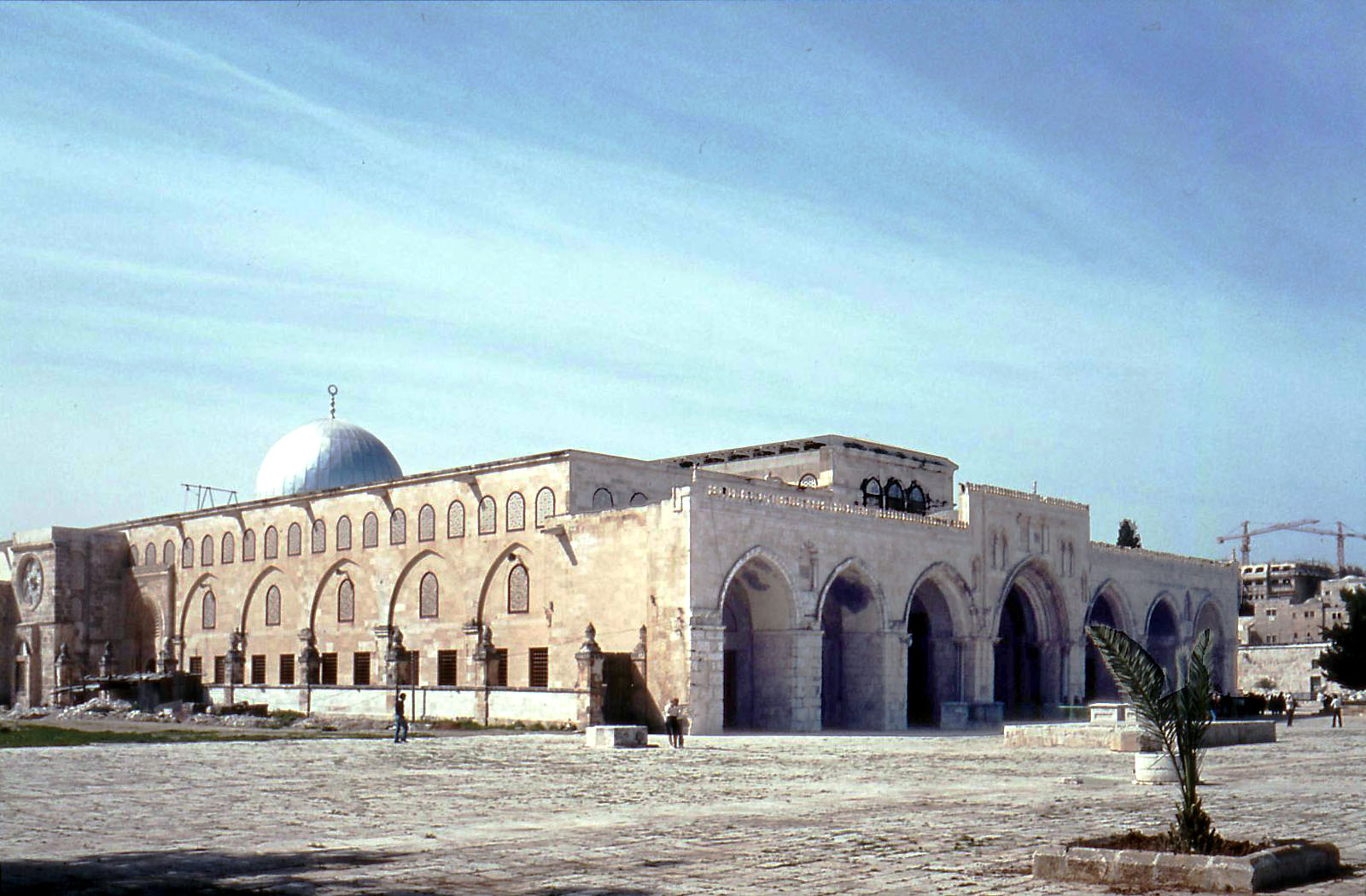
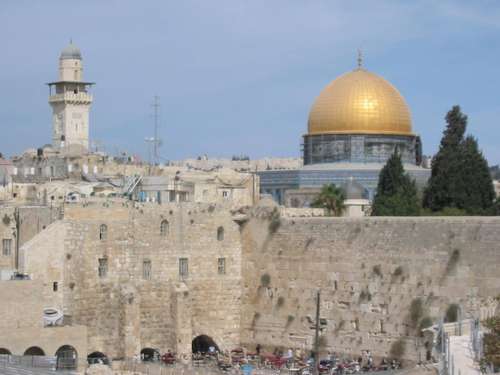
There is a pre-construction excavation going on near the al-Aqsa mosque in East Jerusalem. "Israel says the dig is a necessary precursor to replacing an access ramp connecting the Jewish quarter of the Old City to the compound, which is in the Muslim quarter. Muslim leaders complain they were not consulted about the dig, and say that the foundations of the al-Aqsa mosque could be damaged."


The al-Aqsa Mosque is a very holy place in Islam. The Temple Mount, however, is a very holy place in both Islam and Judaism (and Christianity, but honestly, they have enough to go around). The Temple Mount also contains the Dome of the Rock and the Western Wall.


The al-Aqsa Mosque has always been a target for Islamophobes and a flashpoint for rebellion--much of it unjustified. The Wikipedia article has a good summary here. In 1969 an evangelical Christian-Zionist set fire to the mosque. Israel was incorrectly blamed. In 1981 an American-Israeli soldier opened fire in the mosque, killing two.

In September 2000, future Israeli PM Ariel Sharon "visited" the site--with an armed escort of several hundred policemen--which contributed to the al-Aqsa Infatida. Aside from being a champion of the settlement movement, Sharon was viewed by Muslims as a war criminal for his part in the Sabra and Shatila massacre of 1982. In short, he was a bogeyman, and although the visit was not the sine qua non of the ensuing 4.5 years of insurrection, I suspect it could rightly be called a contributing cause.

So, why the history lesson? It's just another lesson in the stupidity of the species. Clearly, the state of Israel should be very cautious in dealing with the site (parts of which, I should add, are under Muslim administration, so it's not like it's being held hostage by Israel--quite the opposite). And yet, and in spite of the warnings of his own Defense Minister, the Israeli PM Olmert is ordering the excavations to continue.

Which once again begs the question: why do so many on both sides of the conflict seem determined to prevent peace?

Thursday, February 08, 2007

Election woes, and other ridiculous things

Liberals Forced To Change First "Fixed Election Date" Over Religious Conflict
According to this CityNews article, the Ontario Liberal Government has had to change the provincial election date from October 4, 2007, to October 10, 2007. The reason is that Shemini Atzeret (perhaps better known as Simchat Torah, and/or the day after Sukkot) falls on that date, which would prevent some Jewish people1 from voting. The opposition loved this, of course...


"We're happy the date has been moved," adds PC MPP Tim Hudak. "But my goodness, you think they would have thought of this two years ago when they set the election date."

Well, yeah, okay, it was a mistake...but let's be fair. The Hebrew Calendar is a little complicated to follow for those unused to it, specifically those used to the good old-fashioned (Christian/Euro-centric but stable) Gregorian calendar. I mean, even the calculation of Easter is based on the Gregorian calendar, albeit with a little lunar twist thrown in.

Thankfully, the Jewish community has responded positively to the date-change:


But Jewish leaders see it differently, applauding the government's courage to admit its oversight after first refusing to alter the timeframe.

"This is something that all Ontarians should take pride in, and it should give comfort to Ontarians," claims Steven Shulman of the Canadian Jewish Congress. "There's a clear statement being made by the government to accommodate this sort of conflict, and next time it may be another community that's in conflict."

Here's the Ontario Government news release.


Gay Sheep Revisited

Saletan breaks down the pros and cons of the research being done on ovine sexuality at Oregon Health & Science University and Oregon State University.

My problem with this is the same as my problem with the biological determinism argument in general: how long before the discovery of genetic/neurological causes of sexuality turns into the search for a genetic control of sexuality? Apparently there is good evidence to suggest a strong correlation between a belief in the inherent-ness of sexuality and acceptance of sexuality.2 But then, those who reject homosexuality currently tend to reject a biological basis for it.3
Alan Turing, the famed British polymath, was treated with hormones to "correct" his homosexuality. He killed himself. But even if treatment worked, the question for me is: should it? Should we try to "correct" a benign biological characteristic, which to my mind is as much an element of personhood as handedness, eye-colour, et cetera?

And furthermore, should the (hypothetical) finding that sexuality is not biologically determined change our acceptance of people who identify as homosexual? In a time when political adherence and religion, among other things, are considered inherent to the extent that no person should be required to change them, why should sexuality be considered not just chosen, but apparently chosen whimsically, and open to alteration without doing fundamental damage to the psyche and identity?

I fear that the hyper-focus on the biological nature of sexuality (true as it seems to be) misses the point rather extravagantly, and while we can hope it will lead to short-term gains in the area of increased tolerance and acceptance, I can't help being concerned about the ultimate consequences.


  1. According to Stats Can, and the 2001 census, there are about 191 thousand Jewish people in Ontario, out of about 330 thousand in Canada. That's a little under 60% of the Canadian Jewish popumation. Of course, not all of those would consider themselves unable to vote on Shemini Atzaret.
  2. From Wikipedia article "Biology and sexual orientation": Ernulf, K. E., Innala, S. M., & Whitam, F. L. (1989). Biological explanation, psychological explanation, and tolerance of homosexuals: A cross-national analysis of beliefs and attitudes. Psychological Reports, 65, 1003-1010. See also: Whitley, B. E., Jr. (1990). The relationship of heterosexuals' attributions for the causes of homosexuality to attitudes toward lesbians and gay men. Personality and Social Psychology Bulletin, 16, 369-377.
  3. See the "Pathogenic theory of homosexuality" article at Wikipedia.

Saturday, November 18, 2006

Mortality and Morbidity Report

Why? Because I can't focus worth a damn. I mean, that's generally the truth...but I always go to bed on Friday thinking: Okay, tomorrow I will be a writing and researching fiend and generally instead I sleep in a lot and wake up with a killer headache and futz about.

I did manage to watch an episode of House MD, and while the bright yellow Spanish subtitles were a little distracting, it was a fascinating/heartwrenching episode. Episode 3x03, "Informed Consent"...House & the team treat a hugely respected medical researcher (who has a history of using less-than-totally-ethical methods) who wants help to die. All the usualy House machinations and so on, but that debate, which continued through the episode, was really well done. I found myself 110% on side with House, of course. His take was that he would help, when and only when he knew the person's condition was untreatable and fatal. Thus, a patient refusing tests got no help from him, but one refusing pointless treatment would.

This strikes pretty close to the bone right now, as a dear-one of a dear-one is in the twilight, and so we've discussed the issue in general--that difficult but real line between not wanting someone to suffer needlessly, and wanting them to die. As I said to her (in one of those epiphanies-out-loud that I didn't realize until I said it) "It's not about wanting the person to die, because they are already. All you can choose is how." I think if people got that, the death-with-dignity debate would dry up and dissappear.

I find it totally bizarre, the extent to which my society values technical signs of life and scoffs at quality issues. Obviously we're slowly turning away from that, but things like the Terry Schiavo debacle remind me how very many people still see the issue as black and white. What really disturbed me about that was the argument that Ms. Schiavo should be kept alive because there was an off-chance that a kernal of sentience still hid within her ruined body. To me, that was another argument for letting her go. I can think of few scenarios more nightmarish than being trapped inside a totally nonresponsive body for decades. I've told my family that regardless of brainwaves or whatever, if I can't communicate, and especially if I can't be communicated to, to let me go. Isn't communication the essence of humanity?

The only caveat would be if keeping me "alive" would increase the chances of successful organ transplant. That'd be acceptable, obviously. I'm O-neg too, so I assume my organs would be snapped uo like hot cakes. The only thing I'm currently not registered to donate is my eyes, and that's just because my Mom freaked on me at the Health Card place when I was filling out the form, and I was a minor at the time. Next Health Card, the eyes go on the list. I'll admit it did wig me too originially, but it didn't take long to become accustomed to the reality that I wouldn't need them, and they could give someone their sight back. Given my screwed up hearing, and the constancy of physical pain I've experienced, I could survive without feeling or hearing, but sight? No way. I really think I'd lose my mind.

Which leads me to the second morbid discussion I've had in the last few weeks: embalming. Thanks, but no. I'm not too keen on cremation (irrational, I know) although I'd rather be cremated and buried than become an object d'creepy-art on someone's mantel. Under a tree would be nice (though most commercial cemetaries don't do that because if the tree dies, families get upset...also? I feel like the roots sometimes pull urns up). Or buried vertically, like they do in some cemetaries where the land is scarce. Or as I've said, not embalmed and buried in a bio-degradable casket so I can actually, you know, return to the earth instead of poisoning it. My impression is that this is the position of Halakic authorities too. I can only assume the North American obsession with embalming and coiffing the dead has something to do, a) with the idea that the dead will rise from their graves on Judgement Day, and thet it'd be nice if they looked respectable, and b) the general Western horror of death.

Mummification and excarnation sort of freak me out, though I'll admit to a personal attraction/repulsion to Towers of Silence ever since I read Such a Long Journey. I can't decide if I find it the most or least pure and sacred funerary rite. My general attraction to Zoroastrian cosmology does not help with the ambivalence.

Wikipedia's 2 cents on natural burial, excarnation, and a link to the Canadian Natural Burial organization.

Thursday, November 09, 2006

To veil or not to veil?


I've seen a lot more women on campus and on the TTC wearing not just a hijab (at right), but a niqab (at bottom) as well lately. Originally I must admit, it struck me as quite odd. I mean, hijabs are so common in T.O., and I don't understand how it could be seen as oppressive. If I were visiting a conservative Muslim country, or even married a conservative Muslim, or what have you, I would probably take one on voluntarily as a sign of respect. How is it any different from an Amish bonnet, a kippah, a turban, etc etc?


But a niqab, similarly to a burqa, covers the face. Especially in the West, that's like a prototypical symbol of dehumanization. Scratching out someone's face in a picture is a symbolically powerful act, and injuries to the face are evidence of a personally-motivated murder, and so on. For that reason, I can understand why veils are so much more disquieting to Westerners. I myself have had moments of *...the hell?* upon seeing a woman veiled.


But here's something else I've noticed. Women wearing the niqab are categorically not wearing a burqa. The veil does not seem particularly physically uncomfprtable, and is often worn with suitable modest but individually styled clothing. A woman in a black hijab/niqab on the bus this morning was wearing a beautiful light purple robe or dress (I couldn't tell under her coat, but it was open at the front) embroidered with little white flowers. Another woman on campus was wearing a beautiful brown underskirt. And these women walked tall, looked up, and for heavens' sake, were at university. I would be hard-pressed to make an argument that either of these women were "oppressed" or in any way "suffering" for the religious or cultural garb they were wearing, which for all I know, they chose themselves. Certainly, their individuality was externally apparent, perhaps more so than the parade of cookie-cutter Prada-sweatsuit knockoff-Louie-Vuitton-bag-carrying young women of other religions or cultures who swarm campus.


What would be a concern, I suppose, was if the rules were so fluid as to be adapted to quash whatever sign of individuality might be allowable beyond the black-letter law.