Sunday, March 09, 2008

In which I tell Serbia to get over it

Dear Serbia,

You lost. Get over it.

Hugs & Kisses,

Sarah

Okay, that's a teeny, tiny bit oversimplified. Nevertheless, I'm a tad bit baffled at the "debate" about the legality of Kosovo declaring independence, for a number of reasons.

1) This is really always a political question. I mean, we can dither about the legality of unilateral declarations, the Supreme Court can issue a decision on it (Reference re Secession of Quebec, [1998] 2 S.C.R. 217), but the fact of the matter is a state is a state if and when other states agree that it is a state, the anomaly of Taiwan notwithstanding. This is a political question, and you can't put the rabbit back in the hat later by saying it broke the rules.

2) As the international Covenant on Civil and Political Rights puts it:

1. All peoples have the right of self-determination. By virtue of that right they freely determine their political status and freely pursue their economic, social and cultural development.

And as the SCC noted in the Reference re Secession (at para. 114):

The existence of the right of a people to self-determination is now so widely recognized in international conventions that the principle has acquired a status beyond "convention" and is considered a general principle of international law. 

Self-determination is generally though of in two contexts, both involving the domination of a people by an outside force:

The right of colonial peoples to exercise their right to self-determination by breaking away from the "imperial" power is now undisputed...

The other clear case where a right to external self-determination accrues is where a people is subject to alien subjugation, domination or exploitation outside a colonial context. (Reference re Secession at paras. 133-34)

Clearly Quebec, which gets all sorts of free rides and special treatment from the Canadian government, doesn't fall under those categories. But I'm pretty sure Kosovo does.

Kosovar Albanians are a relatively homogenous national group living on a relatively discrete chunk of Europe who apparently cannot be part of Serbia without the two sides killing each other. Sure, there are examples of multi-ethnic states succeeding, but they have characteristics, like integration, or a supra-national identity, or most importantly, not killing each other. Both theoretically and functionally, Kosovo is a textbook example of why/how self-determination is so important.

3) How is this news to anyone?

Kosovo has been de facto seceded from Serbia since 1999, when the UN declared it a protectorate. Yes, there were attempts to negotiate a mutually acceptable status, but once they fell through, all bets were off. I don't think it says anything that the UN has yet to acknowledge Kosovo; I think they're basically being polite, to avoid the appearance of having instigated the whole thing. If I am surprised by anything, it is that it took this long for a declaration of independence to be made.

Monday, March 03, 2008

News of the ridiculous part II

Cal State University fires Quaker for inserting "nonviolently" into loyalty oath (via BoingBoing)

A Quaker math teacher at California State University East Bay has been fired for inserting the word "nonviolently" into the loyalty oath that state employees are required to sign. The woman, who works with young people who need remedial help with math, has always made this change in the loyalty oaths she's signed throughout her long teaching career, but the CSU East Bay administration fired her for refusing to pledge to violate her religion's tenets to in defense of the Constitution (a document that guarantees religious freedom).

News of the ridiculous

You have got to be kidding me.

Court bans veiled terror suspect (BBC)

An Austrian court has excluded a young Muslim woman from the start of her trial on terrorism charges because she refused to remove her full-face veil.

In which I continue pimping LANGUAGE LOG

Awesome.

Tautology of the day.

Oooooh, meta-humour

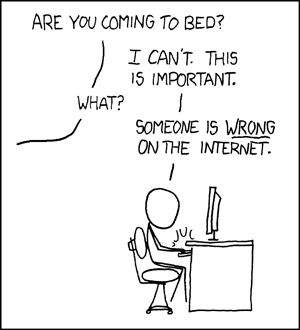
This xkcd is teh awesome.

But just as awesome is the follow-up Language Log post.

Saturday, March 01, 2008

Those of Us with Our Panties in a Bunch v. Mock Trial

As my caveat lector (right) makes very clear, I am not afraid of a good argument. In fact, given my vocation and, some would say, pathological inability to keep my mouth shut, I am more or less doomed to a life of debate. One of the most delightful manifestations of my contrarian nature is my staunch opposition to over-wrought complaints of injured sensibilities and the arch self-righteousness of special interest wankery. If I am a feminist, I am a small-“f” feminist, thank you very much. As proof, I offer a complete list of the last three things that made me as teeth-grindingly angry as I have been for the last week:

  1. The militantly feminist politics teacher who told me that wearing makeup was a betrayal of the “cause” and suggested we move to consensus government because it was easier on women
  2. The guidance counsellor who demanded that I had an obligation to take math and computer science because previous generations of women had fought for my ability to do so (apparently I owed them some Cs and Ds, although why they preferred to be paid in the currency of bad grades I’ve no idea)
  3. The lit professor who insisted that (a) cannibalism was good, and (b) that anything any person of British extraction had ever done was inherently evil (particularly perplexing given that she was a white Australian)

In short, I am astronomically unlikely to find something “offensive to women,” let alone to raise the issue. There is, of course, one major exception: when those arguing the counter-feminist perspective (some of them, I’m sure, quite convinced that they are being excellent little third-wave feminists) are so obviously missing the point that I despair for the rhetorical and analytical skills of my generation.

Now let me clear (somebody has to, I suppose): I take no issue with Mock Trial. Not having seen it, I cannot take issue with it. I know that many people on both sides of the debate invested enormous amounts of time and effort into the show, which by all accounts was 90% unimpeachable, at least under the terms of this debate. I’m told it was amusing; I’m told it raised $10,000 for charity. This is commendable, and it has nothing to do with this debate.

My concern, the issue to which I am sacrificing so much precious dental enamel, is the cultish attitude of those who have equated criticism of Mock Trial with betrayal of Osgoode, nay, of freedom of expression itself. To them I have but one question: Seriously?

While I sympathize with distrust of censorship, some counter-arguments have gone so far as to raise the spectre of Osgoode turning into a fascist police state where all free expression is quashed. While I admit there are days when these hallowed halls of learning strike me as dystopian, it is clear that the school is too committed to being Kafkaesque to waste time being Orwellian. Plus—thankfully—law students are mouthy little brats who would never let that happen. This is yet another straw man argument that ignores the issues.

There are legitimate counter-arguments to the positions (a) that a strip-tease is an entirely inappropriate feature of an official school event, in that it furthers the acculturation of the virgin/whore dichotomy in the legal profession; (b) that depicting a specific and identifiable student as an embodiment of the worst stereotypes of (attractive) female lawyers, namely that we sleep our way to the top, is not only potentially defamatory and unquestionably injurious to the target, but also harmful to the student body as a whole; (c) that any attempt to address a breakdown of institutional standards must go outside that institution to challenge the defensive groupthink to which any school or organization is prone; and (d) that serious breaches of standards which take place in a public and highly publicized forum are properly addressed in an equally public forum. But I haven’t heard any yet. Instead, I’ve heard a lot of arguments so heinously illogical that they deserve to be broken down into their component logical fallacies.[1]

Regarding “Come join the Cabaret…”

Mock Trial is, I think, best defined as a cabaret show. Cabaret as an art form is generally a bawdy, funny, sometimes vulgar intertwining of performances of varying calibre and has also traditionally been a venue for social and political satire and commentary. Mock Trial is very much along this vein. It is a cobbling together of the efforts of many different people into a final product that is meant to be entertaining, humourous, and racy, while simultaneously satirizing Osgoode, the legal profession and various notable personalities both at Osgoode and in the larger legal community.

The comment begins with masterful examples of both the bare assertion fallacy and begging the question. Since mock trial = cabaret and cabaret = good, mock trial = good. This is also a nice specimen of the weak analogy. It then moves on to a simultaneous ad hominem attack/use of loaded language, by dismissing the complainants as part of the “legacy of melodrama that is Oz” who are “getting their knickers in a knot.” The mischaracterization of the debate continues, as we find out that the subject of the knicker-knots in the mere “’raciness’ and ‘inappropriateness’ of some numbers.” I would classify this as abuse of quotation marks. No one is concerned that some of the Mock Trial performers showed a little ankle, it is how they did so and the likely consequences that have our unmentionables all a-tangle.

The comment then moves on to a rhetorical device so rare I feel luckier to have witnessed than if a Spix’s Macaw landed on my shoulder. Having established—or rather, asserted—the Mock Trial-cabaret link, the article goes on to compare criticism of Mock Trial to censorship by the Nazis (the author’s disingenuous and exclamation-pointed demurral aside). Indeed, it is the rare reductio ad hitlerum, not seen in the wild since the mid-twentieth century.[2] Both a false analogy and an attack ad hominem, this particular logical fallacy is too frail to survive the arched eyebrows of its interlocutors. It demands the question, once again: Seriously?

The article moves away from Teutonics and on to a reaffirmation of the previously discussed bare assertion/begging the question: “At Osgoode, Mock Trial is one of the most apt forums in which to criticize the legal regime in which we find ourselves.” This neatly sidesteps the fact that, (a) if Mock Trial is that important to legal discourse at Osgoode, then perhaps we should take in our shingle and go home, and (b) that the impugned elements of the show had nothing to do with the “legal regime”. Then the article moves on to a fallacy of relevance implicating Jonathan Swift as a hypothetical supporter of Mock Trial’s right to say anything, however defamatory or sexist. My counter-hypothesis is that Swift is currently turning in his grave like Pulsar B1257+12. While the article may be right that “satire gets a point across far more effectively than the clearest analytical writing,” it sadly fails to prove that Mock Trial is satirical.

Satire must have an object. It must satirize something. It is a manifestation of irony. So then, what was the object of the satire in the impugned parts of Mock Trial?

**cricket noises**

Ah yes, that’s right, there was none. To its credit, the article does explain the use of non-satirical humour in cabaret:

In terms of non-satirical content, such as plain old “toilet humour,” gratuitous swearing, or sexually explicit content, I would like to point out three things. First, cabaret has always included these aspects of entertainment and humour – it is part of the genre. Second, the performers in Mock Trial are adults, who are capable of making decisions about what they are willing to take part in. They are not goaded, paid or tormented into participating, and what appears on stage is therefore not exploitive of them.

I would also like to point our three things: First, appealing to the authority of cabaret is unhelpful because no one has actually established that this is an apt analogy. Second, defending Mock Trial on the basis of the performer’s personal agency is missing the point by a margin of error comparable to New Coke. It is a non sequitur; nobody is arguing that the dancers or actors were forced to do something exploitative. The problem is the loss of agency on the part of other women in the Osgoode community. Third, while I’m glad to hear that Mock Trial doesn’t pay or coerce its participants, the point is irrelevant to the current debate.

In the last four paragraphs, the article moves into an analysis of the freedom of expression interest supposedly threatened by those of us with our lingerie in a barrel hitch. This is purports to be the crux of many of the arguments for Mock Trial’s impunity, and it is defeated only by its myopic hypocrisy.

I would agree that it is good advice to not “assume that because you were morally offended by something in the show that everyone was or should be offended.” However, it is likewise true that one should not assume that because they were not “morally offended,” no one else would be either. It is entirely true that “that kind of thinking that leads to moral arrogance as well as a lack of dialogue between divergent viewpoints.” Such moral arrogance could include the un-argued assumption that support of freedom of expression is a carte blanche for anything, no matter how harmful. Blackface? Punch and Judy? Snuff films? Why not?

Now, I clearly don’t agree with that point of view, especially in this context. The medium is the message, and if the medium is a school-supported, firm-funded, institutionalized performance which paints women as sexualized being to the exclusion of other traits, then the message isn’t “women are just sexual”—which would be bad enough—but “Osgoode and the firms agree that women are just sexual”. But perhaps I could “agree to disagree”, had the article not concluded with an admonishment that the complainants had expressed their discontent wrongly. In short, Mock Trial can say what it wants because freedom of expression is paramount, and if you don’t like it, shut your face. Charming. And that’s not the worst of it.

Regarding “The beauty of freedom and feminism”

This article avoids any particularly egregious rhetorical abuses by the simple use of wishful thinking, and a troubling misunderstanding of what it is to be feminist. It begins where the previous one left off by indulging in rampant hypocrisy, ironically by misusing the word “hypocritical":

The first issue is between the student and the producers. Anyone who has spoken on behalf of this student to other organizations or to the school newspapers is simply hypocritical in their actions. If this student chooses to handle the issue personally, then that should be respected. Using the student to advance your own grievances is discourteous. Regardless, the skit in question in no way TRUTHFULLY depicts any student in this school and is just a farce of a fictional situation.

From this I glean several troubling themes. We should not, apparently, support members of our community who have been maligned. We should also not use blatant and troubling evidence of a problem in the institutional culture of the school to illustrate that problem. I confess that following these suggestions would make it frankly impossible to be a lawyer, to advance cases and use evidence, particularly when I agreed with my clients and their cause.

Also, the statement that there was no targeting of a student is obviously untrue, however sincere the author may be. I can’t believe—or, perhaps, refuse to believe—that all or even most of those who contributed positively to Mock Trial were aware of the situation and untroubled by it.

The article continues:

The second issue a few people had with the show is the alleged “misogynist” depiction of women. "is is something that falls under the headings of “taste” and “censorship”. I would be dishonest if I said every skit showed women in the best light. However, that is my opinion. I am entitled to that opinion just as women are entitled to be smart and sexy, even overtly sexual if they choose. Women can even be bitchy and sarcastic in their skit, a la moi. This is the beauty of freedom and feminism! You can be want you want to be. You can be criticized, but you should not be stopped.

This is troubling, once again in that missed-the-point, fallacy of relevance way. First Wave, Second Wave, Third Wave, Post-, or reluctant feminist, there is one thing we can all agree on: that individual women have a right to self-determination. Women’s identities should not be determined solely by the external culture. Women should feel free to express their sexuality, their “sexyness” howsoever they choose. So, why then is it problematic for Mock Trial to feature stripping female lawyers and young women lawyers prostituting themselves?

Because the dance was a depiction of young female lawyers in general, and because the skit was a depiction of a young female lawyer in particular. It is not the behaviour that calls for criticism, but rather that said behaviour is a public representation of a stereotype that many of us have had to fight against. It is also screamingly ironic that the skit ridiculed that which the dance purported to celebrate.

In short: Worst. Third-Wave Feminists. Ever.

For those who were offended by the show, you are entitled to voice your own opinion. You could address the issue with the producers or in the Obiter, but to go so far as to contact corporate sponsors is preposterous! The sponsors come and see the show; therefore, they can personally address any issues they have with the producers or the school.

Again, it is interesting how Mock Trial should be immune from criticism, but its critics are not. We are “entitled to voice” our “own opinion”…at the time and venue, and to the audience, that is least likely to respond. Please read Committee for the Commonwealth of Canada,[3] then get back to me.

The article concludes on a morass of appeal to emotion (they’ll cancel our beloved Mock Trial!), ad hominem attacks (you hate charity!), and an amusing poison pill: “Seeing our peers’ talents is secondary to the charitable contribution.” Since that’s true, and since Mock Trial appear incapable of raising money without particularly unfunny and damaging portrayals of members of our community, maybe we should quash the whole thing and try for something less mean-spirited?

Regarding “In defense of Mock Trial”

I’ve read this article several times now, and while I am more than willing to point out its flaws, I shall make the caveat that, while I believe this is a particularly inept satire of the complainants, it may in fact be an incredibly clever satire of the respondents.

I have a disability. It’s genetic, so there’s not too much I can do about it. My doctor tells me that my chromosome five is abnormally short, and as a result I don’t have a sense of humour.

To begin with, this article could easily have kept its basic premise without invoking chromosomal abnormalities. I don’t find Le Jeune’s syndrome[4] particularly amusing, and I would caution the author that a quick Google might have prevented him from mocking an actual and tragic genetic disorder. I’m also discouraged that there was no fact-checking on the part of the editors.

Having begun with retards, the article moves on to racism.

Having this disability is usually fatal in most societies. I’ve heard reports that in some island cultures, children born with this disability are actually thrown off cliffs, to the mirthful approval of the community. I think they did this in ancient Sparta as well, although this is still a point of debate among contemporary academics. In other societies, those born with this disability and it impossibly difficult to mate with the opposite sex. As a result, they usually relegate themselves to living in caves. Surprisingly however, my disability has never been an obstacle for me in Canada – thanks primarily to our culture of ultra-political sensitivity.

Anhedonia and over-sensitivity are then conflated:

I’ve recently discovered that my disability is actually an advantage in many circumstances. By not being able to laugh, I have the luxury of finding offensive just about anything. Any mention of sexuality? Obviously sexist. Allusion to ethnicity? Obviously Racist. Satirical suggestion? Most definitely discrimination. I also find that most people are afraid to disagree with me. Those who are not, I usually like to portray as colonial supremacists. This usually does a good job of shutting them up.

First of all, this “joke” lacks continuity. Lack of sense of humour does not make one jump to conclusions like this. Again, the author could have claimed to have the fictional illness Hypersensatus politica without dragging people with serious medical problems down into the muck with him. Second, he paints the complainants as malignant narcissists who cannot abide any criticism.

The irony is so thick only Paul Bunyan could dent it. And yet the ad hominem attacks continue:

Being able to point out offensive material has now become second nature. It’s a knee-jerk reaction that doesn’t really require any higher cognitive function. I no longer ask myself why I am offended, I am merely comforted by the fact that I am. And besides, I find it’s a great way to get people into trouble, and also to set the bar so incredibly high that people around me are perpetually afraid of what to say. I like it when people respect my values. I call it a subtle form of coercion.

The complainants are apparently irrational (and possibly stupid), textbook cases of narcissistic personality disorder, and apparently dabbling in Munchausen Syndrome by Proxy or at least an overdeveloped sense of Schadenfreude.

Continuity breaks down again when the narrator states: “My latest pet peeve are school performances. I really think they just aren’t funny anymore.” Um, if you were born without a sense of humour, when did you know they were funny? When satire is good, it’s very, very good, but when it’s bad, it’s this article. I believe Jonathan Swift’s rotational velocity is approaching light speed.

I’ll spare myself the analysis of the next two paragraphs, which continue the theme of narcissism. The article then concludes with yet another bizarre mischaracterisation of the issues:

I also don’t see the point in opening up lines of dialogue with those who have offended me. It’s much easier just to tell on them. I guess this is something I learned from elementary school. If I can’t deal with an issue, I seek higher authorities to resolve the problem for me. It makes me less accountable. In truth, I’m not sure if I’m in it to change the opinions of those who I think are offensive. I’m more interested in my own emotional catharsis. It’s easier to complain than to explain.

To those critical of the way the complainants made their complaint as not “opening up lines of dialogue,” I’d like to point out in as few words as possible the flaw in your argument: it’s wrong. It’s just so, overwhelmingly, obviously wrong that it almost doesn’t bear analysis. The complaints didn’t move this debate from the private to the public sphere, because it was already in the public sphere. Even in the Excalibur article, both sides were given the opportunity to express their opinion, and it’s hardly our fault that some people just tried to bluff their way to a defence of the indefensible. To argue that Mock Trial should not be called on its errors for the sake of abstract and unanalysed claims to “humour” and “freedom of expression,” while simultaneously berate its critics for “telling on” it is so painfully illogical that I lose a few neurons every time I contemplate it. If Mock Trial is blameless, than complaints cannot harm it. But if Mock Trial is blameless, then why hasn’t their been a single articulate statement in its defense? If untempered freedom of expression is good, then why are we not free to express our problems with the show?

Now if you’ll excuse me, I have to go batten down the hatches against the inevitable backlash.


[1] I won’t criticize any of the authors for their use of appeal to ridicule, since it’s one of my favorite rhetorical tools. I can’t blame anyone for trying to be funny—I can only blame them for failing.

[2] http://en.wikipedia.org/wiki/Reductio_ad_hitlerum.

[3] v. Canada, [1991] 1 S.C.R. 139.

[4] http://www.nlm.nih.gov/medlineplus/ency/article/001593.htm.

Friday, February 22, 2008

In which my long-dormant feminist side speaks out

Okay, brief intro to a sordid tale:

Osgoode has an annual charity review called Mock Trial. Mock Trial is usually pretty racy. This year, Mock Trial took an unfortunate turn from "racy" into "what the hell...that's inappropriate." Friend of mine complains to York University's student paper, resulting in this article: "Producer shows no concern over ‘misogyny’" Quote:

     “There were a couple of scenes in this year’s performance that were unacceptable and downright offensive,” she said.
     One such scene, according to Brierley, involved female law students “gyrating” on chairs to the song ‘Buttons’ by the Pussycat Dolls.

...

     “There was another scene which portrayed a female law student who was essentially down on all fours, pretending to give [oral sex] to somebody who was playing a partner in a downtown Bay Street law firm,” she said.
     “The reason for which this law student was doing this was to gain funding for an environmental program.”
     Brierley claimed the female law student depicted in the skit was also meant to resemble an actual student.
     “As it turns out, the [female] character that was being portrayed was actually modelled after a specific individual at Osgoode. And although no names were mentioned, everybody that I spoke with after the performance knew exactly who it was referring to.”
     Elizabeth Martin*, another Osgoode student, said she knows the student who was being depicted personally, and that although no names were mentioned, the skit referred to the student through personal details known to the Osgoode community.
     “They made sure they made reference to [those things] in the opening of the skit to allude to her. And from there, it went on to this degrading act,” she said.
     “She’s deeply humiliated. She doesn’t even want to attend school.”

First of all, from all accounts it was meant to depict this person, and there was a striptease, so the whole "Brierley claimed" thing is misleading.

The producer contacted not only denied that the skit was inappropriate in any way, but also denied personal responsibility, or responsibility to the student body:

     [James Butlin, one of the show’s producers, said] “We’d certainly not apologize. Our show raises almost $10,000 for local charity and involves over 15 percent of our student body, and the response to our show has been excellent from all but these people that I hear about now.”

I...what? WHAT?! Goddammit man, if they'd only owned up to how totally NOT CRICKET that was, we would have been okay, I think. But instead, people went mental, siding with either "Mock Trial" or "Alyssa" (as if those two sides were mutually exclusive, as if Alyssa some sort of irrational hate-on for Mock Trial in general).

My favourite part, and by favourite I mean most-rage-inducing, is that people are angry she went "outside" the school. As if Osgoode is sort of sacred closed community and by "snitching" she broke some sort of unspoken rule. That is patently ridiculous. Osgoode is part of York--sorry folks, but it's true. Also? Osgoode has this bizarre secret-society mentality that allows institutional biases and groupthink to reign; those who don't buy in only have to survive three years of it, so we cope. If you think something is a serious problem, you have to go outside the school.

The editor of Obiter Dicta, the Osgoode paper, said in the most recent issue:"This is essentially a private affair that has unfortunately been played out publicly..." which is simply untrue. If someone had said something offensive is, say, a class, that might have counted as private. But Mock Trial is a publicly advertised show. Public sexism and inappropriate behaviour requires public discussion and public apology.

I will now quote the entirety of Alyssa's comment in the most recent edition of Obiter, because I think it's cogent and eloquent and deserves to be available in an indexed/html sort of a way:

While it is noble that so many Osgoodians spend months preparing an entertaining production in order to raise money for charity, the content of some of Mock Trial last week was troubling to say the least. I would like to preface the comments I am about to make by saying that I commend the dedication and hard work that so many student colleagues have spent on this performance. There is clearly a great deal of talent within the halls of Osgoode. My comments here and those that I made to the Excalibur are not meant in any way to undermine the efforts put forth by the vast majority of participants in the performance. It is unfortunate, however, that the production as a whole has been tarnished by the poor judgement of a few people who felt the need to include questionable material. In a profession where women struggle to be taken seriously, one has to wonder why students – many of whom were female – are perpetuating the very gender stereotypes that make it difficult for women to succeed and why their so-called progressive institute of higher education is allowing this to happen.

Two skits in particular were offensive: one with female students performing a chair dance to the lyrics “loosen up my buttons, baby,” and another depicting a female law student crawling on the floor and simulating oral sex on a male lawyer with whip crème and knee pads. As for the sexually charged dance scene, I fail to see the value in inviting the public to our school so that they can see female law students dancing in a sexual manner on chairs. What a woman does on her own time is her business. What people do at a public event in the name of Osgoode Hall becomes everyone’s business. I for one do not appreciate being associated with this type of performance given that I face enough problems as a young female trying to succeed in a field dominated by men and male oriented career norms.

Most troubling about the performance, however, was the second skit mentioned above. The vast majority of my criticism rests here. While the dance was inappropriate, the now infamous “blow job” scene was degrading, offensive and I would even go so far as to suggest that it constitutes sexual harassment. Aside from being completely inappropriate at a public event attended by families, professors, student colleagues and friends, this skit maliciously targeted a specific female student in a manner that can only be understood as an attempt to humiliate this individual and tarnish her reputation. Although no names were mentioned in the show, it was clear to most people that I have spoken to since the performance last week exactly who this character was supposed to be.

Both of these scenes were offensive in their portrayal of women in a profession where women have had to fight for respect and the right to be taken seriously as intelligent professionals. The portrayal of women in this manner also undermines the ability of female students at Osgoode Hall, such as myself, to feel that they are earning an education in a safe space where they are respected as intelligent and capable individuals rather than sexual objects. What’s worse is that this event had the school’s name all over it, suggesting that this type of depiction of women is sanctioned by Osgoode as an institution.

Finally, the fact that there were so many people involved in the production implies an institutional culture at this school that sees no problem in treating its female students in this manner. Presumably dozens of students witnessed rehearsals of Mock Trial practices and dress rehearsals and yet the performance went on as is – three times. This is clearly a much bigger and more systemic problem. The fact that many knew about the offending performance and no one felt compelled to remove this content is perhaps the most disturbing aspect of this entire story.

This should never have happened. The Mock Trial producers should never have included these scenes and the Dean – who performed in the Wednesday night performance– should never have allowed this to continue for two additional evenings. These Mock Trial scenes have embarrassed the school and personally harassed and degraded a member of its community. For the first time in my life, I am embarrassed to be affiliated with this institution. I was so outraged, in fact, that I contacted the Excalibur so that they could report on it. They ran the story on the front page of this week’s edition. When asked to comment, one of the producers remained unremorseful, as if doing something for the purpose of raising money for charity gives them a carte blanche to treat people in such a degrading manner. As for the notion that the offending scene featured a “fictitious character,” that is simply not true and everyone knows it. Claiming that it was not an actual representation after the fact does not change this.

I have been challenged – privately, by members of the Osgoode community and my friends – for my decision to complain to the sponsoring firm so that they could “raise these issues with the producers of Mock Trial and to either pull funding for next year’s production or make it conditional on the content of the production being less offensive to women and other vulnerable groups.” Note that this is a direct quotation from the letter I sent to Cassels Brock; I do not think this is an unreasonable request. People have pointed out to me that this may have an impact on the ability of Mock Trial to secure funds in the future for its charitable aims. While I understand why some may be concerned, perhaps those same people should be instead complaining to those responsible for this, rather than the person tired of this kind of behaviour at Osgoode. I have received numerous letters of support in the past day, from total strangers thanking me for speaking out publicly about this issue. Clearly I am not the only one who feels offended by what happened last week.

Make no mistake: if Osgoode loses funding in the future for Mock Trial, it is not because a female law student got mad as hell and raised a fuss, but rather because there was a failure of judgement and oversight at all stages of the process. If people don’t want their dirty laundry aired, then perhaps they should keep their clothes clean. I don’t think it’s appropriate to be quiet about this simply because this is a charitable event and it reflects poorly on the school. It should. We have to face the consequences as a community for allowing this to happen and not run for cover. This is indicative of a systemic problem and a culture at Osgoode that makes this kind of behaviour possible. There are plenty of ways to raise money for charity in an inclusive and respectful manner and defaming a member of our community in a (mostly) otherwise entertaining production is not one of them. (emphasis mine)

Now, I applaud Obiter for including a number of pro/con comments in this issue, and I only have serious concerns with one: "Come join the Cabaret…" by Sheila Hyatt. The comment states: "Mock Trial is, I think, best defined as a cabaret show. Cabaret as an art form is generally a bawdy, funny, sometimes vulgar intertwining of performances of varying calibre and has also traditionally been a venue for social and political satire and commentary. Mock Trial is very much along this vein."

Okay, I'm agree so far. But the comment continues: "I’ve heard mostly positive comments about the show. Naturally, however, this is law school, and in keeping with the legacy of melodrama that is Oz, I have also heard murmurs that some people are getting their knickers in a knot over the 'raciness' and 'inappropriateness' of some numbers."

Again: What? This isn't about a couple of prudes in a tizzy because someone showed some ankle, for heaven's sake.

The comment then raises the similarity of Mock Trial with the cabaret as depicted in the film Cabaret, stating: "The film deals with cabaret in Germany during the Nazi rise to power. Between 1933 and 1945, the art form was essentially “sanitized” due to Nazi repression of social and political criticism, as well as a desire to exert greater control over public morality. Clearly I am not saying that those who are worried about the content of the Mock Trial show are repressive, fascist, racist, dictators!"

HAHA, CLEARLY! My God, we've actually gotten to a use of reductio ad Hitlerum. (I suppose Godwin's law fits too.)

The major problem for me is that I agree with much of this comment, if it were applied to different circumstances. The statement that: "I would like to point out that, as anyone who has studied Jonathan Swift can tell you, satire gets a point across far more effectively than the clearest analytical writing." So true! And that: "...don’t assume that because you were morally offended by something in the show that everyone was or should be offended. It is that kind of thinking that leads to moral arrogance as well as a lack of dialogue between divergent viewpoints." Yes, yes!

But of course, the comment misses several major points. Like the fact that these differences of opinion aren't about opening a progressive discourse, but about a series of ad hominem attacks that the comment itself has participated in (seriously? Nazis? SERIOUSLY?). Also, the striptease was sort of a side note, but was nevertheless problematic not because it was "racy" but because of the way it portrayed a group of students. Would it be okay for a skit to portray any other group by reference to a single, generalized stereotypical characteristic? Hell no.

Another point is that satire and parody have an object. Had the dance number been contextualized, even briefly, it might fit into this category. Male and female students stripping as the only way to pay gargantuan tuition. perhaps, or a sexy dance choreographed to a recording of a boring lecture set to hip-hop music. As it stood however, the only message of the piece was "SEXY DANCING".

The fact that these two skits (mainly the one consisting of a personal attack) made it into Mock Trial concerns me a little. The fact that half the Osgoode community seems hell-bent on attacking the whistle-blowers is, to my mind, far far more alarming.

If I Had A Million Dollars (Pt. IV)

So if you're wondering, I haven't just morphed into some sort of crazed consumer whore. This all started with me looking, seriously looking, for the ultimate coffee maker. One that had the following:

  • Attached grinder
  • Timer
  • Thermal carafe

They're surprisingly hard to find, although I have found these:

Cuisinart Fully Automatic Burr Grind & Brew Thermal™ 12 Cup Coffeemaker

Cuisinart Fully Automatic Burr Grind & Brew Thermal™ 12 Cup Coffeemaker

Capresso 455 CoffeeTEAM Therm Stainless Coffeemaker/Burr Grinder Combination

Capresso 455 CoffeeTEAM Therm Stainless Coffeemaker Burr Grinder Combination

Oddly enough, the real problem seems to be the inclusion of the carafe, which I find bizarre.


But as I trolled the interwebs for something suitable, I came across all these other goodies, and couldn't resist sharing them.

The Genuine Turkish Bathrobe

Genuine Turkish Bathrobe 

SONY Paperless Paperback

Sony Paperless Paperback

The Organized Traveler's Carry-On

Organized Traveler's Carry-On

The Better Winter Hat

The Better Winter Hat

Tuesday, February 12, 2008

The Queen of the Grammar Rodeo Agrees

A different Language Log poster notes another pointless attack on Rowan Williams, the Archbishop of Canterbury.

Williams said: "...I must, of course, take responsibility for any unclarity in either that text or in the radio interview..." to which UK Times columnist Alan Hamilton commented:

So, Christians: to pride, lust and the rest, add the eighth deadly sin of “unclarity” — a word that is obscure enough not to appear in the Oxford English Dictionary.

Benjamin Zimmer, editor of American Dictionaries for Oxford University Press, points out how asinine that criticism is.

Sunday, February 10, 2008

LANGUAGE LOG Chills Out on the A of C...sort of

Further to my last post, the always-interesting Language Log also posted on the beleaguered Rowan Williams. Now, the post seems a tad harsh on the A of C, while explaining what total hash the media has made of his comments, so I am going to cheat here and quote the concluding paragraph first, lest you think poster Geoffrey Pullam is as much of a negative nancy as the rest:

Dr Williams is a gentle, learned, brilliant, scholarly man, and a bit of a public relations doofus. The calls for his resignation are not unjustified. He should be the holder of an endowed professorship in some suitable subject at some research-led university. He should not be a prominent church administrator, and certainly not the Archbishop of Canterbury. Someone duller, less original, less intelligent, and more political should be found for that job.

Now, half my brain is shrieking in outrage at Pullam's fatalism, while the other half is nodding and thinking yeah, pretty much.*

Anyhoo, with that caveat I send you on your way:

The archbishop, the law, and the press

*Interestingly, Pullam criticizes Willaims for taking a tolerant stance on homosexuality--though he, like I do, agrees with said stance--because of the schism it threatens within the Anglican Church. Perhaps it is because I am (a) only nominally Anglican, or (b) not British, but I am less bothered by the spectre of a schism than I am by the idea of any church paying lip service to intolerance in order to maintain political and financial prominence. I'd be perfectly happy to declare my self a "New Order Anglican" or "Reformed Anglican" or whatever, if it meant belonging to a more inclusive church, and especially if said more-inclusive church was still headed up by the A of C, thus granting us entirely symbolic but still pretty nifty authority.

Friday, February 08, 2008

Oh for Pete's Sake, Chill Out on the Archbishop of Canterbury

A few days ago, Rowan Williams, the completely sane Archbishop of Canterbury (i.e. the head of the Anglican Church), gave a speech on civil and religious law in which he backed the inclusion of some sharia law provisions into British law, similar to statements he had recently made in a BBC interview.

Cue international freak-out.

His actual statements include:

For example, Muslims could choose to have marital disputes or financial matters dealt with in a Sharia court.

He says Muslims should not have to choose between "the stark alternatives of cultural loyalty or state loyalty".

I defy you to find fault with that.

He also said, quite rightly:

He stresses that "nobody in their right mind would want to see in this country the kind of inhumanity that's sometimes been associated with the practice of the law in some Islamic states; the extreme punishments, the attitudes to women as well". ...

"There's a place for finding what would be a constructive accommodation with some aspects of Muslim law, as we already do with some other aspects of religious law."

So of course, the UK government and numerous commentators have decided to go completely snakey, shrilly insisting that there is no law but law, and the UK government is its creator, for all Brits.

Which is just not true, of course. Jewish and Muslim arbitrators exist and are regulated to deal with some family/civil law issues.

One of the main problems is that Muslim religious marriages are not recognized, requiring Muslim couples to register a civil marriage as well. This is not the case for most other groups' marriages. Because of the confusion and double standard, people who believe themselves to be protected by civil family law are not.

It was probably naive of the Archbishop to drop such comments into the already murky Euro-American debate about the merits and contours of multiculturalism without having a more concrete stance from which to argue. However, I find it incredibly irritating that the man is being attacked for suggesting that the UK (a) acknowledge that sharia is going on "behind closed doors", and (b) promoting pluralism and inclusion. All the pompous "experts" sputtering that no one should be excepted from the law because of their religion -- and alluding to polygamy and corporal punishment when they do so -- are indulging in a shamefully self-serving straw-man argument. Not only didn't Williams say that, but he explicitly said not that. If you aren't willing to debate the actual issue, please be quiet.

And even if Williams was making an absurd suggestion, he has no power to implement it. He's the head of a Christian sect, for heaven's sake. Everybody needs to simmer down now.

Saturday, February 02, 2008

In which I review The Hunting Party, which was awesome

Yesterday I actually watched a feature-length film (pauses for your shocked reactions). It was The Hunting Party, a 2007 film directed by Richard Shepard, starring Terence Howard and Richard Gere. It rocked.

405px-Hunting_party_poster

Long story short: the movie trifecta of burnout has-been (Gere), sellout success (Howard), and brilliant-but-green young'n (Jesse Eisenberg) go on a buddy road trip. Only it's through post-war Bosnia, and they're going to locate a Serbian war criminal, Radoslav Bogdanović a.k.a. The Fox, and interview him. Or, possibly, kill him. One of the two.

The movie is loosely based on an Esquire article, which you can read here. The film has been criticized as being anti-Serb, which is a fair concern, I think, but not a fair conclusion. Gere's character has a personal hatred of The Fox, and countervailing characters and themes are presented. The real, and really dark, humour of the piece is in the resigned uselessness of the UN personnel. They know the war criminals of all stripes are still in the former Yugoslavia, but they don't even have the tools, much less the mandate, to capture them:

Operating under the banner of the UN, the local IPTF unit was composed of Egyptians, Indians, and Bulgarians and was mandated to chronicle human-rights abuses and reform the area's police force. One thing it certainly wasn't doing was looking for the many war criminals believed to be residing in the Foca vicinity.

"Oh, no, we don't get involved in that at all," an Egyptian officer told us, looking alarmed at the very prospect. "In fact, we don't even have a copy of the indictment list." (Esquire article)

This is a real problem, noted in my beloved Carol Off book The Lion, The Fox, and The Eagle (no relation). There was, and continues to be, a lack of political will in finding some of the archest villains of the Yugoslavian conflict. Some of those at large include Goran Hadžić, Radovan Karadžić (the model for The Fox), Ratko Mladić, and Stojan Župljanin.

The "Hunting Party" aspect of the movie might be pure fiction, but the ham-handed flailings of those who claim to be trying to capture these men is all truth:

The topic arose because of a full-page ad in that week's edition of Slobodna Bosna, a Bosnian newsmagazine. Placed by the U. S. State Department's Diplomatic Security Service, it announced the $5 million bounties the American government had recently posted for the capture of Karadzic, Mladic, and Yugoslav president Slobodan Milosevic. Unfortunately, the notice was also a prime example of why governments shouldn't be in the ad business; not only were the photographs of the three men out-of-date, but the toll-free informant hot line accepted calls from the United States only--useful, perhaps, should any of them be hiding out in Des Moines. (Esquire article)

Thursday, January 31, 2008

If I had a million dollars...Real Estate Edition

Currently I am salivating over the new development at St. Clair and Bathurst, pretentiously named "The Forest Hill".

500 St Clair W

Located practically on top of all necessary amenities (Loblaws, Shoppers, Subway)? CHECK

Has amenities (Multimedia room, exercise room, etc.), but no pointlessly luxe ones (Olympic size pool with swim-up bar)? CHECK

Gorgeous exterior? CHECK

Microwave, stove/oven, fridge, dishwasher, all in pretty pretty stainless steel? CHECK

Ensuite laundry? CHECK

Individually controlled heating? CHECK

Suites wired for high-speed Internet? CHECK

Honestly, I don't know what else I could ask for...mmm....condolicious...

Saturday, January 26, 2008

Bush did something right? *shockedface*

So, another day, another questionable (but not offensive) e-mail forward from relatives:

George Carlin's Solution to Save Gasoline
Bush wants us to cut the amount of gas we use..... The best way to stop using so much gas is to deport 11 million illegal immigrants!
That would be 11 million less people using our gas. The price of gas would come down.....
Bring our troops home from Iraq to guard the Border....
When they catch an illegal immigrant crossing the border, hand him a canteen, rifle and some ammo and ship him to Iraq ... Tell him if he wants to come to America then he must serve a tour in the military....
Give him a soldier's pay while he's there and tax him on it.....
After his tour, he will be allowed to become a citizen since he defended this country.....
He will also be registered to be taxed and be a legal patriot..... .
This option will probably deter illegal immigration and provide a solution for the
troops in Iraq and the aliens trying to make a better life for themselves.. ....
If they refuse to serve, ship them to Iraq anyway, without the canteen,
rifle or ammo..... Problem solved.....
If you think this is a good solution to both the problems, forward it to your friends. ............
I just did........

Okey dokey, so, yes, an oversimplification of the US immigration problem. But it does seem fair to fast-track those willing to fight...and in fact, it's being done right now!
Active-duty servicemen and women from all branches, as well as certain
components of the National Guard and reserves, can move to the front of the line
for U.S. citizenship under an executive order that President Bush signed July 3,
2002. (Seattle Post-Intelligencer, Saturday, June 3, 2006)

This makes sense, seeing as how military service has been the basis of citizenship for centuries. (See Wikipedia, "Athenian Democracy"). It is the basis of the French Foreign Legion. It has even been considered by Canada, despite the fact that citizenship is currently a requirement of military service. ("Military considers citizenship-optional recruitment drive", Montreal Gazette, Monday, August 21, 2006)

Wednesday, January 23, 2008

Heath Ledger dead at 28

First, depressing NYT article:

The Death of Heath Ledger

Longer, more detailed and up-to-date depressing NYT article:

Heath Ledger, Actor, Is Found Dead at 28

...

“There was no indication of a disturbance,” he said, adding that there were no signs that Mr. Ledger had been drinking. Nor were any illegal drugs found in the loft, which takes up the entire fourth floor. Neighbors said Mr. Ledger had occupied it for several months.

Police officials said that a bottle of prescription sleeping pills was found on a nearby night table, but that they did not know whether the pills had anything to do with Mr. Ledger’s death. Officers who checked the apartment found other prescription medications in the bathroom. A spokeswoman for the medical examiner’s office said an autopsy would be conducted on Wednesday.

Mr. Browne said no obvious indication of suicide, like a note, was found in the bedroom.

...

The housekeeper and the masseuse pushed open the bedroom door and saw Mr. Ledger, unconscious, on the floor. They shook him but could not revive him, and then called for help, the police said. The housekeeper told officers that she had heard him snoring in the bedroom around 12:30 p.m., the police said.

...

[Regarding Brokeback Mountain:] “Mr. Ledger magically and mysteriously disappears beneath the skin of his lean, sinewy character,” Stephen Holden wrote in The New York Times. “It is a great screen performance, as good as the best of Marlon Brando and Sean Penn.” Mr. Ledger was nominated for an Academy Award for best actor, but the Oscar went to Philip Seymour Hoffman for “Capote.”

...

[Regarding his daughter, Matilda Rose, born Oct. 28, 2005:] “You’re forced into, kind of, respecting yourself more,” he said. “You learn more about yourself through your child, I guess. I think you also look at death differently. It’s like a Catch-22: I feel good about dying now because I feel like I’m alive in her, you know, but at the same hand, you don’t want to die because you want to be around for the rest of her life.”

Oh no.

From Wired.com, via Boing Boing:

Israel Eyes Thinking Machines to Fight 'Doomsday' Missile StrikesPac3_dvd10733_300x375_2

Israel has been hit in recent years by thousands and thousands of rockets, mortar shells, and missiles.  And that could be just a preview of the onslaught Iran may one day unleash. So Israeli military leaders have begun early planning for a new, robotic defense system, armed with enough artificial intelligence that it "could take over completely" from flesh-and-blood operators.   "It will be designed for... autonomous operations,' Brig. Gen. Daniel Milo, commander of Israel's air defense forces, tells Defense News' Barbara Opall-Rome.  And in the event of a "doomsday" strike, Opall-Rome notes, the system could handle "attacks that exceed physiological limits of human command."

How do you say "Skynet" in Hebrew, again?

Thursday, January 17, 2008

Who is a "black" Toronto Student?

Something that hasn't been addressed in the "Afrocentric Schools" debate:

This 2006 StatsCan breakdown shows that Toronto's Caribbean immigrant population is 7% of the total, and it's African immigrant population is about 5%...in other words, a fairly even split. In all this talk of "Black" and "Afrocentric" schools, I've yet to see a single mention of the fact that "blacks" from the Americas and "blacks" from Africa have different cultures, religious groupings, languages, etc etc (and I am ignoring, for the moment, the differences within black African Canadians as a heterogeneous group, and black Caribbean Canadians as a heterogeneous group).

This is merely anecdotal, but my brother went to a majority-black school where the major racial divide was between the African kids and the Caribbean kids...and the handful of white kids picked sides. Now, it never really concerned me that my brother was in the minority (as a middle-class white Canadian male, I figured it was an experience he should have once in his life) but I was intrigued with that dynamic.

If I Had a Million Dollars... (Part III)

Philips' Eco TV

ECOTV_270x276 

Amazon Kindle e-book reader

Kindle

Clear2O water filtration pitcher

platinum-pitcher_270x329

It's about damn time: "Canada puts Guantanamo on torture watch list"

As reported by the Globe, CTV, and many others...

From the Toronto Star:

While Canada's foreign affairs officials publicly state they accept U.S. assurances that Toronto-born detainee Omar Khadr is being treated humanely, consular officials are being warned privately that Guantanamo Bay is a possible site of torture.

A Foreign Affairs Department training manual titled "Torture Awareness Workshop Reference Materials," gives the legal definitions of torture and instructs consular officials how to detect signs of abuse of Canadians detained abroad.

Under the heading, "Possible Torture/Abuse Cases," the manual lists Afghanistan, China, Egypt, Guantanamo Bay, Iran, Israel, Mexico, Saudi Arabia, Syria and United States.

Wednesday, January 16, 2008

Guestblogging by KellF

My good friend Kelly got into it with a National Post "writer"...displaying the usual eloquence via rage that is usually my stock in trade. It's such a spot-on comment that I am reproducing it here, for posterity.

The article:

http://network.nationalpost.com/np/blogs/fullcomment/archive/2008/01/14/karen-selick-flying-free-is-a-privilege-not-a-right.aspx?CommentPosted=true

The comment:

This is the first article I've read by Karen Selick, and I have to say I was surprised and dismayed to discover at the bottom of the article that she is a lawyer. I felt this way because of the absurd language in which Ms. Selick has couched her argument, nay, diatribe.

Ms. Selick, have you read the actual judgment, or just a headline, before you went on your neoliberalist rant? As there is so much to respond to, I'll try to make this as orderly as possible.

Use of Terms in Article

1)  Using words such as 'victimization' to characterize airlines and passengers  who bear the extra costs for disabled persons is, to make an understatement, grossly inappropriate. The term 'victim' carries with it notions of an imbalance of power which causes harm to the less powerful of the parties amounting in some wrong-doing. It also (inappropriately here) congers up images of recipients of physical abuse. Common law, equitable doctrines and statutes arise throughout our legal history to mitigate the power imbalances in order to protect the less powerful. This history has culminated into such important documents as the Charter of Rights and Freedoms, the Canadian Bill of Rights and the Canadian Human Rights Code. The individuals and entities which are negatively impacted by the re-distributive effects of these legal instruments are NOT victims. They have been given an opportunity to present their case, have been heard, and the values Canadians have enshrined in our legal instruments and common law has determined that the airlines are to bear the cost at issue. Due process combined with Canadian values does not amount to victimization.

Use of Analogies in the Article

1) Comparing the re-distributive effects of the above mentioned instruments to a thug steeling (even if for good reasons) is likewise comparing the Government of Canada to a thug. Taxation of wealth, through GST, Income Tax, capital gains tax and the like are means of providing services and redistributing wealth. It is a pillar of the Canadian ethos to provide for those who are in need. This value exists, and manifests, within  a democratic society, which is certainly not  tantamount to two thugs steeling, but to a system which theoretically provides a voice and agency for those in our society to make change and hold accountable decision-makers. If this system is unsatisfactory to you Ms. Selick, then I put it to you to critique our political system rather than the values it upholds in our legal traditions.

Legal Argument

1) Ms. Selick suggests that the legal entitlements to disabled-persons is to consume like everyone else. The actual legal entitlement is something quite different. Rather, "persons with disabilities have the same rights as others to full participation in all aspects of society and equal access to transportation is critical to the ability of persons with disabilities to exercise that right. Persons with disabilities have the same needs to travel as others - for example, for business, for pleasure, and for medical reasons - and should have the same travel options that are provided to others, such as those respecting mode of transportation, departure times, cost, quality of service and the ability to travel with friends, family or colleagues". It might be worth reminding Ms. Selick that the plaintiff in this case is dependent on a disability pension, which means her ability to save is in some measure determined by the government. To argue that she should simply save longer, or to argue that other working people may not have the opportunity to fly, is disingenuous given that she does not have the opportunity to 'work harder' or whatever it is that the neoliberalist agenda suggests that those in poverty ought to do to un-mire themselves from their own situation. If those who require disability pensions are not able to afford air travel because their salary does not allow them to save enough to pay for a necessary companion, then the government is choosing to disallow, wholesale, a segment of the population from those rights enshrined in our legal instruments.

The Result

While I disagree with the principles that you have outlined in your argument, and I agree in principle with the result of the CTA decision, I might suggest that the cost would be more squarely redistributed to the government itself rather than the private carriers. The issue is not whether the aircrafts themselves are wheelchair accessible (as in the recent VIA precedent), and so the duty to accommodate may arguably have been fulfilled. The right to full access and enjoyment by disabled-persons, in cases such as these, might better be born by the government as it would be distributed to the tax-paying population generally, and the access to such services would be administered in a reviewable way by an agency of the government. This cost is properly born by taxpayers as the provision of such opportunities is consonant with the values upheld in our fundamental ideas of human rights.

The "response":

...

Second, to kellf: 

I assume that by "congers" you mean "conjures" and that by "steeling" you mean "stealing". 

The rest of your comments are more  severely flawed, but would take longer to answer.  I'll get around to answering all of them, sooner or later, in my National Post column, which appears approximately every two weeks, but not on any fixed day.

That will allow my arguments to reach more people than the number who will bother reading all the way down to the end of this comment site. 

However, I've already dealt with arguments like your many times in the columns I wrote for Canadian Lawyer magazine from 1990 to 2006.  They're all posted on my website:  www.karenselick.com. 

Happy reading!

The response to the "response":

I applaud your use of 'Appeal to Ridicule' argument fallacy. Yes, my spelling was incorrect for two words - something which happened in my haste to post to your column. Hopefully you'll be able to see past the errors (although somehow I doubt you did - stating something is erroneous and not backing it up is another fallacy you've attempted to use: "Appeal to Authority"), and in this post be able to read through the exact words used to detect the sarcasm in the first sentence. Best of luck.

*****

Oh, PS, I think you meant 'yours' in your last post.

How come I never Overhear anything funny?

From Overheard In New York

The United Nations, Encapsulated

Dude #1: They have been underestimating my power.
Dude #2: What?
Dude #1: They have been underestimating my power for quite some time now.
Dude #2: What are you, a supervillain? Who's been underestimating your power? The justice league?
Dude #1: No, the electric company. They say I owe them eight hundred dollars.
Dude #2: Dude, you and I were having two totally different conversations.
--Penn Station
Overheard by: 13Atlantic

Tuesday, January 15, 2008

If I had a million dollars... (Part II)

Archos TV+ - digital AV recorder

Archos TV

From the CNET review:

Looks like Archos has finally let the cat out of the bag on their first set-top DVR, the Archos TV+. Offered in 80GB ($249) and 250GB ($349) versions, the Archos TV+ looks to do about everything the Apple TV failed to deliver, including: an onscreen recording guide; 640x480 video recording quality; a QWERTY remote control; an infrared emitter for controlling your cable box or TV; a built-in Wi-Fi and Ethernet that can be used for on-demand video downloads from CinemaNow; a fully-functional Opera web browser with Flash video support (YouTube, DailyMotion, CNET TV, etc.); optional Flash video game downloads; and it even includes cables (gasp!).

Monday, January 14, 2008

If I had a million dollars... (Part I)

Nightingale Headboard from Anthropologie.com

Nightengale

Apple iPod Touch

ipodtouch-hero

Object permanence/I'm bad at Peek-a-boo

Ever since I took Psych 100 at Queens, I've had a fascination with describing people's quirks (very much including my own) with genuine--if pop--psychology. My stepfather and I had a discussion a while ago about the fact that I'm a clutterbug, and he attributed it to my being such a visual person that things are literally "out of sight, out of mind" for me (e.g. if I don't see my new box of highlighters, I will buy more on the assumption that I'm out).

This makes sense to me. I also tend to do this when grocery shopping, for instance buy 2 of something I have 3 of because it's a dry good and therefore lives in the back of my cupboard, but forget to buy milk even though I'm almost out because it's in the front of my fridge.

Anyway, I've been trying to remember what that's called, and I finally did, which is why I'm blessing all of you with this long-winded explanation. The Wikipedia article is short, so I'm going to quote the whole thing, more or less:

Object permanence is the term used to describe the awareness that objects continue to exist even when they are no longer visible.

Jean Piaget conducted experiments with infants which led him to conclude that this awareness was typically achieved at eight to nine months of age, during the sensorimotor stage of cognitive development. Such experiments consisted of behavioral tests with infant subjects. The infant would be shown a desirable object or toy, for example, and the toy would then be covered by a blanket or otherwise obscured from view while the infant was watching. Some of the infant subjects would immediately exhibit signs of confusion or dismay. Piaget interpreted these behavioral signs as evidence of a belief that the object had somehow 'vanished' or simply ceased to exist.

Piaget concluded that some infants were too young to understand object permanence, which would tend to explain why they cry when their mothers were gone ("out of sight, out of mind"). A lack of object permanence can lead to A-not-B errors, where children reach for a thing at a place where it should not be.

Sunday, January 13, 2008

Video Trailer Roundup

Wanted (June 08)

Batman: The Dark Knight (July 08)

Get Smart (June 08)

Babylon A.D. (August 08)

Indiana Jones and the Kingdom of the Crystal Skull (May 08)

no trailer...lame!

News Roundup

globeandmail.com: New organ donation rules don't exclude gay men

New Health Canada regulations won't prohibit sexually active gay men from donating their organs, but will merely formalize standard industry practice to prevent transmission of disease, according to several Canadian transplant associations.


Suburban sex-trade workers more vulnerable

Suburban prostitutes are more vulnerable to attack or even murder because of a lack of support services compared with their big-city counterparts, says a former sex-trade worker who once strolled the streets of small-town British Columbia.


U.S. doctors weigh in on right-to-life case

Samuel Golubchuk, the 84-year-old Orthodox Jewish man whose life has become the subject of a court battle over his family's right to demand he be kept on a life-sustaining ventilator, has shown signs of improvement in recent weeks and may not be near death


‘Sanctuary’ means nothing in Canadian law: Day

Public Safety Minister Stockwell Day said Friday that it doesn't matter if Laibar Singh is hiding out in a place of worship or a mall, he's still not entitled to stay in Canada.


Trio charged with human trafficking

Eastern European woman helps uncover ring involving dizzying array of suspects and countries

New Links Page

Rather than clog up everyone's RSS/Facebook feeds when I'm too lazy to, ya know, post an interesting link, I've set up a del.icio.us account for this blog. I can use it to do news roundups too.

http://del.icio.us/thinkingoutloudblog

Wednesday, January 09, 2008

Why don't Canadians understand Canadian Refugee Law?

The CBC reports that the Canadian Border Services Agency is trying to deport Laibar Singh, a paralysed Sikh man who has taken refuge in a Vancouver temple. (here and here)

Singh came to Canada in 2003 on a forged passport. He suffered a massive stroke three years later that left him quadriplegic and unable to care for himself.

...

Singh initially sought refugee status in 2003 on the grounds that he would be persecuted by police in Punjab, where officials have accused him of links to separatist militants, but his refugee claim was denied that same year.

Now, what bothers me is not the fact that Singh's health problems are not grounds for his refugee claim, since that's settled law and although it seems harsh, consider how quickly our whole system would collapse if we accepted refugees on the SOLE BASIS that they came from countries with poor(er) medical care.

Canada (Attorney General) v. Ward, [1993] 2 S.C.R. 689, 103 D.L.R. (4th) 1, 20 Imm. L.R. (2d) 85: restricting mechanisms reflect the fact that the international community did not intend to offer a haven for all suffering individuals. The need for “persecution” in order to warrant international protection, for example, results in the exclusion of such pleas as those of economic migrants, i.e., individuals in search of better living conditions, and those of victims of natural disasters, even when the home state is unable to provide assistance, although both of these cases might seem deserving of international sanctuary.

However, I'm perturbed by the numerous comments here, which often come down to a simplistic "he's illegal, deport him!" analysis (if it can be called that).

The Refugee Convention expressly forbids such tactics:
Article 31
Refugees unlawfully in the country of refugee
1. The Contracting States shall not impose penalties, on account of their illegal entry or presence, on refugees who, coming directly from a territory where their life or freedom was threatened in the sense of article 1, enter or are present in their territory without authorization, provided they present themselves without delay to the authorities and show good cause for their illegal entry or presence.
If you're being persecuted by your government, how exactly are you going to obtain a passport? Or, if you need to escape that country to save your life, but you need a visa to enter a reasonable country of refuge, but that country won't issue you a visa if it thinks you're going to become a refugee, are you supposed to just sit there and die?

Monday, December 31, 2007

Greetings from Sunny Vernon, BC

If you wondered why my blogging has sucked as of late, the reason is (partially) that I'm in BC visiting my family in the Okanagan.

We are staying here:


In Vernon, BC. Elevation, 350m. I wonder if that's why my migraines have been killing me. Also ears popping. Fun fun fun.

My grandparents live nearby in Armstrong, BC. It looks like this:

But not right now because hello, it's December.

At any rate, I'm glad to be back in the Okanagan, because even if I didn't grow up here, it's between Vancouver and 100 Mile House/the Cariboo where I spent a lot of time growing up, so it feels homey. It helps I'm sure that its breathtakingly gorgeous.

By the by, this is where my fascination with Canadian dialects and Chinook Jargon comes from. We all speak West/Central Canadian, but out here it's also Pacific Northwest English, with the unquestionably awesome addition of Chinook Jargon. My aunt said skookum yesterday and I nearly squealed in delight.

Anyhoo, I have better pictures from my brand new digital camera, but I've yet to load the software onto my laptop, so I'll post those later. Now I'm going to go study. Oh, me on vacation...

Wednesday, December 12, 2007

Liveblogging the ICCTC...Okay, maybe not

Hallo from Den Haag.

I arrived in the city at around noon on Sunday. Cabbed it to my hotel, the Parkhotel. Wobbled over to the front desk, only to be told there was no reservation under my name. Or either of the other delegates' names. Or any of the three professors' names.

So we got ridiculously lush exec suites. Me-OW.

More later.

Sunday, December 09, 2007

Liveblogging the ICCTC...This time, I mean it.

I'm drafting this in the last 45 minutes of KLM flight 692 to Schipol Airport, Amsterdam. For some reason my mother insisted it was an 8 hour flight (maybe the last time she came here?) but it was only 6. I was hoping to get some work done on my arguments, but of course, that was not to be. You'd think I'd figure out that air travel is a sucking black hole of productivity and just take enough sleeping pills to ensure I sleep through, but that never happens. I got maybe an hour at the very beginning, but that's it, and I won't get another chance until tonight unless I can check into my hotel room early-ish.

SIDENOTE: there's a kid across the aisles from me who's been crying on and off since the departures lounge. Yo, kid, we're not descending yet. Save the waterworks till your ears are depressurizing.

So let's see: agonizing headache? Check. Gross coffee? Check. Grimy airplane feel? Check.

On the upside, KLM appears to be a relatively kickass airline. The meals were small but good, and they have been relentless with the free non-alcoholic drinks. Another plus, I'm on a real airplane, i.e. one with two aisles in the cabin and a 3-4-3 seating arrangement and a mid-cabin lav. Possibly because I'd flown cross-Canada a dozen-plus times by the time I was five, I got used to the real planes, like this one, a Boeing 747. It has an upper deck, people. Now all I ever travel on are airbuses, which drive me crazy for some reason. Like, they're too big to be fun, like a Dash, but too small to feel like you're anything but commuting. GO trains irk me in the same way.

What can I say; I'm a bundle of quirks.

Anyhoo, I've decided I sincerely need to fly first class or business class at some point, just to see what it's like. Soon.

Sunday, December 02, 2007

Everything You Know About Drugs Is Wrong

Skinner_box

Read an interesting article in the Walrus yesterday....

So, okay, every article I read in the Walrus is interesting. I devour it cover to cover. ANYWAY...

There was an article which I'm going to have to carry around with me and thrust upon unsuspecting friends and relatives. It seems to be online for free at the moment, and you can find it here.

The article is about a SFU psych prof named Bruce Alexander who debunked the Skinner Box theory in the 1970s--only to be promptly ignored.

Skinner Box Theory: Put a rat in a box. Give the rat drugs every time it pushes a lever. The rat will push the lever constantly, so as to be constantly high. Conclusion: access to drugs equals drug addiction.

Alexander had a suspicion that this was not the whole story, based on his work with Downtown Eastside opiate addicts. (Sidenote: I always refer to this as the "Lower East Side", because I watch too much Law & Order.) His observations suggested that addicts could kick the habit, but in the context of their lives, there was no point. He conjectured that the fact that a rat stuck alone in a box (rats are pack animals) with no recreation, company, etc. etc., would of course become a junkie, but that a happy rat with other options might not. So he built a happy rat palace for a whole rat colony, and then gave them the option of drinking regular water to morphine-laced water.

Results: rats prefer drinking regular water and doing happy rat activities to being stoned. This was true even when the water was sweetened to make it more attractive. In fact, even when Alexander forced the rats to become addicted (chemically) by restricting them to the morphine-water, and then gave them the option, they would put themselves through withdrawal in order to go back to their clean, happy-rat lives.

This article is fascinating stuff people. Read it, read it now!

Law, Schmaw, says US on extradition

Via BoingBoing: US gov't to British court: We can kidnap Brits, it's legal

My exact reaction was "Ha ha ha ha wait wtf?"

The Brit representing the US at a meeting with UK jurists stated:

He said that if a person was kidnapped by the US authorities in another country and was brought back to face charges in America, no US court could rule that the abduction was illegal and free him: “If you kidnap a person outside the United States and you bring him there, the court has no jurisdiction to refuse — it goes back to bounty hunting days in the 1860s.”

I don't think it's a "no jurisdiction" issue so much as a "won't bother as he'll be over-ruled" issue. (On the other hand, Canada has gotten at least one guy back, and had the bounty hunters extradited back north to face criminal charges, so go us!)

This, however, is the undeniably hilarious money quote:

“The United States does have a view about procuring people to its own shores which is not shared.”