Showing posts with label Israel. Show all posts

Friday, May 06, 2011

Kirichenko–failure to deal with relevant evidence on conscientious objection

Kirichenko v. Canada (Citizenship and Immigration), 2011 FC 12 (CanLII)

Judge: Justice Russell

Date heard: October 28, 2010

Date decided: January 6, 2011

Counsel for Kirichenko: Geraldine MacDonald

Counsel for Minister: Gordon Lee

The Applicant is a citizen of Russia by birth and Israel by marriage. He claimed refugee protection in Canada due to fear of returning to either country (para. 2).

The Applicant testified that he had been kidnapped by Chechen rebel in 1995 and received injuries then. In 1997 he testified against one of the kidnappers and consequently received death threats. In 1997, he had planned to testify that Russian authorities had been complicit in the kidnapping, and he believed that the authorities wanted to stop him from giving testimony. He and his wife fled to Israel, where they had a child (para. 3).

The Applicant and his wife returned to Russia in 2000 and divorced in 2001. In 2003, the Applicant was again called to testify against his kidnappers and received death threats. He testified that he appeared in court in 2005 and on the following day was attacked by three men. Later in 2005 he was the victim of an attempted hit-and-run. In 2006, he was called to testify again and again received threats, so he decided to leave Russia (para. 4).

In 2006, the Applicant travelled to Israel, where he discovered that because he had been absent for over three years, his bank accounts had been closed and his documents expired. Because he was no longer the father of a young child, he would have to serve in the Israeli military. He left Israel, spent two months in Germany without claiming asylum, and then came to Canada (para. 5).

The RPD found that the Applicant lacked credibility (para. 7), and that he had not established that he was a conscientious objector to serving in the Israeli military (paras. 6-16), in part because it found he had served in the Russian military (para. 10).

At the Federal Court, the Minister conceded that the RPD had erred in finding that the Applicant had served in the Russian military, but maintained that the rest of the analysis on Israel was sufficient to allow the decision to stand (para. 45). Justice Russell, however, found two errors (para. 46).

First, the RPD cited and relied upon a Response to Information Request (an internal research document) that had never been disclosed to the Applicant; this was not “a situation where it can be said that the RPD used a country condition document from public sources that was available to the Applicant” (paras. 47-48). 

Second, the RPD did not mention or deal with the documentary evidence that conscientious objector status was not available to males in Israel (para. 49).

These two errors rendered the decision reviewable since “the whole notion of there being a way out for the Applicant through some available option that he failed to apply for was, on this evidence, entirely illusory” (para. 51).

JUDICIAL REVIEW ALLOWED

Friday, December 17, 2010

Kadah—failure to consider relevant evidence

Kadah v. Canada (MCI), 2010 FC 1223

Issued: December 3, 2010

Presiding: Justice O’Keefe

For the Applicant: Michael F. Battista

For the Minister: Amy King

This case was a judicial review of a finding that the Applicant, a homosexual Arab Israeli, was not a refugee on the basis that there was sufficient state protection in Israel.

There was no question of the Applicant’s credibility, or that he had faced violent persecution. However, the Board found that Israeli law enforcement would have been willing and able to protect him, and the fact that he was rebuffed the only time he sought help was not a good enough reason for him to have not continued to seek help.

Justice O’Keefe recognized the presumption of state protection, particularly in democratic countries, but also notes that “…democracy alone does not ensure adequate state protection and the Board must consider the quality of the institutions providing that protection (see Katwaru v. Canada (Minister of Citizenship and Immigration) 2007 FC 612 at paragraph 21)” (para. 39).

While the Applicant’s single negative experience with he police was not sufficient to rebut the presumption of state protection, the Board had before it documentary evidence of similarly situated individuals who also were unable to access state protection. While the Board is presumed to have considered all evidence put before it, “where there is important material evidence that contradicts a factual finding of the Board, it must provide reasons why the contradictory evidence was not considered relevant or trustworthy” (para. 43). The Board stated that “‘there is no evidence to suggest that police are not responsive to or fail to investigate complaints by members of the Arab community’” (para. 45), when in fact there was “extensive documentary evidence before the Board regarding Israeli police violence and intolerance towards Arab Israelis and Palestinians” (para. 46). The Board also found that “‘there is no evidence of persecution in Israel based on sexual orientation and, in fact, there are specific laws prohibiting discrimination on such a basis’” (para. 47), which contradicted with the Board;s finding that the Applicant’s testimony of his experiences was credible, as well as documentary evidence of persecution (paras. 48-49).

JUDICIAL REVIEW GRANTED

Sunday, March 09, 2008

More settlements = less peace

Via the Beeb:

Israel approves settlement growth

To which I say: Oh, crap.

Granted, it's hard to look at building houses on the one hand, versus opening fire on students on the other, and say "Oh yes, the houses are definitely worse than the mass murder." Of course not.

On the other hand, the mass murder is obviously crazy. CRA-ZY. And ordered by bloodthirsty ideologues who are either fanatics or profiteers. The settlements, on the other hand, are the considered plan of a democratic government to de facto absorb disputed territory. They put civilians on land that may not be theirs to justify putting soldiers on said land which obviously agitates the other claimants to said land who then attack the civilians and are killed by the soldiers. I fail to see what this does besides raising civilian casualties on both sides.

As a fun aside, here is some interesting data on the casualties on both sides:

Year Palestinian Deaths Israeli Deaths Palestinian Injuries Israeli Injuries
2005 216 (52) 48 (6) 1260 (129) 484 (4)
2006 678 (127) 25 (2) 3194 (470) 377 (7)
2007 396 (43) 13 (0) 1843 (265) 322 (3)
Total 1290 (222) 86 (8) 6297 (864) 1183 (14)


From the UN Office for the Coordination of Humanitarian Affairs for the occupied Palestinian territory, via Wikipedia (numbers in brackets represent casualties under the age of 18).

Now if you'll excuse me, I have to go find a non-partisan peacebuilding organization to which to give all my worldly possessions.

Friday, March 23, 2007

I'm going to be critical of Israeli domestic policy here...please avert your eyes if you can't handle it...

The Associated Press reported (all over the internets, but here's a link to the Toronto Star version) that a UN expert has submitted a report to the UN Human Rights Commission which characterizes Israeli domestic policy towards Palestinians as "apartheid."

...Cue crazed uproar about anti-Semitism...

Anyways, the investigator is a South African who--having actually lived under apartheid--should know whether or not something is apartheid. UN Ambassador from Israel Itzhak Levanon called the report "'utterly one-sided, highly selective, and unreservedly biased.'" The one sided-ness may well come from the fact that Dugard (the expert) was only given a mandate to look at the treatment of Palestinians. I haven't read it yet, but I doubt very much his report says that Israelis spend their time dancing about the flowers eating cake and drinking champagne. Nothing about highlighting the criminal treatment of Palestinians negates the possibility that Israelis are also suffering under the situation, for instance, getting kidnapped and bombed, et cetera. Both sides in a conflict can suffer, Mr. Levanon, and in fact, I'm pretty sure that's usually the case.

Levanon also said Dugard used: "'inflammatory and inciteful language' which did not contribute to a constructive dialogue on the Middle East question." I'm assuming by this he means the use of the term "apartheid." Let's assess that. According to the American Heritage Dictionary, apartheid means the following:

a·part·heid (ə-pärt'hīt', -hāt') n.

  1. An official policy of racial segregation formerly practiced in the Republic of South Africa, involving political, legal, and economic discrimination against nonwhites.
  2. A policy or practice of separating or segregating groups.
  3. The condition of being separated from others; segregation.

[Afrikaans : Dutch apart, separate (from French à part, apart; see apart) + Dutch -heid, -hood.]

Well, option 1 clearly does not fit the situation, I must say that option 2 is pretty much spot on. And it's not like Dugard was making wildly speculative accusations:

The 24-page document ... catalogues a number of accusations against the Jewish state ranging from destruction of Palestinian houses to preferential treatment for Jewish settlers in the West Bank.

Separate roads, the need for checkpoints and passes, and the security fence/wall--these all say apartheid. Now, a lot of the criticism of that term has been based on the argument that the Israel/Palestine situation is not "as bad as" South African apartheid, and that calling it "apartheid" necessarily implies that it is. To me, this is an incredibly hollow argument. Criminal acts involve a threshold, on one side of which is acceptable behavior, and on the other is the unacceptable. Now, the spectrum of unacceptable is broad, ranging from just inside the threshold off into the distance. There is, for instance, a hell of a difference between intentional murder, being a serial- or spree-killer, and committing genocide.1 All of these are, however, criminal. Israeli apartheid needn't be "as bad as" South African apartheid to constitute a serious human rights problem, apartheid per se.


  1. I am not suggesting in any way that Israel is committing genocide. That is an untrue and perhaps offensive allegation which has also been thrown into the mix, but unlike the argument for apartheid, there is nothing with which to back it up.

Saturday, February 10, 2007

You say you want a revolution?

The Globe & Mail reports on more Israeli conflict. No one is shocked, of course, but I do find the precise cause of the conflict interesting.


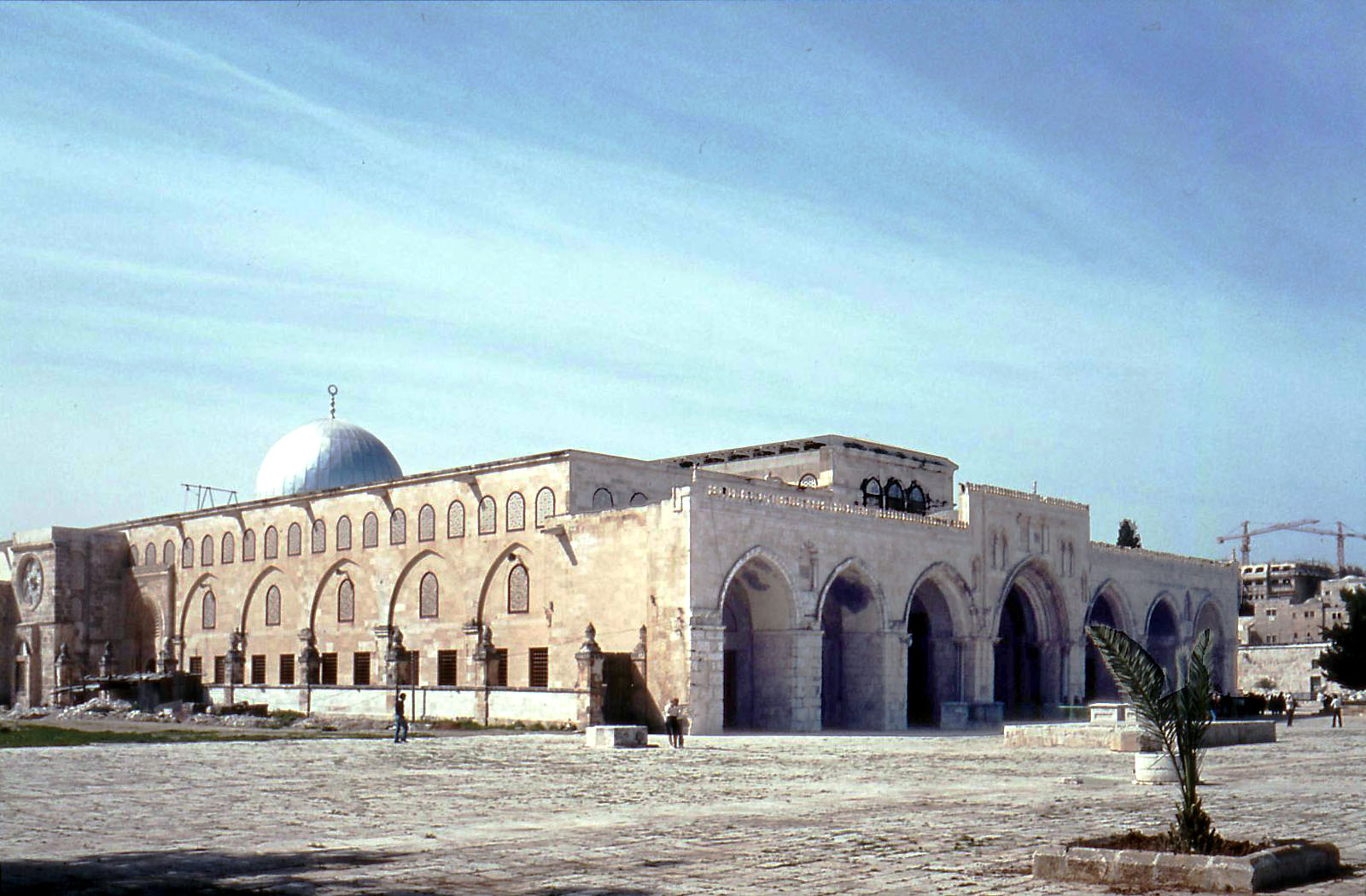
There is a pre-construction excavation going on near the al-Aqsa mosque in East Jerusalem. "Israel says the dig is a necessary precursor to replacing an access ramp connecting the Jewish quarter of the Old City to the compound, which is in the Muslim quarter. Muslim leaders complain they were not consulted about the dig, and say that the foundations of the al-Aqsa mosque could be damaged."


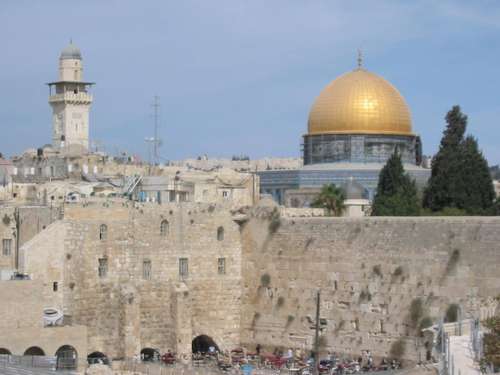
The al-Aqsa Mosque is a very holy place in Islam. The Temple Mount, however, is a very holy place in both Islam and Judaism (and Christianity, but honestly, they have enough to go around). The Temple Mount also contains the Dome of the Rock and the Western Wall.


The al-Aqsa Mosque has always been a target for Islamophobes and a flashpoint for rebellion--much of it unjustified. The Wikipedia article has a good summary here. In 1969 an evangelical Christian-Zionist set fire to the mosque. Israel was incorrectly blamed. In 1981 an American-Israeli soldier opened fire in the mosque, killing two.

In September 2000, future Israeli PM Ariel Sharon "visited" the site--with an armed escort of several hundred policemen--which contributed to the al-Aqsa Infatida. Aside from being a champion of the settlement movement, Sharon was viewed by Muslims as a war criminal for his part in the Sabra and Shatila massacre of 1982. In short, he was a bogeyman, and although the visit was not the sine qua non of the ensuing 4.5 years of insurrection, I suspect it could rightly be called a contributing cause.

So, why the history lesson? It's just another lesson in the stupidity of the species. Clearly, the state of Israel should be very cautious in dealing with the site (parts of which, I should add, are under Muslim administration, so it's not like it's being held hostage by Israel--quite the opposite). And yet, and in spite of the warnings of his own Defense Minister, the Israeli PM Olmert is ordering the excavations to continue.

Which once again begs the question: why do so many on both sides of the conflict seem determined to prevent peace?

Thursday, January 18, 2007

The Raoul Wallenberg Symposium 2007

Part I: Thursday Morning Session

Keynote Address: The Honourable Irwin Cotler


  • Danger of ignorance and apathy
  • Darfur
Legal and Judicial Perspectives on Public Security Issues
The Honourable John C. Major (Moderator)


The Honourable Dorit Beinisch, President of the Supreme Court of Israel


  • Summary of the effectiveness of the Supreme Court, and what special rules (e.g. no standing requirement, real-time decisions, court of first and last instance) have made it more effective
  • Summary of three major controversial opinions: Human Shield/Early Warning, Security Fence, and Directed Killings

The Honourable Ian Callinan, High Court of Australia

  • Terrorism will always require increased security--naive to think otherwise
  • But must ensure that the Cromwellian does not turn to the Orwellian

The Right Honourable Lord Walker of Gestingthorpe, House of Lords

  • Judges have freedom to act without continued attacks by the media
  • Must take the long view of history
  • There is and should be tension between the legislature and judiciary

Monday, January 08, 2007

Not to say I told you so, but...I told you so

Fan-tastic. Now that Saddam Hussein is dead, they've taken him off the list of accused in the Operation Anfal case. Of course, it would have been moderately futile to try the man for crimes, but I can't see as it would have done any harm, and it might have done good. Precedent? Closure? Do these words mean anything to anyone?
=+=+=+=+=+=+=+

In other scary-ass news, Israel might be planning an attack on Iran's nuclear facilities. They claim not, but they've done it before at Osirak, and since Security Council Resolutions have never meant much to the government,* I can't see the backlash from Osirak being enough to dissuade them. Don't get me wrong, every new member of The Club scares the bejeezus out of me, but given Israel's sketchy attitude to the International Atomic Energy Agency and its non-signature of the Nuclear Non-Proliferation Treaty, it probably shouldn't be throwing the first stone. Why does Israel need nukes, anyway? I mean, aren't all of its enemies so geographically close that --even in the absence of retaliation--any meaningful nuke would do horrific damage to Israel's own territory?
=+=+=+=+=+=+=+

So they've finally come up with a vaccine for cancer.** However, this vaccine (which last pretty much your whole life) is most effective if given before the girl is exposed to the virus, so it should definately be given before she becomes sexually active, and probably the younger the better. Nevertheless, some parents seem to have a problem with this. Because it might encourage the children to have sex at a younger age.

What the hell? Why is this argument raised whenever there's an innovation (practical or informational) that allows for safer sex? Do condoms increase the amount of sex or age at which people start having it? Diaphagms? Spermicide? Dental dams? No no no no no. Few enough women know that HPV causes cervical cancer, or genital warts, or sterility, and plenty of women don't even know they have it or have had it, because the active infection often has no symptoms. Also, it can be passed through non-intercourse sexual contact or intercourse with a condom. In short, it is the stealth-jet of venereal diseases. Personally, I'd want my kids vaccinated in utero.

* E.g. 242, 338, 446, 478
** Well, okay, it's a vaccine for human papillomavirus, but that's practically the same thing.

Thursday, December 14, 2006

Israeli Supreme Court Said It First...

So back here I reference the "ticking time bomb" scenario versus the "defense of necessity" model, vis-a-vis torture. Well, as it turns out, the Israeli Supreme Court said it first, aaaaalllll the way back in 1999, in it's incredibly important judgement on the legality of torture, which, grace au the court itself, you can read here.

Particularly on point:
35. Indeed, we are prepared to accept that, in the appropriate circumstances, GSS investigators may avail themselves of the “necessity defense” if criminally indicted. This, however, is not the issue before this Court. We are not dealing with the criminal liability of a GSS investigator who employed physical interrogation methods under circumstances of “necessity.” Nor are we addressing the issue of the admissibility or probative value of evidence obtained as a result of a GSS investigator’s application of physical means against a suspect. We are dealing with a different question. The question before us is whether it is possible, ex ante, to establish permanent directives setting out the physical interrogation means that may be used under conditions of “necessity.” Moreover, we must decide whether the “necessity defense” can constitute a basis for the authority of a GSS investigator to investigate, in the performance of his duty. According to the state, it is possible to imply from the “necessity defense”—available post factum to an investigator indicted of a criminal offence—the ex ante legal authorization to allow the investigator to use physical interrogation methods. Is this position correct?

36. In the Court’s opinion, the authority to establish directives respecting the use of physical means during the course of a GSS interrogation cannot be implied from the “necessity defense.” The “necessity defense” does not constitute a source of authority, which would allow GSS investigators to make use physical means during the course of interrogations. The reasoning underlying our position is anchored in the nature of the “necessity defense.” The defense deals with cases involving an individual reacting to a given set of facts. It is an improvised reaction to an unpredictable event. Thus, the very nature of the defense does not allow it to serve as the source of authorization. ...

37. ...Granting GSS investigators the authority to apply physical force during the interrogation of suspects suspected of involvement in hostile terrorist activities, thereby harming the suspect's dignity and liberty, raises basic questions of law and society, of ethics and policy, and of the rule of law and security. ...
-- President A. Barak (for the court, more or less)

Sunday, November 19, 2006

Foreign policy makes strange bedfellows

So I'm reading this article from the Washington Post...

I'll admit, I haven't been keeping up with the Middle East crisis lately. I was aware of the strike and that it had a significant civilian death toll, but really, is that even news anymore? Shouldn't the headlins just read "Israeli and Palestinian leaders kill civilians, each other" every time, so we know nothing new is going on?

But at any rate, obviously the US were going to veto a condemnation in the Security Council. What I found hilarious/appalling was the voting record of the General Assembly Resolution.

First of all:

The assembly voted 156-7 with six abstentions to approve a resolution put forward by Arab states that also urged the Jewish state to immediately withdraw its troops from Gaza.

Okay fine, that seems reasonsable. What's right is not always popular and what's popular is not always right and all that jazz. But still, I wonder who the naysayers and abstainers were, because that will obviously make a difference to my analysis of the vote...

Voting "no" were the United States, Israel, Australia, the Marshall Islands, Micronesia, Nauru and Palau. Abstaining were Canada, Ivory Coast, Papua New Guinea, Tonga, Tuvalu and Vanuatu.

Come again?

Tuvalu, Palau, Micronesia and the Marshall Islands only recently gained independace from the US, and are from what I can tell are basically unofficial protectorates of the US and/or Australia. Nauru is where Australia sends refugees in order to deny them their rights under UN treaty obligations. Ivory Coast (or Cote d'Ivoire as it is, you know, actually named) has been internally unstable for years, Papua New Guinea was until 1975 an Australian colony, Tonga may be undergoing a violent revolution, and Vanuatu is another micro-state bound to Australia.

Which is not to say that these countries shouldn't have a vote, but clearly half of them are dependant on the US/Australia, so the autonomy of their foreign policy is in doubt. On the flip side, we have...let's see...ALL of Europe, ALL of Central/South America, and the vast vast vast majority of Asia and Africa saying: "All right, Israel. Not cricket." I think just maybe Canada backed the wrong side in this one...

Or as Marx said: "I don't want to belong to any club that will accept me as a member."

Sunday, November 12, 2006

Dear Santa

All I want for Christmas is a unified Palestinian government that Israel will negotiate with.

Abbas upbeat on Palestinian unity (BBC)

(This supercedes my Amazon list, which is mostly TV shows on DVD. Of course, if I'm getting more than one gift...)

Friday, October 27, 2006

Actor Fox sparks debate, support for stem cells (REUTERS)
Seriously? People have nothing better to do with their time than hassle Michael J. Fox about "faking" his Parkinsons? How anyone can fault him for supporting candidates who support research which could save his life, and thousands of other lives, is totally beyond my understanding. And even if he did take or not take his meds to slightly increase his visible symptoms...as far as I'm concerned, that's no different that showering and putting makeup on for a job interview. He still has the symptoms, they're still debillitating, and I don't see why Rush Limbaugh and other right-of-sane pundits should be spared the effects.


Israeli bedside manner helps Ethiopian AIDS doctors (REUTERS)
Dear Israel:
More of this, less of the other, please? That would be awesome, thanks.
No, seriously. We never hear news like this in Toronto, and I know it exists, but never hearing it makes it harder to temper the occaisional erruption of anti-occupation rage. We never hear about their humanitarian works, or peace campaigns, or similar, and it makes the pro-/anti-Zionist debate in Canada so misinformed, black-and-white, and ugly.


Taliban accuse NATO of genocide (REUTERS)
While I'm not a fan of the massive collateral damage accrued by Western forces in Afghanistan and Iraq, it's a far freaking cry from "genocide." When even citizens of the occupying forces speak of colonialism, imperialism, and hegemony, not to mention breaches of Geneva and UN conventions, why wouldn't the Taliban (who, let's all remember, are not the peace-loving populist voice of Afghanistan) use the same discourse to discredit their enemy?