Showing posts with label history. Show all posts

Sunday, March 09, 2008

In which I tell Serbia to get over it

Dear Serbia,

You lost. Get over it.

Hugs & Kisses,

Sarah

Okay, that's a teeny, tiny bit oversimplified. Nevertheless, I'm a tad bit baffled at the "debate" about the legality of Kosovo declaring independence, for a number of reasons.

1) This is really always a political question. I mean, we can dither about the legality of unilateral declarations, the Supreme Court can issue a decision on it (Reference re Secession of Quebec, [1998] 2 S.C.R. 217), but the fact of the matter is a state is a state if and when other states agree that it is a state, the anomaly of Taiwan notwithstanding. This is a political question, and you can't put the rabbit back in the hat later by saying it broke the rules.

2) As the international Covenant on Civil and Political Rights puts it:

1. All peoples have the right of self-determination. By virtue of that right they freely determine their political status and freely pursue their economic, social and cultural development.

And as the SCC noted in the Reference re Secession (at para. 114):

The existence of the right of a people to self-determination is now so widely recognized in international conventions that the principle has acquired a status beyond "convention" and is considered a general principle of international law. 

Self-determination is generally though of in two contexts, both involving the domination of a people by an outside force:

The right of colonial peoples to exercise their right to self-determination by breaking away from the "imperial" power is now undisputed...

The other clear case where a right to external self-determination accrues is where a people is subject to alien subjugation, domination or exploitation outside a colonial context. (Reference re Secession at paras. 133-34)

Clearly Quebec, which gets all sorts of free rides and special treatment from the Canadian government, doesn't fall under those categories. But I'm pretty sure Kosovo does.

Kosovar Albanians are a relatively homogenous national group living on a relatively discrete chunk of Europe who apparently cannot be part of Serbia without the two sides killing each other. Sure, there are examples of multi-ethnic states succeeding, but they have characteristics, like integration, or a supra-national identity, or most importantly, not killing each other. Both theoretically and functionally, Kosovo is a textbook example of why/how self-determination is so important.

3) How is this news to anyone?

Kosovo has been de facto seceded from Serbia since 1999, when the UN declared it a protectorate. Yes, there were attempts to negotiate a mutually acceptable status, but once they fell through, all bets were off. I don't think it says anything that the UN has yet to acknowledge Kosovo; I think they're basically being polite, to avoid the appearance of having instigated the whole thing. If I am surprised by anything, it is that it took this long for a declaration of independence to be made.

Wednesday, August 29, 2007

Rewriting History

The Globe & Mail reports: "Fighting words rile historians: Museum's decision to adapt text sets dangerous precedent"

Might this actually be the most idiotic thing I've ever heard? Well no, of course not... but it is seriously obnoxious.

According to the article:


The fight over the 67-word panel, titled An Enduring Controversy, erupted shortly after the Canadian War Museum opened in May, 2005. A group of veterans objected to its saying that "the value and morality of the strategic bomber offensive against Germany remains bitterly contested," and to its contrasting 600,000 dead with the statement that "the raids resulted in only small reductions of German war production until late in the war."
So the museum is in negotiations with veterans to re-word the panel, to be "more respectful" to those who died during the campaign.

Nothing I've seen mentioned about the controversy claims personal responsibility on the part of the RAF pilots and crew who took part in the bombings. What is controversial is the Allies' decision to firebomb Dresden, resulting in 25,000 dead, and arguable claims of a war crime. The point was not to belittle those who served in WWII, but to demonstrate that the Allies were also guilty of the deaths of civilians, of misjudgment, of disregard for humanity. To simply add information pointing out the casualties on the side of the Allied bombers would be one thing, but to reword the whole exhibit to de-emphasize the controversial and historically significant slaughter is more than irresponsible, it is unacceptable.
The article adds that another controversy is brewing:

One, the National Association of Japanese Canadians, says that the war museum's version of the internment of Japanese Canadians underplays the racist and economic forces behind the internment; the NAJC also wants the museum to recognize that despite the treatment of Japanese Canadians, 150 volunteered to don uniforms and fight for Canada. NAJC president Grace Eiko Thomson met with Mr. Guerts four weeks before his departure.

Yesterday, Mr. Eaton said that the museum had been in touch with the Japanese Canadians (Not recently, according to Ms. Thomson). "Everyone's knocking on the door," Mr. Eaton said.

Frankly, I think this is a slightly different issue. As I said, I don't mind adding details; its when history gets edited out that my inner History major raises an eyebrow. Nevertheless, no museum should be constantly adjusting itself to political pressure.

On an unrelated note, the fact that I can't properly publish from GoogleDocs to Blogger is driving me crazy.

Saturday, July 21, 2007

More 24ths

At the Age of 24...

Dame Agatha Christie 1890-1976

Her first marriage, an unhappy one, was in 1914 to Colonel Archibald Christie, an aviator in the Royal Flying Corps. The couple had one daughter, Rosalind Hicks, and divorced in 1928.

During World War I she worked at a hospital and then a pharmacy, a job that influenced her work: many of the murders in her books are carried out with poison. (See also cyanide, ricin, and thallium.)


Florence Nighingale 1820-1910

Image:Florence Nightingale 1920 reproduction.jpg

In December 1844, in response to a pauper's death in a workhouse infirmary in London that became a public scandal, she became the leading advocate for improved medical care in the infirmaries and immediately engaged the support of Charles Villiers, then president of the Poor Law Board. This led to her active role in the reform of the Poor Laws, extending far beyond the provision of medical care. She was later instrumental in mentoring and then sending Agnes Elizabeth Jones and other Nightingale Probationers to Liverpool Workhouse Infirmary.


Dorothy Parker 1893-1967

In 1917, she met and married a Wall Street broker, Edwin Pond Parker II, but they were separated by his army service in World War I. ...

After her limited schooling, she earned money by playing piano at a dancing school, among other things. She first sold a poem to Vanity Fair magazine in 1917, and some months later, she was hired as an editorial assistant for another Condé Nast magazine, Vogue. She moved to Vanity Fair as drama critic and staff writer following two years at Vogue.

24ths

So, I turned 24 a couple of weeks ago. I realize this is belated, but here are some interesting related trivia tidbits. From Wikipedia, of course...

June 15th in History

At the Age of 24...

Elizabeth I at her coronation

Elizabeth I 1533-1603

["Bloody Mary" Tudor died in November 1558.] Upon Mary's death there was rejoicing in the streets of London, and in November 1558 Elizabeth was set to succeed to the throne. Legend has it that she was sitting beneath an oak tree reading the Bible at Hatfield when the news reached her - although this is unlikely given the winter season. A manservant approached her and breathlessly said, "Your Majesty…". Elizabeth then quoted Psalm 118 in response: "This is the Lord's doing, and it is marvelous in our eyes".


St. Ivo of Kermartin 1253-1303 (patron saint of lawyers)

He went to Orléans in 1277 to study Canon law.


Louise Arbour b. 1947 (UN High Commissioner for Human Rights)

[She] proceeded to the Université de Montréal where she completed an LL.L. with distinction in 1970. She became the Law Clerk for Mr. Justice Louis-Philippe Pigeon of the Supreme Court of Canada in 1971-1972 while completing graduate studies at the Faculty of Law (Civil Section) of the University of Ottawa.


Shirin Ebadi b. 1947 (Iranian jurist and activist)

Ebadi was admitted to the law department, University of Tehran in 1965 and upon graduation in 1969 passed the qualification exams to become a judge. After a six-month internship period, she officially started her judging career in March 1970. She continued her studies in University of Tehran in the meanwhile and received a master's degree in law in 1971.


Sandra Day O'Connor

Sandra Day O'Connor b. 1930 (first woman on the US Supreme Court)

O'Connor attended Stanford University, where she received her B.A. in economics in 1950. She continued at the Stanford Law School for her LL.B, serving on the Stanford Law Review, and graduating toward the top of a class of 102, of which future Chief Justice William Rehnquist was valedictorian. O'Connor briefly dated Rehnquist during this time.

In 1952 she married John Jay O'Connor III, with whom she has three sons: Scott, Brian, and Jay.

...She therefore turned to public service, taking a position as Deputy County Attorney of San Mateo County, California from 1952–1953 and as a civilian attorney for Quartermaster Market Center, Frankfurt, Germany from 1954–1957.


Rosalyn Higgins b. 1937 (President of the International Court of Justice)

Judge Higgins, President of the ICJ.

[She] married the politician Terence Higgins in 1961 (Sir Terence from 1993, Lord Higgins since 1997). ...Higgins studied at Girton College, University of Cambridge receiving her B.A. in 1959 and LL.B in 1962.


Theodora, detail of a Byzantine mosaic in Basilica of San Vitale, Ravenna.

Empress Theodora c. 500-548

In 523 Theodora married Justinian, the nephew of Emperor Justin I. On his accession to the Roman Imperial throne in 527, he made her joint ruler of the empire, and appears to have regarded her as a full partner in their rulership.


Cleopatra VII of Egypt 69-30BCE

Image:Lawrence Alma-Tadema- Anthony and Cleopatra.JPG

Cleopatra and Caesarion visited Rome between 47 BC and 44 BC and were probably present when Caesar was assassinated on 15 March 44 BC. Before or just after the assassination she returned to Egypt. When Ptolemy XIV died due to deteriorating health, Cleopatra made Caesarion her co-regent and successor. To safeguard herself and Caesarion she also had her sister Arsinoe killed, a common and necessary practice of the times.


Vijayalakshmi Pandit (1935)

Vijaya Lakshmi Pandit 1900-1990 (first female President of the UN General Assembly)

In 1921 she married Ranjit Sitaram Pandit. She was the first Indian woman to hold a cabinet post.


Sonia Gandhi b. 1946 (Italian-Indian politician and widow of former Indian PM Rajiv Gandhi)

Sonia Gandhi

[She and Rajiv Gandhi] were married in 1969, after which she moved into the house of her mother-in-law and then Prime Minister, Indira Gandhi. ... The couple had two children, Rahul Gandhi (born 1970) and Priyanka Gandhi (born 1972).


Image:Aphra-behn-190x287.jpg

Aphra Behn 1640-1689 (English writer, scientist, and spy)

In 1663 Aphra visited an English sugar colony on the Suriname River, on the coast east of Venezuela (a region later known as Suriname). During this trip Aphra is supposed to have met an African slave leader, whose story formed the basis for one of her most famous works, Oroonoko. The veracity of her journey to Suriname has often been called into question; however, enough evidence has been found that most Behn scholars today believe that the trip did indeed take place. ...Shortly after her return to England in 1664 Aphra married Johan Behn, who was a merchant of German or Dutch extraction.


Madame Curie 1867-1934 (Polish-French scientist)

Maria Skłodowska-Curie.

Eventually in 1891, having saved up some money earned working as a governess, Maria went to join her elder sister in Paris.

Skłodowska studied mathematics, physics and chemistry at the Sorbonne. (Later, in 1909, she would become the Sorbonne's first female professor, when she was named to her late husband's chair in physics, which he had held for only a year and a half before his tragic death). In early 1893, she graduated first in her undergraduate class.


Image:SantaTeresa.jpg

Saint Teresa of Avila 1515-1582 (Spanish mystic)

Leaving her parents' home secretly one morning in 1534, at the age of 20, Teresa entered the Monastery of the Incarnation of the Carmelite nuns at Avila.[citation needed] In the cloister, she suffered greatly from illness. Early in her sickness, she experienced periods of spiritual ecstasy through the use of the devotional book, Abecedario espiritual, commonly known as the "third" or the "spiritual alphabet" (published in six parts from 1537-1554).


Image:Stamp Hannah Arendt.jpg

Hannah Arendt 1906-1975 (German philosopher and political scientist)

She married Günther Stern, later knowns as Günther Anders, in 1929 in Berlin (they divorced in 1937).

The dissertation was published the same year, but Arendt was prevented from habilitating, a prerequisite for teaching in German universities, because she was Jewish. She worked for some time researching anti-Semitism before being interrogated by the Gestapo, and thereupon fled Germany for Paris.


Aspasia c. 470-400BCE (Milesian sex worker, philosopher, and political strategist)

Image:Aspasia.jpg

Being a foreigner and possibly a hetaera, Aspasia was free of the legal restraints that traditionally confined married women to their homes, and thereby was allowed to participate in the public life of the city. She became the mistress of the statesman Pericles in the early 440s. After he divorced his first wife (c. 445 BC), Aspasia began to live with him, although her marital status remains disputed.Their son, Pericles the Younger, must have been born by 440 BC.


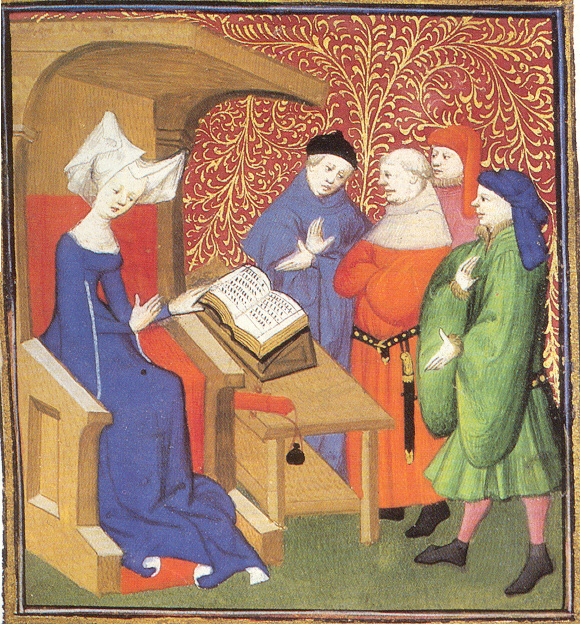
Image:Christine de Pisan - cathedra.jpg

Christine de Pizan 1364-1430 (French writer and philosopher)

She successfully educated herself by immersing herself in languages, the rediscovered classics and humanism of the early Renaissance, and within Charles V’s royal archive that housed a vast amount of manuscripts. De Pizan did not, however, assert her intellectual abilities, or establish her authority as a writer until she was widowed at the age of twenty-four.

Christine married Etienne du Castel, a royal secretary to the court, at the age of fifteen. She bore three children, a daughter (who went to live at the Dominican Abbey in Poissy in 1397 as a companion to the king's daughter, Marie), a son Jean, and another child who died in childhood. De Pizan’s familial life was threatened in 1390, however, when Christine’s husband, while in Beauvais on a mission with the king, suddenly died in an epidemic (Willard 39). Following du Castel’s death, Christine was left to support a large household, and to pay off her husband's extensive debts. When she tried to collect money due to her husband’s estate, she faced complicated lawsuits regarding the recovery of salary due to her husband. In order to support herself and her family, Christine turned to writing.


Isabelle Allende b. 1942 (Chilean novelist and activist, related to assassinated Chilean leader Salvador Allende)

From 1959 to 1965, Allende worked with the United Nation's Food and Agriculture Organization in Santiago, then later in Brussels, Belgium, and elsewhere in Europe. For a brief while in Chile, she also had a job translating Romance novels from English to Spanish. However, she was fired for making unauthorized changes to the dialogue of the heroines to make them sound more intelligent as well as altering the Cinderella endings to let the heroines find more independence and do good in the world. Her daughter Paula was born in 1963. In 1966, Allende returned to Chile, and her son Nicolás was born there that year.

Saturday, April 07, 2007

Announcements and Feuds

FIRST ANNOUNCEMENT:

I am going to Galway June 10th to 17th. For reals, yo.

SECOND ANNOUNCEMENT:

I am working for the Journal this summer!


Okay, so the "bad" news is that the Journal is only 12 weeks of work. Boo hoo and all that jazz. Yes, it involves a paycut. However, I am forcing myself to remember several key things:

  1. I ♥ the Journal to a possibly unhealthy extent.
  2. I will be able to complete the insane summer workload at the office without dying.
  3. I will actually have some time off in the summer, an event that occurs with roughly the same frequency as Halley's Comet.

So, my brain can please shut up about the paycut or whatever I'll be taking. Please. That would be awesome, thanks.


The Washington Post reports that a rare congenital disorder may have been a factor in the famed Hatfield-McCoy feud. The best/funniest part is that certain experts on the feud are denying the importance of the fact that the McCoys have a disorder which makes them irrationally angry (or, more specifically, makes them blindly furious where healthy people would just get a little irked).

This is the Hatfields, not the McCoys...but they don't look irrationally angry, do they? Of course, they have chosen to include guns in their family portrait...not sure what that's all about...


I'm sorry, what? What possible point could there be to that? How obviously a connection do you need? No one is saying the feud was caused by the illness, only that its severity and length were probably the result of the fact that the McCoy's were medically predisposed to going apeshit at the mildest provocation. How do you respond to that with derision? Ahhh!

Monday, March 26, 2007

Woke up this morning ...

(...got myself a gun...no wait, that's the Sopranos theme song...)

Ahem. I woke up this morning to a thunderstorm. As occasionally happens, I found myself literally, physically unable (despite a big ol' cup of coffee, and eating breakfast) to wake up. Fine motor control? Nyet. Eyes focusing? Ne pas. Muscle tone? Halo.1

So I go back to sleep for an hour or so because frankly? That's the only thing that ever works. And as I'm downing my second mammoth cup of coffee, I check my newsfeeds, and it appears that my beloved Slate has an article on sleep.2

The character Mike from My Own Private Idaho (River Phoenix). We have one thing in common...and it's not hustling, smoking, or road-tripping with Keanu Reeves...

Well, the article doesn't tell us much we don't already know, or at least, much I already don't know. I've become something of an armchair sleep doctor (and seriously, that specialty needs a better name...I suggest hypnologist) since developing narcolepsy in undergrad. Still, I find the synchronicity amusing.


Also today in Slate, William Saletan mentions a new study (ooh, shiny!) about the damage daycare may do to young kids. It's brief enough that I'll cite the whole shebang:

A big study suggests preschoolers who get non-parental child care are more likely to become disruptive in fifth or sixth grade. Non-parental child care includes nannies, day care, and "anyone other than the child's mother who was regularly scheduled for at least 10 hours per week." Caveats: 1) Kids who get good child care also do better on vocabulary tests. 2) The differences are small. 3) Parenting quality and genes are bigger factors. Conservative spins: 1) If you put your kid in day care, you're inviting the other kids to raise him, so they all become silly and disruptive. 2) Moms should stay home. 3) The problem will get worse as more parents dump their kids into day care. Liberal spins: 1) The study has no control group. 2) It doesn't adequately distinguish good child care from bad. 3) Kids who learn freedom and responsibility in good day care may be labeled disruptive by elementary-school teachers, because elementary schools treat kids like prisoners. 4) If you really want a generational disaster, try forcing moms to deal with kids all day on top of their paying and non-paying jobs.3

Now, I was a daycare baby from an early age (two single parents on opposite sides of the country) so I do take a very small and possibly irrational bit of offense at this suggestion. Which does not, of course, mean that it's untrue (I especially like Saletan's Liberal spin #3). Personally, however, I've always thought that daycare was an important step in naturally acquiring immunity, and in group socialization. I suspect that, as this NY Times article posits, there are a host of other considerations: the underfunding of the daycare system, the fact that the relationship is correlative as opposed to causative as the groups were self-selecting and there was no control group, et cetera. I think daycare kids are likely more prone to having to "fight" for adult attention, but suspect we are also better at entertaining ourselves. It's purely conjecture, of course, but that's what my common sense tells me.

Besides which, the whole idea that childhood is supposed to be some sacrosanct utopia, or that a happy child is mutually inclusive with a passive, obedient child, are weird Victorian remnants (thank you, Neil Postman). How about we work on feeding and educating all our kids before we start criticising the working poor for putting their children in daycare? ...Just a thought.


Finally, this morning I also found out that the Archbishop of Canterbury, Head of the Church of England, has stated that the Church is considering reparations for its part in the slave trade.4

What?

How in heavens name would one calculate such a payment, much less figure out who should receive it? And how would you calculate the extent to which the public service of the Church should or should not mitigate such a payment?

And how would you reconcile the cheapening effect of paying meaningless "damages" with the immense spiritual and historical scars of the Atlantic slave trade?

Apologies, yes. Doing everything one can to ameliorate the situation of the descendants of slaves, of course, yes. But monetary reparations strike me as a tacky lose-lose situation. It makes me sad that the overly litigious greed of North American society has moved into international affairs.


  1. "Halo" means no in Chinook Jargon, my favourite language. I'm trying to learn it, or at least some of the vocabulary. I also don't think it's a pidgin as much as a creole, since my impression is that there are native speakers (i.e. those who speak it from birth--clearly there are Native/Aboriginal Canadian speakers).
  2. A few years ago, they also did an article on the narcoleptics pharmaceutical of choice: http://www.slate.com/id/2079113/
  3. From http://www.slate.com/id/2162652/
  4. Reported by the BBC, here: http://news.bbc.co.uk/2/hi/uk_news/6494243.stm

Saturday, February 10, 2007

You say you want a revolution?

The Globe & Mail reports on more Israeli conflict. No one is shocked, of course, but I do find the precise cause of the conflict interesting.


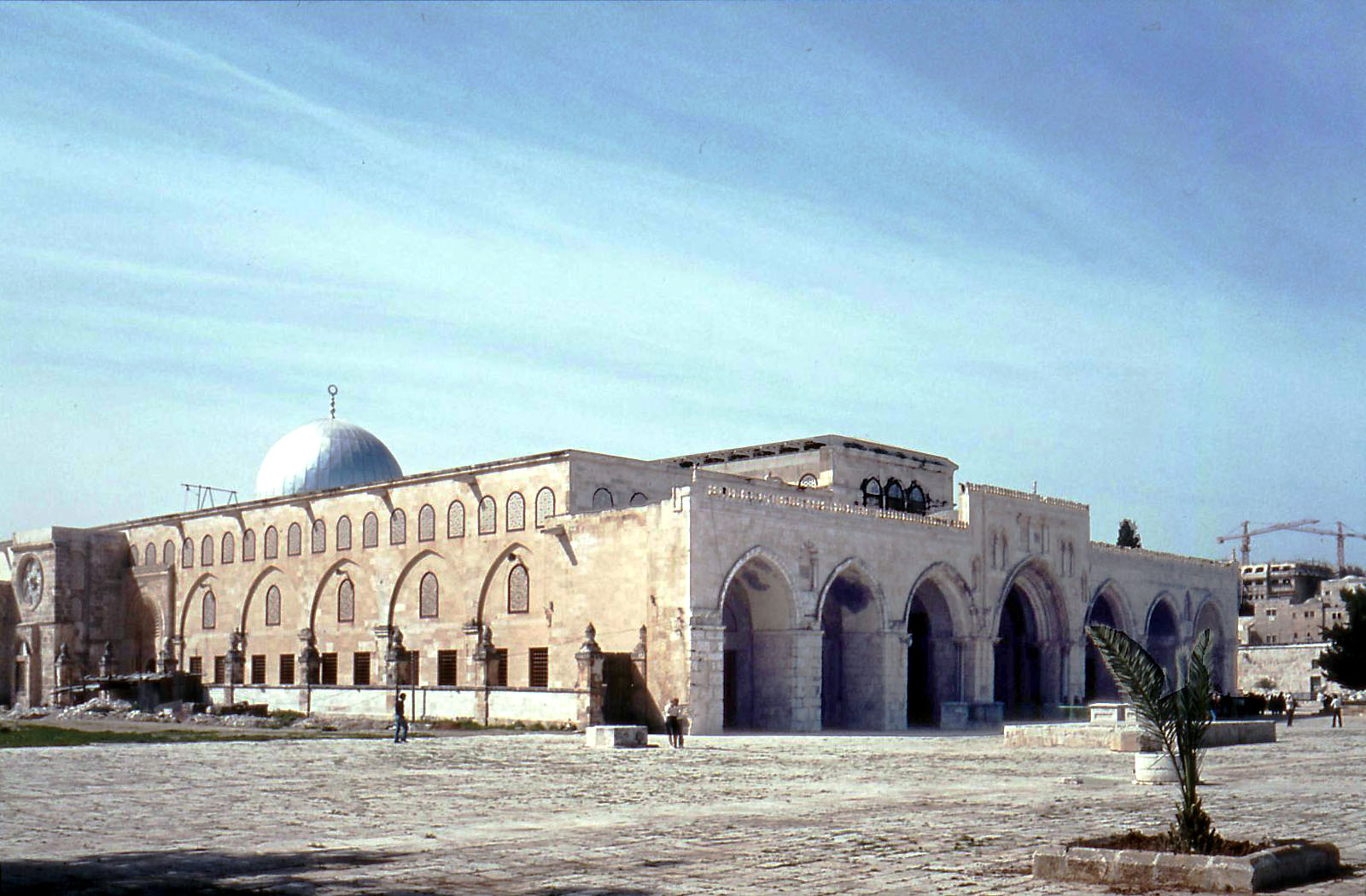
There is a pre-construction excavation going on near the al-Aqsa mosque in East Jerusalem. "Israel says the dig is a necessary precursor to replacing an access ramp connecting the Jewish quarter of the Old City to the compound, which is in the Muslim quarter. Muslim leaders complain they were not consulted about the dig, and say that the foundations of the al-Aqsa mosque could be damaged."


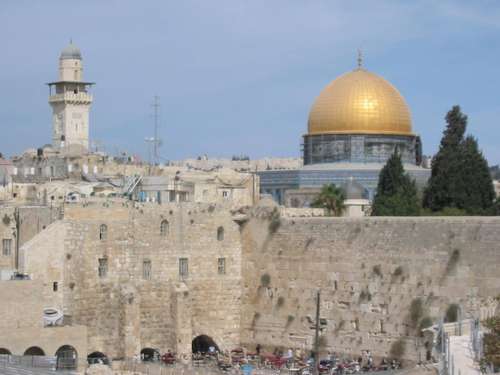
The al-Aqsa Mosque is a very holy place in Islam. The Temple Mount, however, is a very holy place in both Islam and Judaism (and Christianity, but honestly, they have enough to go around). The Temple Mount also contains the Dome of the Rock and the Western Wall.


The al-Aqsa Mosque has always been a target for Islamophobes and a flashpoint for rebellion--much of it unjustified. The Wikipedia article has a good summary here. In 1969 an evangelical Christian-Zionist set fire to the mosque. Israel was incorrectly blamed. In 1981 an American-Israeli soldier opened fire in the mosque, killing two.

In September 2000, future Israeli PM Ariel Sharon "visited" the site--with an armed escort of several hundred policemen--which contributed to the al-Aqsa Infatida. Aside from being a champion of the settlement movement, Sharon was viewed by Muslims as a war criminal for his part in the Sabra and Shatila massacre of 1982. In short, he was a bogeyman, and although the visit was not the sine qua non of the ensuing 4.5 years of insurrection, I suspect it could rightly be called a contributing cause.

So, why the history lesson? It's just another lesson in the stupidity of the species. Clearly, the state of Israel should be very cautious in dealing with the site (parts of which, I should add, are under Muslim administration, so it's not like it's being held hostage by Israel--quite the opposite). And yet, and in spite of the warnings of his own Defense Minister, the Israeli PM Olmert is ordering the excavations to continue.

Which once again begs the question: why do so many on both sides of the conflict seem determined to prevent peace?

Monday, February 05, 2007

Quebec town excludes Muslims, human rights

(Apologies, my images won't post...will try to fix later)
Google News Canada brought this little gem to my attention: "Welcome to town, here are the rules" (Globe & Mail, 5 Feb 07)

It appears that, starting with the Municipalité Hérouxville. a number of Quebec municipalities are adopting so-called "Public Standards" that outline what is and what is acceptable in the town. The county (Mékinac) has a visible-minority population of only 0.16%, so I wonder why they feel so inundated that they must shore up the original cultural fabric, but the reason is less important than the method used.

Of course, the standards themselves are not as starkly exclusionary as the headlines paint them. This is not a case of a town posting a "No Fat Chicks" sign at the city limits. In fact, the standards state: "...we would like to invite, without discrimination, in the future, all people from outside our MRC that would like to move to this territory." They continue:

So that the future residents can integrate socially more easily, we have decided unanimously, to make public, certain standards already in place and very well anchored in the lives of our electors.

THE PROS
It is hard to criticize the people of Hérouxville for promulgating such core Canadian standards as the following:
We consider that men and women are of the same value. Having said this, we consider that a woman can; drive a car, vote, sign checks, dance, decide for herself, speak her peace, dress as she sees fit respecting of course the democratic decency, walk alone in public places, study, have a job, have her own belongings and anything else that a man can do.
...

Our children are required to attend public or private schools to insure their social development and to help integrate into our society. Any form of violence towards children is not accepted.

...

In our schools certified men and women teach our children. The women or men teachers can teach boys or girls with no sexual discrimination. They do not have to dress any different to accomplish their tasks.

...

...boys and girls [play] the same games and often play together.

...

Our immense territory is patrolled by police men and women of the "Surete du Quebec". They have always been allowed to question or to advise or lecture or to give out an infraction ticket to either a man or woman.

...

The employers must respect the governmental laws regarding work conditions. These laws include holidays known and accepted in advance by all employees.

...

You will appreciate that both parents manage the children needs and both have the same authority. The parents can be of the same race or not, be from the same country or not, have the same religion or not, even be of the same sex or not. If a boy or girl wants to get married, they may, they have the liberty to chose who their spouse will be.

Sure, the wording is a little graceless (bear in mind, this is not the original French, which I assume bore little or no grammatical resemblance to Yoda), but all in all the above is a reasonably acceptable code, more descriptive than anything else, and imposing very few positive duties...and those it does impose are, I beleive, of a character that even more libertarian Canadians would accept as neccessary. Unfortunately, the "Standards" go further than they should.

THE CONS
This particular line in the preamble disturbed me, despite its vagueness:

We would especially like to inform the new arrivals that the lifestyle that they left behind in their birth country cannot be brought here with them and they would have to adapt to their new social identity.

They would like to inform? Oh, how very kind of them...If I hear one more person say that those who come to Canada must "leave behind" their "old" culture, I am going to beat them senseless. Did the English leave behind their culture? Did the French? Note that these "Standards" were promulgated in English and French, not, say, Mohawk (which, thank your chosen gods, still exists, unlike so many actually indidgenous languages). But thanks for coming out.

And after the otherwise agreeable paragraph on the equality of women, this is thrown in:

...we consider that killing women in public beatings, or burning them alive are not part of our standards of life.

There's so much wrong with this my eyes cross just reading it. First of all, what in the hell are they referring to? Sati? Please, real sati is incredibly rare, and always has been (and Canada and India have comparable suicide rates, according to the WHO) so that's crap. So then, so-called "bride burning" (dowry murder)? Well, no one's going to argue that isn't a serious problem (one which is slowly getting better?), but it is equal parts hysterical and hypocritical for Canadians--or Westerners in general--to point shocked fingers at other cultures for violence against women, just because other cultures have flashier, more exotic ways of killing females. Newsflash people: we don't have an iron-clad system of protection for women, we just have less imagination. StatsCan tells us that "Between 1995 and 2004, 39% of all homicides committed against females were perpetrated by a spouse..."

http://www.digitalsky.org.uk/venus/venus-symbol.jpg

This provision, which of course gets most of the press, is stupid and xenophobic, but really is not saying much at all:

We listen to music, we drink alcoholic beverages in public or private places, we dance and at the end of every year we decorate a tree with balls and tinsel and some lights. This is normally called "Christmas Decorations" or also "Christmas Tree" letting us rejoice in the notion of our national heritage and not necessarily a religious holiday. These festivities are authorized in public, schools, and institutions and also in private.
I've never been a big fan of banning Christmas trees from public places; generally I prefer the "pack the lobby with as many diverse holiday decorations as possible" methodology. Forgive me, I grew up in Toronto, where eating latkes by the light of the Christmas tree was a standard activity and I was jealous of my half-brother because there were Muslim kids in his elementary school so he got to celebrate Eid too, the perfect Abrahamic hat trick. And don't forget Solstice or Lunar New Year or International Women's Day (always celebrated with pretzels in the venus-symbol).

http://www.mef.qc.ca/images/kirpan.gif

Then there's this unsubtle dig:
In our schools the children cannot carry any weapons real or fake, symbolic or not.
Thanks? That is a heavy handed indictment on the recent decision of Multani v. Commission scolaire Marguerite‑Bourgeoys, wikisummarized here, wherein a Sikh student was found to have the right to carry a kirpan, as mandated by his religion.

http://image.guardian.co.uk/sys-images/Guardian/Pix/pictures/2006/10/05/jkstrwapaa.gif

Then there's this:

You may not hide your face as to be able to identify you while you are in public. The only time you may mask or cover your face is during Halloween, this is a religious traditional custom at the end of October celebrating all Saints Day, where children dress up and go door to door begging for candy and treats. All of us accept to have our picture taken and printed on our driver’s permit, health care card and passports. A result of democracy.

A...a what of democracy? Thanks, Jack Straw, but I hardly think the niqab qualifies as either a security threat or a threat to Western civilization, and by the way, in what alternate universe is Hallowe'en a) a human right, or b) a religious holdiay? It's a pagan holiday, you imbeciles, and by the way, your ancient pagan ancestors weren't above burning people alive, so lets not get uppity, alright? I say that with the greatest affection, too, being a sometime student of neopaganism myself, but truth is truth, and a history of human sacrifice is near universal.

There's some more assorted drivel about no extra holidays, no prayer spaces provided at work, no tinting windows so people can't see in to sweaty excercise rooms, and the like. Basically, ridiculous in a way that boggles the mind.

Monday, January 29, 2007

The objectivity asymptote

So, as I said yesterday, Semi Chellas's article "Good to Go"* got me thinking. The article is about embedding journalists in Afghanistan (or, more accurately, about a course Chellas took part in for journalists who will be embedded).

The question/concern for Chellas (and, of course, for many journalists and observers of the war) is that embedding journalists will detract from the ideal of objective reporting. Living side-by-side with the soldiers on "your" side of the battle, depending on them for your life, as well as livelihood, will undoubtedly create bonds of camaraderie that will bring bias into the reporting.

Here's my question: when aren't reporters living side-by-side with the military? I mean yes, there are a few brave or foolish souls who go it entirely alone, but whether in an official or unofficial capacity, aren't most journalists required by the circumstances to avail themselves of the protection of their home-state's deployed forces? Even the first war correspondent did so, although in an unofficial capacity. Another example: Peter Arnett, who has been highly critical of US war strategies and foreign policy, was in fact fired in 2003 for expressing that opinion, has also travelled with troops. So to did Dickey Chapelle, and Ernest Hemingway. And does anyone remember Nora Dunn's character in Three Kings? Yeah. I can think of a few reasons why, too...
  • The risk of being shot at while reporting amongst the locals ("friendly" fire)**
  • The risk of being shot at by the locals**
  • Language barriers
  • Transportation
  • Access

There are also positive benefits to forging a bond with the troops, as they are more likely to trust you and be open with you.

The bottom line, for me, is that most journalists are, in one sense or another, "embedded". The ideal of objectivity is just that, an ideal, and while it is something to strive for, to emulate, I do not believe it can be perfectly achieved by any person, let alone the multi-faceted leviathan that is the world, the modern media reporting it, and the audience of billions. Reality is the asymptote, always approaching but never touching the axis of objectivity.

Relativist? I think it's simply realistic. A cognitive bias is a powerful thing. Postmodern/cognitive psychology analysis is helpful here: the human brain is designed to think in heuristics and categories, to value the in-group, et cetera. These aren't just random errors, but rather "shortcuts" the human brain has evolved to make, because it lacks the computational power to make detailed objective decisions about every stimulus to which it is exposed. The point is not to pretend the biases are not inevitable, that they do not exist, but rather, to acknowledge the fundamental slant in our thinking.

Knowing that we cannot be 100% objective, we are obligated:
(a) to publicize that caveat (for instance, embedding reporters, but make openly acknowledge that the reporters are embedded), and
(b) to seek corroboration from other sources and from empirical data whenever possible.

* The article is for registered readers only (odd...) but you don't need to read it to get the idea. Here is the Wikipedia primer. Here is the article on war correspondents.

** The Committee to Protect Journalists reports 93 journalists and 37 media support workers killed in Iraq since 2003.

Sunday, January 28, 2007

Two more reasons THE WALRUS is my Bible

The Walrus is the only magazine--with the possible an humorous exception of Blender--that I read cover-to-cover. Sometimes I pounce on it and devour it back-to-front with such speed that I am left with a sense of regret that I have not savoured it. Usually I am able to pace myself, to ration out an article or two with breakfast or before bed, the better to last until the next month. As is probably obvious, I am also evangelical about it, thrusting URLs and photocopies of articles upon friends and co-workers and profs. I do not always agree with the writers (indeed, what fun would that be?) but I always see their point and enjoy their argument.

Two articles I read this morning drove home the point (to the extent that I am now blogging them instead of getting ready for work). The first, "Once Upon A Country" by Don Gillmore, is such an astute deconstruction of the current state of Federal politics in Canada that it should be required reading for...well, everyone. On top of that, it is such a delectable piece of writing that the logophile in me actually got shivers at some turns of phrase. As above, the article is available on The Walrus's site, but to illustrate my point:

On Gerard Kennedy:

"Kennedy came as a potential king-maker and as conciliator, mending rifts in the party he hoped to inherit, a diplomat who was treading carefully toward a New Liberalism. Hanging back, he let [Stephane] Dion and Bob Rae tear at front-runner Michael Ignatieff. While campaigning, Kennedy had gone to Ryerson University in Toronto to talk to business students, celebrating his relative youth among the future managers, moguls, and hustlers, who on that day were slouched in low-cut jeans, Tibetan symbols tattooed on their lower backs, checking their BlackBerries and observing Kennedy with a sense of discovery. ...Kennedy was of the West, where money and power were shifting. As he reminded delegates, it was time to stop spotting the Conservatives eighty seats west of Kenora every election."

On Bob Rae:

"In political terms, Rae was reminiscent of Jimmy Carter, a good man who magnified the complexities of governing an ungovernable country and who aged visibly under the burden, frightening Americans, who quickly retreated to the calming void of Ronald Reagan."

On Stephen Harper as a narrator and a narrative:

"His narrative is tightly controlled; he chooses the story and the way to tell it, and to whom it is told. And what of the narrator? Harper is a putative Westerner, his ideas and adult self formed there, though he doesn’t fit the mould of the Western politician, lacking the polished frontier presence of Peter Lougheed certainly or Don Getty’s rugged athleticism or the extended happy hour of Ralph Klein. No, Harper looks distinctly Central Canadian. He looks like the planned community of Don Mills: meticulous, efficient, and sterile. ...He has kept a tight lid on information coming out of his caucus and limited access to the national press, a relationship still marked by pettiness and an air of regency. His story comes out in Barthesian semiotics, a Western story of stolid morality, the new sheriff riding in to clean up the town."

On the Liberals' underestimating of Harper and his party:

"The Liberals are still hoping that Harper’s natural petulance will irk voters, that his fragile alliance will fray, that his evangelical roots will frighten, or that Maurice Vellacott will fall down on the floor of the House of Commons and speak in tongues. But Harper has developed the necessary cynicism to hold onto federal power. Perhaps his decisions have had Shakespearean consequences, the soul tortured by the actions of the man. Maybe Harper has spent nights rereading the Book of Matthew ('For what is a man profited, if he shall gain the whole world, and lose his own soul?') and weeping tears of apostasy. But he is the equal of Jean Chrétien as a street fighter, which makes him dangerous and, on occasion, fascinating."

On Chrétien himself:

"...the purest politician the country has produced in three decades, an instinctive fighter who had delivered three majorities and who looked, in the unflattering, changeable light of the convention room, darkly reptilian, his limbic self revealed as he watched his creation onstage. He had plucked Dion from academia to use him as an attack dog for unity. Dion was not a natural politician, and ten years later he still isn’t. He is the antithesis of Chrétien, a shy, rigorous thinker. A reporter asked Chrétien what a good leader was. 'A good leader,' answered the pragmatist, 'is one who wins elections.'"

On Conservative environmental policy:


"Harper has cancelled Kyoto Protocol initiatives and cut funding to climate-change programs by 80 percent. Alberta, Harper’s political base, is the country’s largest producer of hydrocarbons, and the oil sands are one of the most concentrated sources of global pollution. It was left to Environment Minister Rona Ambrose to explain the government’s isolationist position, and she stayed on message with the tenacity of the early Ronald Reagan; she was vilified by the left for incompetence and by the Liberals for idiocy. In the House, and in tentative trips abroad, she had an air of the sacrificial, like the first to go in a horror film."

Again--vividly--on Chrétien:


"To watch Chrétien is to see the essence of Liberalism, that mixture of voodoo and instinct and machinery that carried them for more than a decade. Consider his gifts: linguistically eclectic, intellectually indifferent, politically astute, a mixture of the sinister and the avuncular. Yet when he spoke, he roused his people. 'Harper was watching earlier. Maybe he is still watching. Stephen, Stephen—can I call you Steve, like George W.?' His appeal is difficult to define. Perhaps voters accepted his sweet, fraudulent mythology, le p’tit gar de Shawinigan, or maybe it was the grudging respect accorded survivors. Or the unknowable alchemy that is the successful politician."

And on the relationships of the left and right:


"There is a Through the Looking Glass aspect to federal politics that goes something like this: The NDP borrows the occasional idea from the Green Party, but feels it is a marginal group (NDP Pat Martin said the Greens functioned primarily as 'big catch basin for wing nuts who would otherwise gravitate to our party' ). The Liberals poach ideas from the NDP (former NDP head David Lewis was called the best policy chairman the Liberals ever had) and feel, in the words of Martha Hall Findlay, that they 'have good ideas but are unable to implement them[...'] The Conservatives have contempt for the Liberals, but strategically Harper can be a Liberal himself...

Canada isn’t the only country where the definitions of liberalism and conservatism are being refined, colliding in a slow-motion car crash. In Spain, the Socialist Party introduced radical social legislation but also embraced freemarket economics and lowered income taxes by 6 percent. In Britain, Tony Blair used a combination of fiscal conservatism and Labour rhetoric to hold onto power for a decade, and now British Conservatives, who have learned from Blair, are championing bicycle paths and the environment. In the US, Bill Clinton was described as the best Republican president since Eisenhower. The Liberals have long been accused of campaigning from the left and governing from the right, and traditional lines continue to blur in the rush for the centre. The NDP is 'tough on crime,' the Conservatives celebrate diversity, Ignatieff favours Canada’s continued military presence in Afghanistan."

Now, how can you fail to be stirred by that? I've hardly even touched on Gillmor's substantive analysis. Go read the article!

T'other I want to talk about is "Good to Go" by Semi Chellas, but that shall have to wait until I, at least, arrive at work.