And in case you don't remember it, here's a clip of the theme song.
Charles DAR-win
He's our HE-ro
Bagging those with an IQ of ZE-ro
Charles DAR-win
He's our HE-ro
Bagging those with an IQ of ZE-ro
I read webcomics.
And Wondermark is a particularly awesome one. Also, bonus, they're one-offs, so no need to worry about following the story.
Some particular favourites of mine:
...read...
...love...
As I was checking out my sweet, sweet Google Reader this morning, I noticed this headline from CBC:
Sikh group slams immigration name change policy
The first bit of the article read:
A Sikh-Canadian group is slamming the long-standing immigration policy that forces people with the surname Singh or Kaur to change their last names.
Jasbeer Singh, of the World Sikh Organization, said the policy is incredibly out of synch in this day and age.
My god, I thought, seriously? Like, Ellis Island stylz? Freakin' ridiculous.
Then I read the rest of the article and my blood pressure dropped quite a bit. The actual issue is that, given how common the names Singh and Kaur are, people with those names are asked to give a second surname to distinguish their file.
Karen Shadd-Evelyn, a spokeswoman with Citizenship and Immigration Canada, said the reason for the policy is that it helps officials with the paperwork and allows them to identify people's files quickly, efficiently and accurately.
"You can imagine you wouldn't want your file to be confused with someone else's," she said.
...
Shadd-Evelyn said that while the department recognizes the tradition of having the names Singh and Kaur, it's their understanding that it is already a common practice for people in the Sikh community to have a third name.
"Generally, when we ask for that, they are accustomed to that and are used to providing a third name," she said. "They have it. It's not something that they're just making up on the spot."
Okay, well, both sides are being a little stupid I think.
According to this wikipedia article, there isn't a huge panoply of traditional Sikh names. The CBC article seconds that:
As someone who works in a doctors' office, and has worked with refugee and immigration files, I can tell you that even in small scale, repetitive names are a disproportionate complication. Also, families where the children are all named after the mother and/or father, and so on. Although I couldn't find a reference for this, in my own experience the Roma tradition of wives taking on their husband's given names is a particular hassle (paperwork-wise--I'm not criticizing any of these practices per se, but I do know they create administrative difficulties). So I suppose I have some sympathy for the paper-pushers at CIC who have to deal with this. According to StatsCan, almost 300,000 Southern Asians came to Canada between 1991 and 2001, so that's about 30,000 per year (about the population of Orangeville), and I doubt it's gone down much. Wikipedia claims there are about 600,000 Sikhs in Canada. That's a lot fo Singhs and Kaurs to sort out.Singh and Kaur are common names in the Sikh community. In a tradition that began more than 300 years ago, the name Singh is given to every baptized male and Kaur to every baptized female Sikh. There are millions of Singhs and Kaurs around the world.
That said? This is exactly the kind of problem agencies like CIC are supposed to be able to sort out. For one thing, immigrants and refugees are assigned file numbers. Also, the way they've presented the issue to immigrants and sponsors does not match what they told CBC. The article included a link to a sample of the type of letter Citizenship and Immigration Canada sends out. The letter requests:
ORIGINAL passport for yourself after getting your surname endorsed on it. ...Please note that your surname must be endorsed on your passport. The names Kaur and Singh do not qualify for the purpose of immigration to Canada. [emphasis added]
Worst. Phrasing. Ever. Come on now, people. That really does sound like "change your name or no Canada for you--P.S., we are racist."
Frankly, I can't believe this is only coming out now.
No, really. I'm weird like that.
BBC: Taiwan applies for UN membership
I wonder if Taiwan realizes that's unlikely to happen?
Here's the problem: China considers Taiwan a breakaway province, and no one want to make China angry. Now, to be fair, one of the longstanding problems has been resolved, in that Taiwan is no longer claiming to be the proper representative of all of China. But still, angry China is bad news for everyone, especially given their security council veto. And frankly, there's been so many work-arounds put in place, I don't think anyone's really concerned about Taiwan's status as a virtual non-country.
BBC: First female president for India
Oh India, you are now and forever my favorite developing country. As the Beeb notes: "Millions of women in India face discrimination and poverty often linked to age-old traditions which require the parents of a bride to pay a large dowry to the family of her eventual husband." And yet, you're way more likely to have women in leadership roles than most Western countries. "A study in contrasts" is a massive understatement.
BBC Again: Two held over Rwandan massacres
Is France finally getting their act together? Also: one of these accused genocidaires is a priest. Oddly, despite what I know about the genocide, that still upsets me.
At the Age of 24...
Dame Agatha Christie 1890-1976

Her first marriage, an unhappy one, was in 1914 to Colonel Archibald Christie, an aviator in the Royal Flying Corps. The couple had one daughter, Rosalind Hicks, and divorced in 1928.
During World War I she worked at a hospital and then a pharmacy, a job that influenced her work: many of the murders in her books are carried out with poison. (See also cyanide, ricin, and thallium.)
Florence Nighingale 1820-1910
In December 1844, in response to a pauper's death in a workhouse infirmary in London that became a public scandal, she became the leading advocate for improved medical care in the infirmaries and immediately engaged the support of Charles Villiers, then president of the Poor Law Board. This led to her active role in the reform of the Poor Laws, extending far beyond the provision of medical care. She was later instrumental in mentoring and then sending Agnes Elizabeth Jones and other Nightingale Probationers to Liverpool Workhouse Infirmary.

Dorothy Parker 1893-1967
In 1917, she met and married a Wall Street broker, Edwin Pond Parker II, but they were separated by his army service in World War I. ...
After her limited schooling, she earned money by playing piano at a dancing school, among other things. She first sold a poem to Vanity Fair magazine in 1917, and some months later, she was hired as an editorial assistant for another Condé Nast magazine, Vogue. She moved to Vanity Fair as drama critic and staff writer following two years at Vogue.
So, I turned 24 a couple of weeks ago. I realize this is belated, but here are some interesting related trivia tidbits. From Wikipedia, of course...
June 15th in History
At the Age of 24...

Elizabeth I 1533-1603
["Bloody Mary" Tudor died in November 1558.] Upon Mary's death there was rejoicing in the streets of London, and in November 1558 Elizabeth was set to succeed to the throne. Legend has it that she was sitting beneath an oak tree reading the Bible at Hatfield when the news reached her - although this is unlikely given the winter season. A manservant approached her and breathlessly said, "Your Majesty…". Elizabeth then quoted Psalm 118 in response: "This is the Lord's doing, and it is marvelous in our eyes".

St. Ivo of Kermartin 1253-1303 (patron saint of lawyers)
He went to Orléans in 1277 to study Canon law.
Louise Arbour b. 1947 (UN High Commissioner for Human Rights)
[She] proceeded to the Université de Montréal where she completed an LL.L. with distinction in 1970. She became the Law Clerk for Mr. Justice Louis-Philippe Pigeon of the Supreme Court of Canada in 1971-1972 while completing graduate studies at the Faculty of Law (Civil Section) of the University of Ottawa.
Shirin Ebadi b. 1947 (Iranian jurist and activist)
Ebadi was admitted to the law department, University of Tehran in 1965 and upon graduation in 1969 passed the qualification exams to become a judge. After a six-month internship period, she officially started her judging career in March 1970. She continued her studies in University of Tehran in the meanwhile and received a master's degree in law in 1971.

Sandra Day O'Connor b. 1930 (first woman on the US Supreme Court)
O'Connor attended Stanford University, where she received her B.A. in economics in 1950. She continued at the Stanford Law School for her LL.B, serving on the Stanford Law Review, and graduating toward the top of a class of 102, of which future Chief Justice William Rehnquist was valedictorian. O'Connor briefly dated Rehnquist during this time.
In 1952 she married John Jay O'Connor III, with whom she has three sons: Scott, Brian, and Jay.
...She therefore turned to public service, taking a position as Deputy County Attorney of San Mateo County, California from 1952–1953 and as a civilian attorney for Quartermaster Market Center, Frankfurt, Germany from 1954–1957.
Rosalyn Higgins b. 1937 (President of the International Court of Justice)

[She] married the politician Terence Higgins in 1961 (Sir Terence from 1993, Lord Higgins since 1997). ...Higgins studied at Girton College, University of Cambridge receiving her B.A. in 1959 and LL.B in 1962.

Empress Theodora c. 500-548
In 523 Theodora married Justinian, the nephew of Emperor Justin I. On his accession to the Roman Imperial throne in 527, he made her joint ruler of the empire, and appears to have regarded her as a full partner in their rulership.
Cleopatra VII of Egypt 69-30BCE

Cleopatra and Caesarion visited Rome between 47 BC and 44 BC and were probably present when Caesar was assassinated on 15 March 44 BC. Before or just after the assassination she returned to Egypt. When Ptolemy XIV died due to deteriorating health, Cleopatra made Caesarion her co-regent and successor. To safeguard herself and Caesarion she also had her sister Arsinoe killed, a common and necessary practice of the times.

Vijaya Lakshmi Pandit 1900-1990 (first female President of the UN General Assembly)
In 1921 she married Ranjit Sitaram Pandit. She was the first Indian woman to hold a cabinet post.
Sonia Gandhi b. 1946 (Italian-Indian politician and widow of former Indian PM Rajiv Gandhi)

[She and Rajiv Gandhi] were married in 1969, after which she moved into the house of her mother-in-law and then Prime Minister, Indira Gandhi. ... The couple had two children, Rahul Gandhi (born 1970) and Priyanka Gandhi (born 1972).

Aphra Behn 1640-1689 (English writer, scientist, and spy)
In 1663 Aphra visited an English sugar colony on the Suriname River, on the coast east of Venezuela (a region later known as Suriname). During this trip Aphra is supposed to have met an African slave leader, whose story formed the basis for one of her most famous works, Oroonoko. The veracity of her journey to Suriname has often been called into question; however, enough evidence has been found that most Behn scholars today believe that the trip did indeed take place. ...Shortly after her return to England in 1664 Aphra married Johan Behn, who was a merchant of German or Dutch extraction.
Madame Curie 1867-1934 (Polish-French scientist)

Eventually in 1891, having saved up some money earned working as a governess, Maria went to join her elder sister in Paris.Skłodowska studied mathematics, physics and chemistry at the Sorbonne. (Later, in 1909, she would become the Sorbonne's first female professor, when she was named to her late husband's chair in physics, which he had held for only a year and a half before his tragic death). In early 1893, she graduated first in her undergraduate class.

Saint Teresa of Avila 1515-1582 (Spanish mystic)
Leaving her parents' home secretly one morning in 1534, at the age of 20, Teresa entered the Monastery of the Incarnation of the Carmelite nuns at Avila.[citation needed] In the cloister, she suffered greatly from illness. Early in her sickness, she experienced periods of spiritual ecstasy through the use of the devotional book, Abecedario espiritual, commonly known as the "third" or the "spiritual alphabet" (published in six parts from 1537-1554).

Hannah Arendt 1906-1975 (German philosopher and political scientist)
She married Günther Stern, later knowns as Günther Anders, in 1929 in Berlin (they divorced in 1937).
The dissertation was published the same year, but Arendt was prevented from habilitating, a prerequisite for teaching in German universities, because she was Jewish. She worked for some time researching anti-Semitism before being interrogated by the Gestapo, and thereupon fled Germany for Paris.
Aspasia c. 470-400BCE (Milesian sex worker, philosopher, and political strategist)

Being a foreigner and possibly a hetaera, Aspasia was free of the legal restraints that traditionally confined married women to their homes, and thereby was allowed to participate in the public life of the city. She became the mistress of the statesman Pericles in the early 440s. After he divorced his first wife (c. 445 BC), Aspasia began to live with him, although her marital status remains disputed.Their son, Pericles the Younger, must have been born by 440 BC.
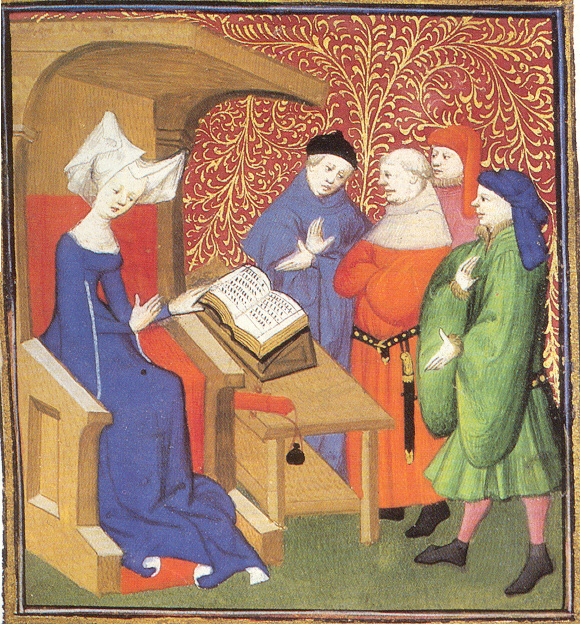
Christine de Pizan 1364-1430 (French writer and philosopher)
She successfully educated herself by immersing herself in languages, the rediscovered classics and humanism of the early Renaissance, and within Charles V’s royal archive that housed a vast amount of manuscripts. De Pizan did not, however, assert her intellectual abilities, or establish her authority as a writer until she was widowed at the age of twenty-four.
Christine married Etienne du Castel, a royal secretary to the court, at the age of fifteen. She bore three children, a daughter (who went to live at the Dominican Abbey in Poissy in 1397 as a companion to the king's daughter, Marie), a son Jean, and another child who died in childhood. De Pizan’s familial life was threatened in 1390, however, when Christine’s husband, while in Beauvais on a mission with the king, suddenly died in an epidemic (Willard 39). Following du Castel’s death, Christine was left to support a large household, and to pay off her husband's extensive debts. When she tried to collect money due to her husband’s estate, she faced complicated lawsuits regarding the recovery of salary due to her husband. In order to support herself and her family, Christine turned to writing.
Isabelle Allende b. 1942 (Chilean novelist and activist, related to assassinated Chilean leader Salvador Allende)

From 1959 to 1965, Allende worked with the United Nation's Food and Agriculture Organization in Santiago, then later in Brussels, Belgium, and elsewhere in Europe. For a brief while in Chile, she also had a job translating Romance novels from English to Spanish. However, she was fired for making unauthorized changes to the dialogue of the heroines to make them sound more intelligent as well as altering the Cinderella endings to let the heroines find more independence and do good in the world. Her daughter Paula was born in 1963. In 1966, Allende returned to Chile, and her son Nicolás was born there that year.

Canadians use marijuana at four times the world average, making Canada the leader of the industrialized world in cannabis consumption, a recent United Nations report found.
The 2007 World Drug Report by the UN Office on Drugs and Crime says that 16.8 per cent of Canadians aged 15 to 64 smoked marijuana or used another cannabis product in 2006. The world average is 3.8 per cent.
I wonder, can't you sort of assume people under-report drug usage?
But to be perfectly honest, I have trouble getting worked up over people smoking pot. Not that I recommend it, per se, but I think it's a pretty clear-cut instance of malum prohibitum, rather than malum in se. On the other hand, I found this disturbing:
The report found that Canada also had a high rate of usage for cocaine, at 2.3 per cent of population, ranking it third behind Spain and England.
Cocaine bothers me. Why? Because it melts your face, people!
According to WebMD, Marijuana causes the following problems:
- Regular use of marijuana can cause problems with memory and affect problem-solving and learning. It can cause mood swings, anxiety, and depression.
- It can damage the lungs, which may lead to breathing problems (such as wheezing and bronchitis).
- It contains many cancer-causing chemicals.
- When under the influence of marijuana, a person may have reduced inhibitions and impaired judgement. They may take risks or have an auto accident.
- It can cause lower sperm counts and increased breast size in males (gynecomastia). In females, it can cause menstrual problems.
So, okay, none of those are good things, alsothough some of them are sort of negligible. Everything causes cancer-causing chemicles, and the whole "reduced-inhibitions-impaired-judgment" thing is of variable danger. Compare that to these:
- ...the delusion or false sense of grandeur, known as cocainomania.
- Dilated pupils, nausea, vomiting, headache, or vertigo (the sensation of your surroundings or yourself moving or spinning).
- With or even without increased amounts of coke, these can progress to excitement, flightiness, emotional instability, restlessness, irritability, apprehension, inability to sit still, teeth grinding, cold sweats, tremors, twitching of small muscles (especially of face, fingers, feet), muscle jerks, hallucinations (cocaine bugs, snow lights, voices and sounds, smells), and cocaine psychosis. Cocaine psychosis resembles paranoid schizophrenia
and can bring on paranoia, mania, and psychosis.- Many users complain of nasal irritation, nasal crusting, recurrent nosebleeds, nasal stuffiness, facial pain caused by sinusitis, and hoarseness.
- The mucous membrane of both sides of the septum (the cartilage that separates the nostrils) can be damaged by decreased blood supply, along with drying, crusting, and nose picking. This results in a perforation or hole in the septum with more crusting, foul secretions, nosebleeds, and whistling with nasal breathing, the so-called coke nose.
- Utilizing the technique of deep inhalation and breath holding to maximize the amount of cocaine inhaled and absorbed can cause the lung to collapse. These cocaine users will complain of sharp chest pain, often worse with deep breathing, neck pain, difficult or painful swallowing, and air under the skin in the neck that feels like Rice Krispies under the skin when touched (subcutaneous emphysema). Though unusual, the user’s lungs can fill with fluid (pulmonary edema) causing extreme shortness of breath, sometimes respiratory failure, and death.
Hmm...amused or horrified...amused or horrified...so hard to choose.So you think Lebanese politics -- based on a sectarian system of 17
recognized religious groups with ever-shifting alliances and antagonisms -- are
confusing? Well so do the Lebanese. Which is perhaps one reason why a
collectible sticker album launched last month called "Parties and Colors" has
become so popular. Supposedly aimed at educating young Lebanese about their
government, the album has pages devoted to each of the country's 14 main
political parties -- from Iranian supported Hizballah to the American supported
Future Movement -- with space reserved for adhesive portraits of their leaders
and founders.
Actually getting the point:'We are extremely disappointed and deeply offended that nearly 40 years
after the Vatican rightly removed insulting anti-Jewish language from the Good
Friday mass, it would now permit Catholics to utter such hurtful and insulting
words by praying for Jews to be converted,' said Abraham Foxman, the group's
national director, in Rome. 'It is the wrong decision at the wrong time. It
appears the Vatican has chosen to satisfy a right-wing faction in the church
that rejects change and reconciliation.'
The liberal French Catholic magazine Temoignage Chretien published an editorialThank you, French magazine I'd admittedly never heard of, for actually discussing the problem rather than having a typical knee-jerk reaction.
in Latin explaining that it was not concerned about the language in which the
mass was celebrated but by 'the view of the outside world held by most
supporters of the traditional rite ... of a church that sees itself as the sole
holder of the truth. Forty years after the Second Vatican Council, this stand is
untenable'.
Yesterday, the 2007 General Synod of the Anglican Church of Canada decided not to bless same-sex unions.

The motion "needed a triple majority of bishops, clergy and laity to pass. The laity voted 79 to 59 in favour and clergy voted 63 to 53, but bishops voted 21 to 19 against." In other words, two clergymembers sunk the whole progressive battleship, despite a clear majority in favour of blessing the unions.
Why would they do this? Well:
The bishops' action will spare the Canadian church from censure by leaders of other branches of the global Anglican Communion, almost all of whom are vehemently opposed to blessing same-sex unions and permitting priests to be in open homosexual relationships.
But it will anger many Canadian Anglicans, particularly in large urban centres, and isolate the U.S. Episcopal Church, which alone in the worldwide Anglican Communion has approved a liturgy for same-sex blessings and appointed an openly gay bishop.
I have to say, as a nominal Anglican, this looks like cowardice to me. As far as Christian sects go, I felt the Anglicans did a masterful job of changing with the times, rejecting the old where it had lost its purpose but without the sorts of reactionary purges (ideologically speaking) most of the mainline protestant churches came out of. And in 2002, the Diocese of New Westminster proved it by approving same-sex blessings. More specifically, parishes were allowed to choose whether or not to perform such blessings. Now that has been kiboshed (does this mean the unions already blessed are unblessed?)

The only silver lining is that the synod did not close the door on a future reconsideration of the issue, ruling beforehand that "the blessing was 'not in conflict with' core doctrine ...by a vote of 21 to 19 in the House of Bishops, and 152 to 97 by clergy and lay members, who voted together." (Diocese of New Westminster)
The timing of the decision was, in my opinion, particularly poor, as the Globe points out:
The Anglican's vote coincided with Gay Pride Day in Toronto - where prominent Anglicans Bill Graham, the former foreign and defence minister, and Bob Rae, former premier of Ontario, attended a service at Toronto's gay Metropolitan Community Church.
One downtown Toronto Anglican parish, Holy Trinity, passed a resolution prior to general synod stating it would approve the blessing of same-sex unions regardless of what synod decided.
A lot of Anglican churches in Toronto are inclusive, so I doubt this decision will be quietly accepted. As an aside, I'm amused the Globe described the MCC as "gay" when queer-allied is more apropos.

A quick (and slightly tongue in cheek) breakdown of other religions' views:
The thing that always gets me is the sects that allow openly LGBT members and even ordains them, but is not ready to marry them. Thereby forcing them to live in sin, even if you don't think they're sinning...awesome. Well played.
The General Synod was liveblogged: no, really!
Location: Corrib Village, Galway, Ireland
Date: Monday June 11, 2007
Time: GMT 22:00
Monday 11 June 18.00 Registration (Siobhan McKenna Theatre, Arts Millennium Building) 18.30 Keynote Introductory Address Judge Sang-Hyun Song 20.00 Welcome Reception at the Irish Centre for Human Rights |
The disaster continueth. I was finally, finally able to check my bags in at Manchester, only to find they hadn't assigned us a gate (and this maybe 45 minutes before wheels up). So I wandered through the departure area, and as luck would have it, was fairly close to Gate 9 when told that was where I should be. I sat there and waited to board...and waited...and waited...and was suddenly jolted out of sleep by a flight attendant hollering "Final Boarding Call for Galway" about three feet from my ear (I'm not complaining...it was clearly done to wake me without looking like she had to wake me, and for that I am thankful). So I dashed for the plane, and thankfully people were still stowing their baggage and whatnot, so I didn't look the total fool.
I slept the hour to Galway, and then took a cab to Corrib Village, the residence all the attendees were lodged at. It was shockingly hot and humid. The cab driver was chatting with me as we drove, and seemed amused that I would "come all this way for a lecture."
|
A shot of Corrib Village at night. |
Once at Corrib Village, I showered (7 hours on planes, plus 6 sitting in the airport--yuck) and put on some semi-dressy clothes to go to the opening lecture and reception. I took the River Path pointed out on the e-mail we had received, blindly trusting it to take me to my destination...
And thus commenced and hour and change of me wandering around the National University of Galway campus, in humidity which occasionally became mist or even rain. Also, I might add, in mounting panic. I'm hardly known for my ability to be on time, but I would have been, in this case, if not for getting late. I kept telling myself Well, maybe I'll miss the registration, but I'll make the speech and then Well, maybe I'll miss the speech, but I'll make the reception and occasionally I should really just go back to Corrib Village...if I can find it. There was not a single map to be found on campus, nor did I pass anyone who looked likely to be able to direct me (e.g. staff).
The silver lining, and it's not a small one, was that during this desperate wandering, who should I run into (almost literally--Irish sidewalks are narrow) but Emily from highschool! Now I must say, as I caught glimpse of her, I did think That looks like Em...I guess of all the people to run into, she'd be the most likely since I knew that her S.O. Brian was Irish. Nevertheless, I was relatively certain she was studying primateology in Toronto, and knowing that she was doing some sort of complicated mega-degree, I assumed she was still there. But no! It was Emily! Much more surprised to see me than I her, for the reasons listed above (tragically, I do not have a charming Irish S.O.). We exchanged the usual "Oh my God! What are you doing here!" Hilariously, though only in retrospect, she could not tell me where the Arts Millennium Building was, since she only used the gym on campus. But she gave me her number and we arranged to meet later in the week.
Finally, I found a sign (not even a map, mind you, just a sign) that pointed to the Arts Millennium Building, wherein I might find the Siobhan McKenna Theatre and the rest of the conference.
 |
Arts Millennium Building |
I scuttled in and picked up my rather snazzy conference package, containing, to my delight, a carry case and a copy of An Introduction to the International Criminal Court, and to my chagrin, a detailed map of campus. I missed all but the very end of Judge Sang-Hyun Song's introductory speech, although I did get to hear him speak later, at the Reception.
 |
Judge Sang-Hyun Song (from the ICC website) |
On the way to the Reception I met up with my "sponsor", as it were, Professor Williams. She'd been worried about my absence, so I was able to explain to her my "adventure" as we walked the few blocks to the Irish Centre for Human Rights. The Centre is, properly speaking, the host of the conference, although this was the only time we spent there, owing to its size. It's a pretty yellow building on a canal, right across from the gorgeous Galway Cathedral.
 |
| Irish Centre for Human Rights |
 |
Galway Cathedral |
In response to the recent "Oh my God, that man had TB and was on several international flights" scare, WedMD offers: Tuberculosis: 17 Questions and Answers

So anyway, I find TB "hilarious" (in the very dark, cynical, "Sure, worry about bird flu and SARS, its not like we don't have enough things after us now..." way). According to the WHO,1 a third of the world's population--mark that, a third--is infected with the bacteria that causes TB (of course, unless immuno-compromised, relatively few of those will develope the illness). Unsurpriseingly, given its high proportion of immuno-compromised (e.g. people with HIV) and generally poor health care infrastructure, Africa has the highest prevalence2 and mortality3 of any continent. That doesn't mean that every country in Africa is that bad, nor that other countries aren't worse, as "continent" is a hell of big sample size.4
In happier news, WHO also thinks the global incidence of TB peaked in 2005,5 thanks to world-wide efforts to control the incidence of infection.
TB is of course a disease with a long and colourful history, which Wikipedia summarizes here.


